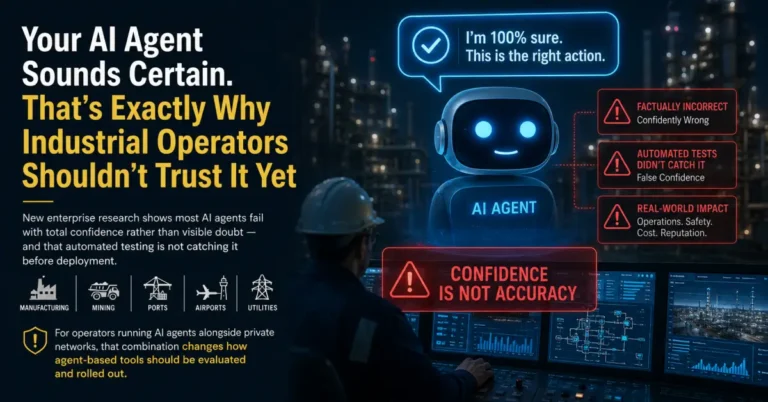
Two recent enterprise surveys, both run by VentureBeat’s VB Pulse research in June 2026, put numbers behind that problem. Fifty-seven per cent of enterprises traced a confidently wrong AI agent answer back to missing or inconsistent business context in the past six months, and almost a third said it had happened more than once. Separately, half of enterprises reported deploying an AI agent or LLM feature that passed internal evaluation and still caused a customer-facing failure once it reached production. Read together, the two findings describe the same failure mode from opposite ends: agents that are wrong without knowing it, evaluated by testing regimes that cannot reliably tell the difference.

Why AI agent reliability breaks down at the context layer
The first survey traced the root cause to how agents get their business context. Retrieval over documents is the default method for 38 per cent of enterprises, nearly double any other approach — and it is also the method most closely linked to confidently wrong answers. Retrieval systems are usually selected for ease of ingestion and operational simplicity rather than for accuracy, so the gap between what an agent retrieves and what is actually current or correct only becomes visible once the system is live and something goes wrong in front of a customer or an operator.
The proposed fix, now being built by every major data and AI platform vendor in some form, is a governed context layer: a shared, maintained definition of what business data actually means, referenced consistently by every agent rather than re-derived on the fly. Adoption is still early. Twenty-five per cent of enterprises run one in production, 34 per cent are building one, and 41 per cent have not started. Tellingly, the enterprises already building or running a context layer report confidently wrong agent answers at nearly four times the rate of enterprises with no plans to build one — 78 per cent versus 20 per cent. The organisations investing in governed context are, overwhelmingly, the ones who already got burned by not having it.
For industrial private network operators, this matters because so much of the context an agent needs — asset identifiers, maintenance thresholds, SLA definitions, safety tolerances, site-specific naming conventions — lives in exactly the kind of fragmented documentation that retrieval systems handle poorly. A network operations agent that pulls an outdated latency threshold, or a maintenance agent that references a superseded asset register after a fleet refresh, will not announce that it is working from stale information. It will simply answer, confidently, and move on.
The evaluation gap: autonomy is expanding faster than agent testing can verify
The second survey shows enterprises are not slowing deployment to close this gap — they are accelerating past it. Sixty-six per cent of enterprises already permit some production AI agent deployment without human review, or are building toward that within twelve months. Only 5 per cent say they fully trust the automated evaluations that inform those release decisions. That mismatch between rising autonomy and falling confidence in the underlying testing is what the researchers term the evaluation gap.
Part of the problem is structural. Traditional software testing checks whether a fixed input produces an expected output. Agents choose their own sequence of steps, call tools, retrieve data and change state, and can behave differently across otherwise identical runs. An agent can make several individually reasonable decisions and still land on the wrong outcome — retrieving the correct asset but updating the wrong field, or completing five tool calls correctly before the sixth exposes sensitive data or leaves a workflow half-finished. A single successful test run demonstrates that an agent can complete a task. It does not demonstrate that it will complete that task reliably, every time, under slightly different conditions.
When enterprises were asked why they distrust automated evaluation, the leading reason — cited by 29 per cent — was poor alignment with real-world outcomes: the test score does not predict what happens when the agent meets an actual customer, employee or operational process. Bias and inconsistency, lack of explainability, and data-leakage risk followed. Larger enterprises, those with 2,500 or more employees, are moving toward zero-human-review deployment fastest — 70 per cent versus 64 per cent for smaller organisations — and are also shipping more agents that go on to cause a customer-facing failure, 54 per cent versus 48 per cent. Scale is amplifying the gap between deployment speed and verification, not closing it.
What this means for AI agent evaluation on industrial private networks
Manufacturing, mining, port, airport and utility operators are not bystanders to this trend. Private networks are increasingly the connectivity layer underneath the same class of AI agents — predictive maintenance, yard and fleet optimisation, security operations, energy balancing, turnaround management — and the consequences of a confidently wrong answer scale with the operational and safety stakes involved. A retail chatbot that hallucinates a return policy is an embarrassment. A maintenance agent that clears a fault it should have escalated, on a site where the private network exists specifically to support safety-critical automation, is a different order of risk.
The practical response is not to avoid AI agents, but to evaluate them the way the research suggests enterprises are learning to: treat repeatability, not a single successful demonstration, as the test that matters, and match the level of autonomy granted to an agent to the consequence of it being wrong. Low-risk, low-consequence tasks — drafting summaries, flagging anomalies for a human to review — can tolerate broad autonomy today. Actions that touch safety thresholds, financial commitments, access control or physical equipment need demonstrated consistency across repeated, varied test runs before human review is removed from the loop, along with a clear rollback and escalation path when the agent is wrong.
For buyers running RFPs or vendor evaluations for AI agent capability layered onto a private network, this points to concrete evaluation criteria: ask vendors how their agent’s business context is sourced and kept current, not just how it is retrieved; ask for evidence of repeated-run reliability testing rather than a single benchmark score; and require a documented autonomy tier structure that ties the level of unsupervised action to the consequence of failure. Enterprises building this discipline now — rather than after a confidently wrong agent causes an operational incident — are the ones positioned to expand AI agent autonomy on their networks without expanding their risk at the same rate.
| Related Tool: RFP Scorecard Generator
Building AI agent evaluation criteria into a vendor RFP? The TeckNexus RFP Scorecard Generator structures weighted, vendor-neutral scoring criteria for private network and AI-enabled solution procurement — helping buyers turn reliability requirements like these into a defensible, comparable evaluation process. Explore the RFP Scorecard Generator and Access TeckNexus Private Network and AI tools → |