July 2026’s roundup: TSMC raises its Arizona commitment to $265 billion, Micron commits more than $250 billion to US DRAM manufacturing through 2035, SK hynix’s $26.5 billion Nasdaq listing prices and begins trading, and hyperscaler data center and interconnect infrastructure keeps expanding from Alberta to Google‘s dark fiber network.

At a glance – Digital Infrastructure Insights for July 2026
- TSMC raised its US capital expenditure by $100B, bringing its total Arizona commitment to $265 billion across up to 12 fabs, driven by sustained AI technology demand through 2030.
- SK hynix priced its Nasdaq ADS listing at $149 per share, raising $26.5 billion in what’s cited as the largest US first-time share sale by a foreign issuer — the direct follow-through on the IPO filing covered in June’s edition.
- Micron committed to exceed $250 billion in US semiconductor investment through 2035, targeting 40% domestic DRAM production to meet AI-driven memory demand.
- Meta broke ground on a CAD13 billion AI data centre in Alberta, Canada (1GW initial capacity, scalable to 1.8GW), and separately disclosed plans for a standalone “Meta Compute” cloud business to sell compute capacity externally.
- Verizon disclosed a dark fiber deal exceeding $1 billion to interconnect Google data centers and launched AI Connect, converting central offices into edge AI inference sites.
- India expanded its semiconductor strategy beyond manufacturing to cover chip design, equipment, R&D, and workforce development, backed by an additional INR1.9 trillion (~$19.7B) investment commitment.
1. Chip manufacturing capital reaches record scale
TSMC and Micron alone committed well over half a trillion dollars in US chip manufacturing capital this month:
- TSMC: increased its US capex by $100B, bringing its Arizona commitment to $265 billion, including eight fabs already pledged and potential for up to four additional advanced manufacturing sites, driven by sustained AI technology demand through 2030.
- Intel: will invest €5 billion in its Leixlip, Ireland factory to expand capacity and accelerate Intel 3 wafer output targeting AI server processors.
- Micron Technology: increased its US semiconductor manufacturing commitment by $50B to exceed $250 billion through 2035, targeting production of 40% of its DRAM domestically to meet sustained AI-driven memory demand and create US jobs.
- Government of India: will invest an additional INR1.9 trillion (~$19.7B) to expand chip and smartphone production — about INR1.3 trillion for semiconductor state aid and INR625 billion for smartphones — building on the 2021 Semicon 1.0 program (~INR1 trillion).
- Marvell Technology: committed $250 million over three years to expand its Bangalore facility in India, aligned with its 20th anniversary in the country; the site, established in 2006, is Marvell’s second-largest R&D organization globally.
Why it matters for buyers: TSMC’s $265B Arizona commitment and Micron’s $250B+ US investment together represent well over half a trillion dollars in committed US chip manufacturing capital in a single month, with India’s INR1.9 trillion and Marvell’s Bangalore expansion showing similar capital intensity applied to a second geography simultaneously. Buyers should treat US and Indian chip manufacturing capacity as expanding on parallel, well-funded tracks rather than a single global bottleneck. → Model chip manufacturing capacity and geography against your supply chain with TeckNexus ROI/TCO tools.
2. The AI chip supply chain keeps diversifying
The same month showed both sides of the memory-price dynamic reshaping chip economics:
- Counterpoint Research: indicates the CPU market is now contested on four fronts — Nvidia entering as a merchant CPU vendor; Arm and Qualcomm introducing their own CPUs; hyperscalers scaling custom Arm-based chips (Amazon Graviton, Google Axion, Microsoft Cobalt); and x86 providers Intel and AMD defending share across cloud and data center workloads.
- ZTE: received US government approval to purchase Nvidia H200 (Hopper) accelerators, adding the Chinese telecom vendor to a list of Chinese firms — Alibaba, Tencent, and ByteDance — granted access to Hopper-based AI hardware under export controls.
- Qualcomm: fiscal Q3 revenue was $9.9B (-4% YoY), topping ~$9.7B consensus, while net income fell to $2.0B (-25% YoY), with results constrained by a memory supply crunch weighing on the smartphone sector and declining handset chip sales.
- Arm: reported record Q1 licensing and royalty revenue driven by accelerating AI data-centre demand, though management cut full-year royalty growth guidance to the high teens from ~20% due to smartphone weakness and rising memory prices, while issuing Q2 revenue guidance above market expectations — shares declined on the outlook.
- Government of India: broadened its semiconductor policy beyond manufacturing to add support for chip design, semiconductor equipment, research and development, and workforce development, aiming to establish an end-to-end domestic ecosystem.
Why it matters for buyers: Counterpoint’s four-way CPU competition framing is a useful structural map for a market that’s genuinely fragmenting — and the same month showed both sides of that fragmentation’s cost: Arm’s AI-driven Q1 record alongside Qualcomm’s memory-crunch-driven profit decline. The rising-memory-price story connects directly to Apple‘s consumer price increases covered in June’s edition. → Compare CPU and chip supply diversification options with TeckNexus Technology Selector.
3. SK hynix’s Nasdaq listing prices as South Korea’s buildout continues
South Korea’s AI infrastructure buildout — first flagged at $650B scale in June — showed no signs of slowing:
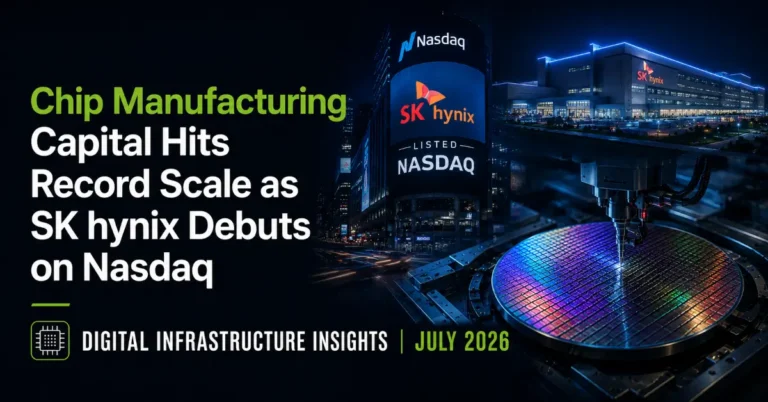
- SK Hynix: priced 177.9 million American depositary shares at $149 each (1 ADS = 0.1 common share), raising approximately $26.5 billion in gross proceeds, with initial trading beginning July 10 in New York — cited as the largest US first-time share sale by a foreign issuer, and the direct pricing follow-through on the IPO filing (targeting a roughly $29B raise) covered in June’s edition.
- SK Group: SK Hynix and SK Telecom, under SK Group, will work with Nvidia by combining AI memory and operator-run AI infrastructure to develop large-scale AI capability — extending June’s Nvidia/SK Hynix/Naver/Doosan partnerships and SK Telecom’s gigawatt-scale AI cloud plans.
- Naver: announced plans to establish an on-premises AI data center in South Korea, according to a report from Seoul, continuing the country’s broader AI infrastructure buildout alongside its Nvidia partnership from June.
Why it matters for buyers: SK hynix’s ADS pricing at $149/share and $26.5B raised is close to, though slightly under, the roughly $29B target reported when the filing was covered last month — a useful reminder that IPO filing figures and actual pricing outcomes can diverge, even for well-anticipated listings. Combined with SK Group’s continuing Nvidia collaboration and Naver’s new data center, South Korea’s AI infrastructure buildout shows no signs of slowing. → Track South Korea AI infrastructure capital flows with TeckNexus ROI/TCO tools.
4. Hyperscaler data center and interconnect infrastructure expands
Meta’s two moves this month show the same company simultaneously expanding capacity for internal use and exploring becoming a capacity supplier to others:
- Meta Platforms — Alberta: started construction of a CAD13 billion data centre in Alberta, Canada to run AI workloads, launching with 1GW capacity and scalable to 1.8GW; the project includes CAD60 million for local infrastructure, roughly 3,000 construction jobs at peak, and 300+ operational roles.
- Meta Platforms — Meta Compute: Bloomberg reports Meta may form a separate unit within Meta Compute to commercialize excess AI compute and provide access to its AI models for external customers, positioning it against neocloud providers like CoreWeave.
- Verizon: disclosed a dark fiber agreement exceeding $1B to interconnect Google data centers and launched its AI Connect initiative, repurposing dark fiber and retrofitting select central offices into small edge data centers to support AI inference workloads, with additional multi-billion AI connectivity deals expected this year.
- Samsung Group: outlined new funding to expand private 5G deployments, edge computing capabilities, and connected devices.
Why it matters for buyers: Meta’s two moves this month — a CAD13B Alberta facility and a plan to sell its own excess compute externally — show the same company simultaneously expanding capacity for internal use and exploring becoming a capacity supplier to others. Verizon’s AI Connect initiative is a similar pattern from the telecom side: repurposing existing dark fiber and central offices, rather than building new infrastructure from scratch, to capture AI inference demand. → Plan hyperscaler and telecom-adjacent AI infrastructure with TeckNexus Network Planning tools.
5. Chip and infrastructure demand reaches new verticals: automotive and quantum
AI-adjacent infrastructure demand extended well beyond the data center this month:
- Qualcomm Technologies: BMW Group awarded Qualcomm a long-term contract as lead compute silicon provider for its digital cockpit and next-generation automated and assisted driving systems, leveraging the Snapdragon Digital Chassis portfolio over the next decade.
- AT&T & D-Wave Quantum: report a live hybrid quantum-classical deployment for enterprise workloads, demonstrating production readiness for optimization tasks delivered via a quantum platform integrated with classical compute.
- Chunghwa Telecom: entered an agreement with Fujitsu and 1Finity to jointly develop All-Photonics Network (APN) and quantum technologies in Taiwan.
Why it matters for buyers: a decade-long automotive silicon contract and two separate quantum-classical infrastructure moves in the same month show AI-adjacent infrastructure demand extending well beyond the data center — into vehicle compute platforms and quantum-classical hybrid systems that are now described as production-ready, not experimental. → Evaluate emerging compute verticals with TeckNexus Technology Selector.
6. Data center policy and regulation mature globally
Regulators began addressing the externalities of AI infrastructure buildout directly this month:
- Australian Government: introduced requirements for AI-focused data centers to underwrite their own power needs so grid reliability and consumer energy prices aren’t adversely affected, and to address water consumption as part of facility planning and operations, as part of Australia’s new AI strategy.
- India: a notified regulatory framework opened national-level authorisation for infrastructure providers, digital connectivity infrastructure providers, internet exchange point providers, satellite earth station gateway operators, cloud-hosted telecommunication network providers, and mobile number portability providers.
- A fabless semiconductor startup: secured new financing to develop switching silicon and systems targeted at edge, aggregation, and telecom infrastructure deployments.
Why it matters for buyers: Australia’s requirement that AI data centers underwrite their own power needs — rather than socializing grid and pricing risk onto consumers — is an early example of a jurisdiction directly regulating the externalities of AI infrastructure buildout, a policy pattern buyers should expect other markets to follow as data center power and water demands scale. → Score vendor and market regulatory readiness with the TeckNexus RFP Scorecard Generator.
Every July item, with full source detail, is on the curated Digital Infrastructure Monthly Insights page →
A note on scope: this roundup covers data center infrastructure, power/cooling, chip manufacturing and supply chain, and physical AI infrastructure specifically. AI models, agents, and applications are covered in the companion AI & Automation Insights series; wireless/spectrum/satellite infrastructure is covered in Advanced Connectivity Insights. Two archive items were excluded from this draft: SK Telecom’s multi-vendor AI-RAN build (Samsung, HFR, Ericsson, Nokia) appears to be the same underlying story as the MSIT/NIA Hyper-AI Network pilot already covered in depth in the July AI & Automation Insights edition; and T-Mobile‘s AI network optimization during a soccer tournament is a wireless-operations story better suited to that series or Advanced Connectivity.
What this means if you’re planning digital infrastructure
July’s throughline is that chip manufacturing capital reached a genuinely new scale this month — TSMC and Micron alone committed well over half a trillion dollars in US investment — while SK hynix’s Nasdaq debut and Meta’s dual expansion-and-compute-resale strategy both show capital markets and infrastructure strategy maturing in parallel. Five moves follow directly from the month:
- Treat US and Indian chip manufacturing capacity as expanding on parallel, well-funded tracks — TSMC/Micron’s US commitments and India’s INR1.9T program are both substantial enough to shape supply independently.
- Watch for actual pricing-versus-filing divergence on any AI infrastructure IPO you’re tracking — SK hynix’s $26.5B raise came in modestly under its initially reported ~$29B target.
- If your infrastructure strategy depends on excess compute resale (like Meta’s planned Meta Compute unit) or capacity supplier relationships, watch which hyperscalers formalize this model next.
- Factor memory price volatility into hardware and chip procurement — Arm’s record AI-driven revenue and Qualcomm’s memory-crunch-driven profit decline are two sides of the same price dynamic.
- Expect data center power and water regulation (following Australia’s model) in more jurisdictions as AI infrastructure scales — build this into multi-year site selection planning.
Catching up? Last month’s edition is here: South Korea’s $650B AI Megaproject Anchors a Month of Chip Supply Diversification: Digital Infrastructure Insights, June 2026 →
→ Start with the TeckNexus Intelligence Platform — independent, buyer-neutral tools for spectrum, TCO, architecture, and RFP decisions.
This analysis is drawn from TeckNexus’s full curated Digital Infrastructure Monthly Insights for July 2026. See every deployment, product, and partnership update.