Data Center

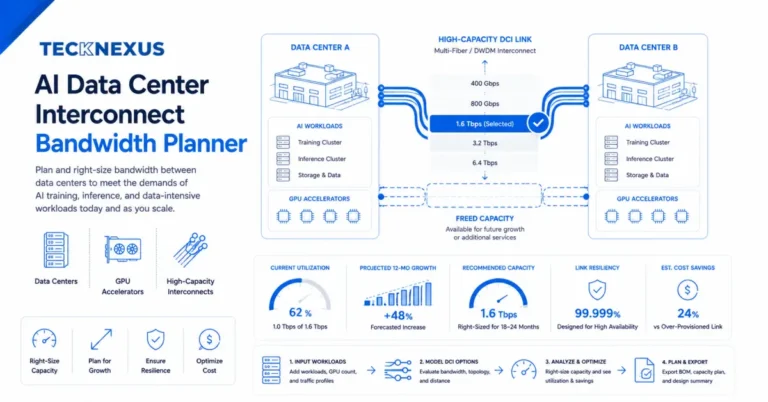
See what scale-up and scale-out network bandwidth an AI deployment actually demands — before the RFP gets written. Based on publicly published accelerator interconnect generations and distributed-training traffic patterns.
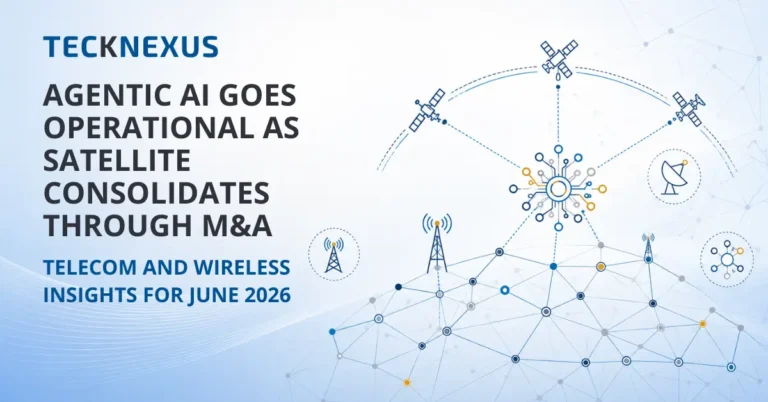
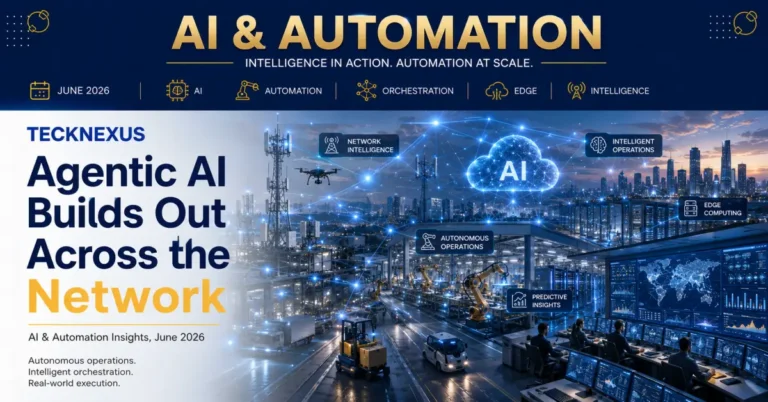
June 2026 showed agentic AI scaling from pilot to platform: industry-wide standards momentum, AI-RAN field trials from Nokia, Amdocs and KDDI, and fresh capital across data centers on three continents. This full roundup covers every deployment, partnership, funding round and governance move from the month, with tools to prioritise AI use cases and plan the network around them.
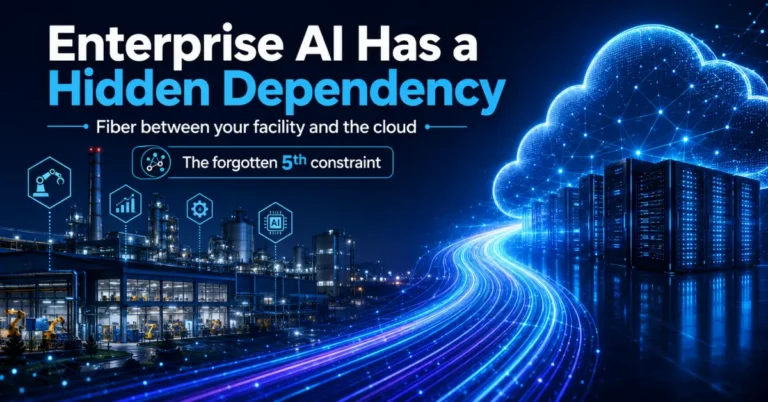
A Fiber Broadband Association and RVA white paper quantifies the fibre interconnection gap underpinning the AI data centre build-out: 2x route miles and 2.3x fibre miles needed by 2029. For enterprise private network buyers, the analysis surfaces a connectivity dependency that rarely appears in AI deployment planning — but should.
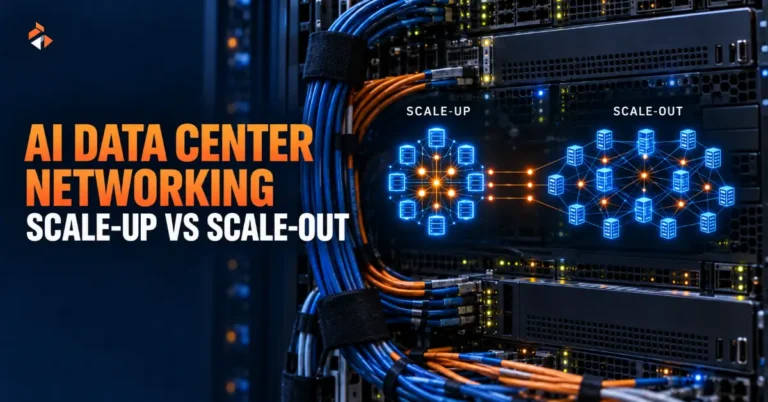
Runaway AI training demand is pushing data center fabrics past their limits, making optical networking the bottleneck to unlock GPU-scale performance and efficiency. Scale-up connects more GPUs within a box or across tightly coupled racks to form supernodes with ultra-low-latency fabrics. A new forecast from Goldman Sachs positions optical networking as the next mega-trend in AI infrastructure, with spend growing an order of magnitude as clusters densify. CPO—integrating optical engines with switch ASICs or accelerators—features prominently in the growth outlook. Expect a technology mix that also includes pluggable 800G/1.6T optics and emerging Linear Pluggable Optics (LPO) to reduce DSP power at short reaches.
The Fiber Broadband Association's Fiber Connect 2026 conference repositioned fiber as a foundational prerequisite for AI infrastructure — not merely a consumer broadband conduit. With hyperscalers investing $370 billion annually in AI, the FBA projects demand for twice as many fiber route miles and three times total fiber deployed today. Over 100 million U.S. homes have now been passed with fiber, yet workforce shortages exceeding 200,000 workers and power constraints threaten deployment velocity precisely when AI-driven demand is accelerating fastest.
The NVIDIA-IREN partnership, announced May 7, 2026, commits both companies to jointly deploying up to 5 gigawatts of NVIDIA DSX-aligned AI factory infrastructure across IREN's global data center pipeline. A five-year, $3.4 billion managed GPU cloud services contract anchors the deal, alongside a warrant granting NVIDIA rights to purchase up to 30 million IREN shares. The Sweetwater campus in Texas serves as the reference implementation for NVIDIA's DSX architecture, signaling a new phase of vertically integrated, gigawatt-scale AI infrastructure planning that is reshaping competitive dynamics across hyperscalers, telecom operators, and enterprise IT.
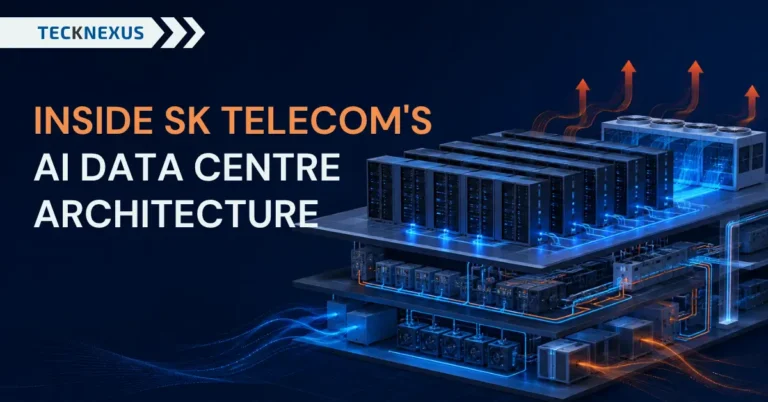
SK Telecom is reorganizing around artificial intelligence to accelerate a B2B push, with a sharp focus on public sector and defense opportunities in South Korea. At a town hall marking six months in the role, SK Telecom’s CEO signaled a decisive shift: make AI the company’s growth engine and align operations, culture, and go-to-market around enterprise needs. The operator outlined an organizational, technology, and culture overhaul to strengthen competitiveness across B2B AI. The company will scale its AI data center footprint by combining capabilities from SK Group affiliates and global partners. SK Telecom advanced its in-house foundation model to a second phase.
Samsung Electronics is accelerating its U.S. foundry strategy with the Taylor plant set to begin operations, anchored by 2-nanometer AI chips for Tesla’s next-generation self-driving platforms. After breaking ground in late 2022 with an initial $17 billion investment, Samsung’s Taylor fab is now holding its equipment installation ceremony and transitioning from build-out to run-up. For the U.S. semiconductor base, Taylor represents an advanced-node capacity point that complements Samsung’s existing Austin operations and expands domestic options beyond a single supplier. Tesla’s AI5 design has taped out, signaling it is ready for volume manufacturing, with AI6 following closely and expected to incorporate low-power DDR (LPDDR) memory to meet stringent automotive power budgets.
A new alliance between SK Telecom (SKT), Arm, and Rebellions targets the fast-growing AI inference market with a server platform designed for sovereign AI and telecom-grade data centers. SKT will validate a new AI server that combines Arm’s AGI CPU—its first Arm-designed data center processor, based on Neoverse CSS V3—with Rebellions’ RebelCard inference accelerator in live AI data center environments. The partners will co-develop the full software stack, from firmware up, and test telco-specific models and large-scale workloads, including SKT’s proprietary foundation model, A.X K1. Industry focus is shifting from training to inference at scale, where energy, latency, and total cost of ownership (TCO) are decisive.
The Federal Communications Commission is advancing a proceeding that would prohibit US carriers from interconnecting with Chinese state-linked operators and from using facilities they own or operate, including data centers and points of presence. The proposal targets interconnection at meet-me rooms, cross-connects, and handoffs that underpin IP transit, voice interconnect, SMS hubs, and enterprise backhaul. The Commission is seeking comment on a ban and will take the item to a vote at its 30 April Open Meeting. Depending on the final order, potential outcomes range from mandatory disconnection to forced divestiture or transfer of affected facilities.

Your Brand. Our Intelligence Tools.

Capture leads at the point of evaluation. Talk to Us →

Sponsored by Palo Alto Networks
⚡ Utilities ⏱ 8 min ✓ Free
This tool is built and hosted by TeckNexus.
Launch Tool →
Whitepaper
This whitepaper explains how utilities can use secure AI-enabled private mobile networks to modernize operations, support distributed intelligence, improve resilience, and strengthen cybersecurity across critical infrastructure. It covers AI applications, private network advantages, zero trust principles, multilayered security architecture, and governance considerations for AI-ready utility environments....
Whitepaper
Non-terrestrial networks are rapidly evolving from experimental satellite systems into an increasingly important part of the global 5G connectivity landscape. This eBook, developed by Radisys in collaboration with TeckNexus, explores how 3GPP standardization, satellite architecture innovation, and software-driven network design are reshaping NTN deployment models. It examines the transition from...
Whitepaper
Private cellular networks are transforming industrial operations, but securing private 5G, LTE, and CBRS infrastructure requires more than legacy IT/OT tools. This whitepaper by TeckNexus and sponsored by OneLayer outlines a 4-pillar framework to protect critical systems, offering clear guidance for evaluating security vendors, deploying zero trust, and integrating IT,...
Scroll to Top