

How the NVIDIA-IREN Deal Is Reshaping AI Infrastructure Partnerships
The NVIDIA-IREN partnership announced on May 7, 2026, is not simply a supply agreement between a chipmaker and a data center operator — it is a structural signal about how the AI infrastructure economy is being architected, financed, and controlled at scale.
Key Terms of the NVIDIA-IREN Agreement
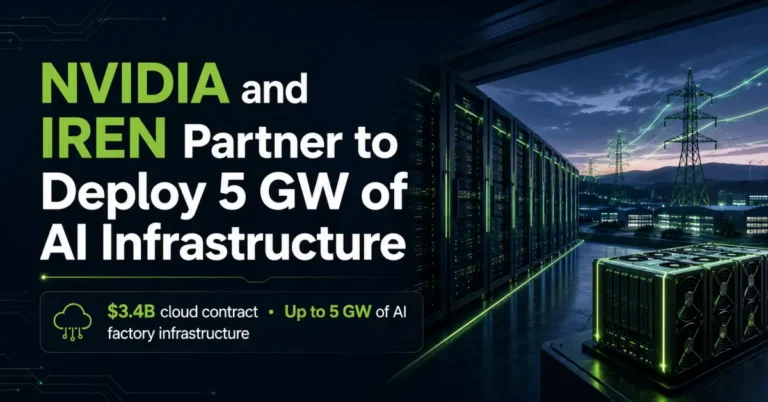
The partnership has two distinct but complementary components. First, NVIDIA and IREN have committed to jointly deploying up to 5 gigawatts of NVIDIA DSX-aligned AI factory infrastructure across IREN’s global data center pipeline. Second, IREN signed a five-year, $3.4 billion managed GPU cloud services contract, giving NVIDIA access to operational compute capacity at IREN’s existing Childress, Texas facility for its own internal AI training and inference workloads. To anchor the long-term relationship, IREN issued NVIDIA a five-year warrant to purchase up to 30 million ordinary shares at $70 per share — representing a potential $2.1 billion equity stake, subject to regulatory approval and performance conditions.

Why the Sweetwater Campus Is Central to NVIDIA’s AI Factory Strategy
The flagship deployment will center on IREN’s 2-gigawatt Sweetwater campus in Texas, which NVIDIA and IREN have designated as the reference implementation for NVIDIA’s DSX AI factory architecture. DSX is NVIDIA’s standardized reference design integrating accelerated compute, high-speed networking, power systems, cooling, and software into a repeatable, scalable blueprint. The first 1.4 GW phase of Sweetwater was energized the same week the partnership was announced, underscoring the operational readiness that made IREN an attractive strategic partner rather than a speculative one.
The Strategic Logic Behind NVIDIA’s Infrastructure Investment Model
Understanding the strategic logic requires recognizing that NVIDIA faces a constraint no amount of chip engineering can solve: the physical scarcity of power, land, and grid interconnection capacity.
Power and Grid Scarcity Are Driving NVIDIA’s Infrastructure Strategy
Grid interconnection queues in the United States now run three to eight years in many regions. Transformer and switchgear lead times exceed 24 months. Skilled data center construction labor is in acute shortage globally. NVIDIA can design and manufacture the world’s most powerful AI accelerators, but it cannot compress utility-scale infrastructure timelines. IREN, by contrast, already holds large portfolios of grid-connected land and power in renewable-rich regions across North America, Europe, and Asia-Pacific — assets that took years to assemble and cannot be replicated quickly. NVIDIA is effectively purchasing access to those scarce resources through equity rights and long-term cloud contracts rather than building from scratch.

NVIDIA’s Emerging Pattern of Strategic Data Center Partnerships
The IREN deal follows a pattern NVIDIA has now executed with at least two other specialized data center operators — CoreWeave in January 2026 and Nebius in March 2026 — each involving equity investments of approximately $2 billion paired with cloud services agreements. Across these three partnerships alone, NVIDIA is positioning itself to influence the deployment of more than 10 gigawatts of AI factory capacity over the next five years. This is not opportunistic deal-making; it is a deliberate strategy to secure dedicated infrastructure capacity outside the hyperscaler ecosystem, which is increasingly building proprietary silicon and may reduce NVIDIA GPU procurement over time.
Competitive Implications for the AI Infrastructure Ecosystem
The implications of this partnership extend well beyond NVIDIA and IREN, touching competitive dynamics across hyperscalers, telecom operators, and enterprise IT buyers.
Why Vertically Integrated AI Factories Are Replacing Standalone GPU Procurement
Industry analysts at Dell’Oro Group have framed the shift precisely: the next phase of AI infrastructure is less about procuring GPUs in isolation and more about deploying repeatable AI factories at gigawatt scale, where compute, power, land, cooling, networking, software, and operations are planned and executed as a single integrated system. IREN’s simultaneous acquisition of Mirantis — a Kubernetes and cloud operations platform — for $625 million illustrates this logic. Raw compute capacity is necessary but insufficient; the ability to orchestrate thousands of GPUs into enterprise-ready AI services is what separates commodity operators from strategic partners.
How Former Crypto Mining Operators Gained a Head Start in AI Infrastructure
IREN’s trajectory from bitcoin mining operator to NVIDIA’s flagship AI infrastructure partner reflects a broader repositioning underway across the digital asset mining sector. Companies that built power-dense facilities for cryptocurrency workloads now hold pre-permitted, grid-connected sites with existing physical infrastructure — a head start measured in years over any greenfield developer. Analysts at HyperFrame Research have noted that this advantage is accelerating capital flows toward operators who can combine power assets with cloud software stacks, and that IREN’s deal with NVIDIA validates the model for peers including Hut 8, Bitfarms, and Cipher.
How NVIDIA’s Infrastructure Partnerships Challenge Hyperscaler Expansion
If NVIDIA and its infrastructure partners lock up 5 to 10 gigawatts of power and land capacity across North America and Europe, that capacity is no longer available to Google, Amazon, or Microsoft for their own expansion. Combined with the earlier $9.7 billion Microsoft-IREN GPU cloud deal announced in November 2025, the picture that emerges is one of intense, multi-front competition for the physical inputs that underpin AI at scale.
Strategic Takeaways for Telecom and Enterprise Technology Decision-Makers
For telecom executives and enterprise technology strategists, the NVIDIA-IREN partnership carries several near-term implications worth tracking closely.
First, the DSX architecture is becoming a de facto industry standard for AI factory design. Vendors, integrators, and colocation providers that align to DSX specifications early will be better positioned to participate in the next wave of AI infrastructure procurement. Second, the managed GPU cloud services model — where an infrastructure operator runs NVIDIA hardware on behalf of a customer at scale — is maturing rapidly. Enterprises evaluating AI compute strategies should assess whether this model offers faster time-to-capacity than hyperscaler cloud alternatives, particularly for workloads requiring dedicated, high-density GPU clusters. Third, power availability is now a first-order strategic variable. Any organization planning large-scale AI deployments — whether directly or through partners — must treat grid access and power contracting as infrastructure decisions, not afterthoughts. The operators who secured that capacity years ago are now setting the terms of the AI economy.
The NVIDIA-IREN deal is a clear marker that AI infrastructure has entered a new phase: one defined by gigawatt-scale planning horizons, vertically integrated factory architectures, and financial structures that blur the line between chip supplier, infrastructure financier, and cloud operator. The companies that recognize this shift early and position accordingly will have a measurable advantage in the AI-native economy taking shape around them.