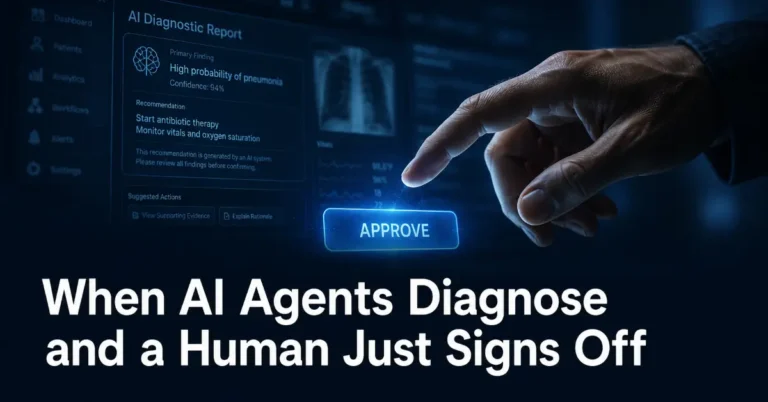
It’s worth sitting with that distinction rather than rushing past it, because “a human signs off” sounds like oversight has been preserved. In practice, sign-off is a much thinner form of human involvement than the diagnose-and-remediate workflows it replaced, and thinner forms of oversight carry their own well-documented risks — risks that don’t show up in a vendor demonstration, only in the accumulated pattern of decisions made under a sign-off model over months of live operation.
What actually changed: from recommend to diagnose-and-propose
The earlier generation of network AI agents operated as advisory tools. An engineer would see a flagged anomaly, review the agent’s suggested cause, and independently work through remediation — the agent contributed information, but the engineer did the diagnostic reasoning and the fix. The workflows now emerging under Nokia and Google Cloud’s agentic platforms compress that sequence. The agent performs the diagnosis itself, proposes a specific remediation, and the engineer’s role narrows to approving or rejecting a fully-formed recommendation rather than building one.
That compression is exactly what makes agentic AI operationally valuable — it removes the slow, manual diagnostic step that used to bottleneck fault response. It’s also exactly what makes the sign-off step do more governance work than it appears to. When an engineer builds their own diagnosis, they’re actively reasoning through the fault the whole way, and disagreement with any single input surfaces naturally. When an engineer reviews a fully-formed proposal and is asked only to approve it, the review is a different cognitive task entirely — closer to proofreading than to independent diagnosis, and proofreading is well known to catch a smaller share of errors than working the problem from scratch.
The sign-off problem: automation bias in a review-only role
This isn’t a hypothetical concern specific to telecom. Any field that has shifted from human-generated decisions to human-approved AI recommendations has run into a version of the same pattern, generally described as automation bias: the tendency for a reviewer to defer to a confident-looking automated recommendation rather than independently verify it, especially once the system has built a track record of being right. The risk compounds over time, not on day one. Early in a deployment, engineers scrutinise agent recommendations carefully, because trust hasn’t been established yet. Months in, once the agent has been right often enough, scrutiny naturally relaxes — and that’s precisely the point at which a confidently wrong recommendation is least likely to be caught, because the review has quietly become a formality rather than a genuine check.
That risk sits alongside a separate finding from this year’s independent agent research: most AI agents fail with total confidence rather than visible doubt. A sign-off workflow assumes the human reviewer will catch the agent when it’s wrong — but if the agent’s output looks identical whether it’s right or wrong, and the reviewer’s engagement has narrowed to approval rather than independent diagnosis, the sign-off step stops functioning as a meaningful check and starts functioning as a formality that happens to have a human’s name attached to it.
Where the industry is building around this, and where the gaps remain
To be clear, this shift isn’t happening in a governance vacuum. Verizon, Mauritius Telecom, Vantage Towers, and Vodafone Germany are championing TM Forum‘s InfraVerse Catalyst project, now in its second phase — an industry effort aimed at the interoperability and orchestration standards that agentic network management will need at scale. Huawei has positioned a telco-focused agentic AI platform concept, framing itself as a platform provider for network operations and OSS/BSS workflows, which suggests the industry expects this operating model to become standard rather than experimental. And AT&T has been positioning its own network to handle agentic AI traffic via fibre, edge, and spectrum investment — infrastructure readiness that assumes agentic workflows, sign-off model included, are becoming a permanent fixture of network operations rather than a transitional phase.
What’s less visible in any of that industry momentum is a standard for what a genuinely meaningful sign-off step looks like, as opposed to a procedurally-present one. That’s a gap operators and their enterprise customers can close through deliberate workflow design rather than waiting for a standards body to specify it, and it starts with treating sign-off as a designed control, not a default behaviour that emerges naturally once a human is technically in the loop.
Designing a sign-off step that actually functions as oversight
- Confidence-tiered escalation: Route recommendations differently based on the agent’s own confidence signal, so a low-confidence proposal triggers active investigation rather than the same one-click approval as a high-confidence one — assuming the vendor’s model exposes a genuine confidence signal rather than a uniform tone of certainty.
- Scheduled independent review: Periodically require engineers to diagnose a sample of faults independently, without seeing the agent’s proposal first, and compare results — a structural check against the scrutiny-decay pattern that sets in once trust in the agent builds up.
- Approval-pattern monitoring: Track sign-off approval rates and approval speed over time; a rate that climbs toward 100 percent or an approval time that trends toward instantaneous is itself a warning sign that review has become procedural rather than substantive.
- Vendor accountability: Treat sign-off design — not just agent accuracy — as a line item in vendor evaluation and governance scoring, since the same underlying model can be deployed with a meaningful review step or a rubber-stamp one depending entirely on how the workflow around it is built.
None of this argues against agentic network management, which is delivering genuine operational value in fault response speed and engineer workload. It argues for treating the word “approves” in any vendor’s description of their agentic workflow as a question, not a reassurance — and for building the sign-off step with the same engineering rigour that goes into the agent itself.
| Related Tool: RFP Scorecard Generator
If your evaluation of an agentic AI vendor doesn’t include a question about how their sign-off workflow is designed, it’s missing a governance dimension that matters as much as model accuracy. The TeckNexus RFP Scorecard Generator helps structure vendor evaluation around governance and security posture — including human-in-the-loop design — rather than capability claims alone. Explore the RFP Scorecard Generator on the TeckNexus Intelligence Platform. |