





Within a single week, two very different visions of AI infrastructure came into focus. In the US, SpaceX set out plans for more than $74 billion of AI supercomputing campuses, one of which could draw up to 6 GW. In Munich, Deutsche Telekom confirmed it is investing close to €250 million to take its Industrial AI Cloud to 20 MW. The numbers are separated by two orders of magnitude, yet both are responses to the same demand signal.

Reading the European moves as a smaller copy of the American build-out would miss the point. Deutsche Telekom and Orange are building a different kind of business: AI compute sold as a sovereign, trusted, industrially focused service, expanded only as fast as customers fill it. With the EU’s AI Gigafactory tender now in its final stretch, that model is about to face its biggest test.

Deutsche Telekom’s telco AI factory sold out in seven months
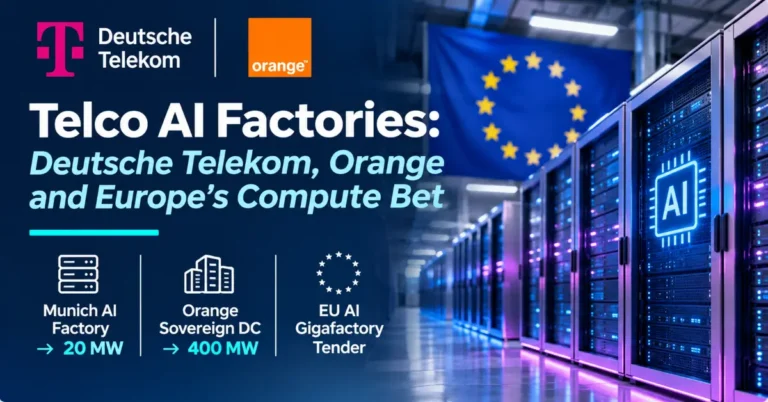
Deutsche Telekom’s AI factory at Munich’s Tucherpark, built with Nvidia and launched in February 2026, opened with around 10,000 Blackwell GPUs and was described at launch as lifting Germany’s available AI computing capacity by roughly 50%. Within seven months, the capacity was fully booked.
The second phase, announced on 9 November, adds Nvidia Blackwell Ultra B300 systems alongside the existing B200 and RTX PRO 6000 hardware, doubling the GPU count to around 20,000 and taking the site to 20 MW. The facility runs at a power usage effectiveness of about 1.2, and its waste heat is set to warm the wider Tucherpark district. A third phase is already in planning, and Deutsche Telekom says it is in intensive talks with partners about a larger commitment in Bavaria, with no final investment decision yet and any move conditional on financing and a viable economic model.
The customer list explains the design. Users include Siemens, Synopsys, Daimler Truck, EDAG, Currenta, PhysicsX, Agile Robots, Wandelbots, the legal AI company Noxtua and the German language model Soofi. Many of these workloads are simulation, digital twins and robotics training, in other words physical AI being developed in software before it reaches the factory floor. This is a cloud built around Germany’s industrial base rather than around frontier model labs.

Orange’s telco AI factory strategy runs through data centres and value targets
Orange is approaching the same opportunity from two directions. Internally, its Trust the Future plan, launched in February 2026, treats AI as a core lever for value creation. The group reported around €300 million of AI-generated value in 2025, tracked across its operating countries, and is targeting more than €600 million by 2028. Usman Javaid, previously Chief Product and Marketing Officer at Orange Business, became Group Chief AI Officer on 1 September with a mandate to embed AI and agentic AI across networks, operations, customer relations and business services.
Externally, Orange is restructuring its infrastructure to sell sovereign capacity. In July it entered exclusive talks with infrastructure investor Morrison to form a 50/50 data centre joint venture in France. Orange would contribute five data centres across four campuses at Chevilly-Larue, Aubervilliers, Chartres and Val-de-Reuil, with a €3 billion programme intended to take capacity to 400 MW, close to ten times today’s level. Orange Business would be the exclusive distributor of the venture’s colocation and hosting services, and Orange would keep operational control of the space running its own platforms. Signing is expected by the end of 2026, with closing in the first quarter of 2027.
The Orange model separates the capital-heavy layer from the service layer: an investor partner shares the cost of the buildings and power, while the operator keeps the customer relationship, the sovereignty promise and the AI services sold on top.
Telco AI factories compared: Europe’s operator models
Set side by side, the two operator strategies and the EU programme now forming around them show how European AI compute is being assembled.
| Dimension | Deutsche Telekom | Orange | EU AI Gigafactories |
| Model | Operator-owned AI factory with Nvidia | Data centre JV with Morrison, services via Orange Business | Public-private consortia, public sector as anchor customer |
| Current scale | Moving to 20 MW, about 20,000 GPUs | Targeting 400 MW across French campuses | Each site over 100,000 AI processors |
| Investment | About €1 billion initially, plus close to €250 million for phase two | €3 billion programme | Up to €10 billion public, over €20 billion private expected |
| Core customers | Industrial firms, start-ups, research, public sector | Large enterprises, SMEs, public sector, Orange itself | EuroHPC and participating member states, plus private users |
| Status | Phase two under way; Bavaria expansion in talks | Signing by end 2026, closing Q1 2027 | Tenders due December 2026 and February 2027 |
Why telco AI factories grow in steps, not megasites
The most important lesson Deutsche Telekom has drawn from its first year is not about construction but about utilisation. An AI factory only pays back if its GPUs are busy, so the company built a first phase, filled it, and is now adding the next. Orange’s joint venture follows similar logic by expanding existing campuses rather than greenfield megasites. That is a deliberate contrast with the US neocloud model, where demand from AI developers is strong enough for companies such as SpaceX to commit capital at gigawatt scale well ahead of new load coming online.
European operators also bring a different set of assets to the table. They already own data centre real estate, grid connections and dense fibre networks, and they hold long-standing enterprise and public sector relationships. Above all, they can credibly offer infrastructure operated under European data protection, security and jurisdiction requirements. For industrial customers training models on proprietary designs or production data, that assurance can matter as much as price per GPU hour.
The constraint is scale. A 20 MW site is significant for Germany but small next to the gigawatt campuses now planned in the US. Power availability, permitting and capital costs in Europe make multi-gigawatt builds far harder, which is exactly the gap the EU AI Gigafactory programme is designed to address.
The EU AI Gigafactory tender is the next test for telco AI factories
The EuroHPC Joint Undertaking opened its call for up to seven AI Gigafactories on 30 July 2026. Each facility is expected to host more than 100,000 advanced AI processors, backed by up to €10 billion of public money that is meant to unlock more than €20 billion of private investment. Rather than acting purely as a funder, EuroHPC and 18 participating member states will jointly buy guaranteed compute access from the selected operators, making the public sector an anchor customer.
Much of the coverage has cited a 12 November deadline, but the timetable has since changed. Large-scale gigafactory tenders are now due on 3 December 2026, while the deadline for medium-scale tenders has moved to 4 February 2027 to give member states time to finalise their national financial commitments. Award decisions had been expected in early 2027, with construction to follow.
Deutsche Telekom has said it is working towards a gigafactory and regards Bavaria as a strong candidate location, but has not confirmed whether it will bid. The hesitation is understandable. A gigafactory is a step change from a 20 MW site to a facility several times larger, and the operator has been explicit that any decision depends on financing and a model that works economically.
The anchor-customer structure is what makes the programme interesting for operators. Guaranteed public demand directly addresses the utilisation risk that has shaped every telco AI factory decision so far. The open questions are whether access pricing will be high enough to fund power and hardware refresh, and whether operators can secure the power those sites will need.
What to watch next in telco AI factories
- Gigafactory bids. Whether Deutsche Telekom, Orange or other operators lead or join consortia before the December and February deadlines, and which sites they put forward.
- Utilisation disclosures. How quickly Tucherpark phase two fills, and whether operators begin reporting occupancy or AI cloud revenue separately.
- Orange-Morrison closing. Final terms of the joint venture and whether its first new capacity is designed for high-density AI racks.
- Physical AI workloads. Whether industrial simulation, robotics and digital twin customers become the defining demand for European AI compute, distinct from frontier model training.
- Wider operator moves. Telenor, Swisscom and Fastweb have already built smaller Nvidia-based sovereign AI clusters; the next wave will show whether these remain national services or become pan-European.
Europe will not match the US gigawatt for gigawatt in the near term, and its operators are not trying to. The bet is that trusted, industrially focused, demand-led AI compute is a durable business in its own right, and that the EU’s anchor-customer model can help it scale. The coming months will show how much of that bet operators are willing to make.
For a monthly view of how AI infrastructure, private networks and advanced connectivity are evolving, explore TeckNexus Monthly Insights. For deeper coverage of AI campuses, power strategy and data centre connectivity, visit the TeckNexus Data Centers and Digital Infrastructure hub.