

Business Intelligence is undergoing change as businesses seek new ways of utilizing their data in order to become even more efficient. Conventional dashboard solutions allow companies to understand how well they have been performing in the past but often need human analysis of the reports generated in order to determine what action should be taken in the future.

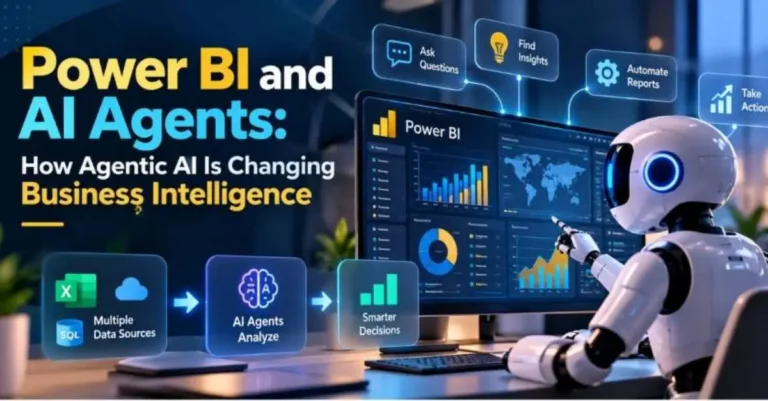
The merger of Power BI and artificial intelligence agents is shifting the paradigm of using the data provided by business. Agentic AI is capable of analyzing the business data, recognizing patterns, answering questions and recommending or carrying out actions based on established goals.

Role of Power BI in Modern Business Intelligence
Power BI is an intelligent business platform provided by Microsoft for the purpose of gathering, transforming, visualizing, and analyzing data from various sources. This tool converts complicated business data into interactive dashboards and reports, which allow tracking the performance of organizations.
Some of the indicators tracked with the help of Power BI include sales, revenue, customers’ behavior, inventories, operational expenses, and other significant measures. Data visualization provided by Power BI makes the process of identifying tendencies and understanding business performance easier.
Nevertheless, traditional business intelligence requires human participation a lot. Employees should examine dashboards, explore unexpected deviations, and make certain decisions about what to do next. The introduction of AI agents into the process may prove useful in such a case. It will be possible to make analysis interactive and automated.

What Is Agentic AI, and How Does It Work?
Agent-based AI is characterized by AI systems that are capable of pursuing specific objectives by developing a plan, utilizing connections to tools, analysis of the available information, and performing actions in the set range of permissions.
According to the way an AI agent is programmed, it can gather information, evaluate the situation, offer recommendations, and initiate the approved business process. For example, in response to the sales manager’s question about what has led to decreasing sales in a certain area, an AI agent that has access to the approved business data can:
Investigate sales trends in various regions.
- Compare the current results with the results of previous periods.
- Find out which products or regions are responsible for falling sales.
- Summarize potential reasons based on the available information.
- Provide recommendations like analysis of stock or alteration of marketing strategy
- Launch an approved workflow if the necessary integrations and permissions are available.
Power BI supplies the base for reporting and analysis, whereas the agent can assist in making conclusions and implementing the next step.
How Are Power BI and AI Agents Changing Business Intelligence?
1. Moving Beyond Traditional Dashboards
The users are required to investigate numerous reports to find out what caused such changes in the metrics.AI assistants allow making the process more conversational and active. Queries in natural language could be asked by employees, and responses could be generated in accordance with the data available.
For instance, instead of analyzing numerous sales reports, the manager need only ask about the product lines that have shown the worst performances.
In such instances, there will be adequate time available to comprehend the issues being faced by the organization, instead of searching for data from the reports.
2. Enabling Faster, Data-Driven Decisions
Late detection of issues could result in reduced sales, unnecessary costs, or other interruptions to business operations. With AI agents, metrics that should be observed, the evaluation of incoming data, and notifying particular situations may be done effectively.
Thus, an agent may detect an unusual spike in customer complaints or a reduction in conversion rates of sales. With the use of proper workflows, the agent may generate a report, inform a particular employee, or start some predefined process. Power BI dashboards will allow employees to comprehend the situation, and AI agents will allow prioritizing actions.
3. Automating Routine Data Analysis
The work of employees often involves preparation of reports, comparison of numbers, finding out-of-the ordinary behavior, and giving answers to the same set of questions.
With proper access to data sources, some of these operations can be performed by AI agents. The agents may provide summaries of week’s performance, make comparisons between departments, or explain reasons for important fluctuations.
For instance, a financial department may employ an agent to examine the financial reporting data that is approved and point out unusual changes in expenses. The automation does not imply that people are no longer needed. On the contrary, it gives them more time for decision-making.
4. Improving Predictive and Proactive Insights
The tool Power BI provides the ability to perform analytics and forecasting depending on the selected solution and data preparation. This sort of analysis can further be utilized by AI agents in aiding team members evaluate different outcomes and act accordingly.
For example, a retail business firm can analyze its past sales data along with inventory statistics and identify possible risks due to a shortage of products. In such a way, AI can provide an overview of the situation and suggest priorities in order to inform the purchasing department.
Such suggestions have to be based on reliable data and relevant forecasting. The forecast cannot guarantee anything but helps to be ready for potential changes rather than react to them.
Which Business Functions Can Benefit From Power BI and AI Agents?
This type of combination would be helpful in various departments in the business.
- Sales & marketing department: Conduct a review of the efficiency of campaigns and sales, and make suggestions to improve them.
- Finance: Add up costs, look at transaction anomalies, budgeting, financial reporting.
- Operations: Measure the level of productivity, detect bottlenecks in the work processes and their performance.
- Retail and inventory: Check the availability of goods, do an analysis of demand for certain goods.
- Customer service: Control service KPIs, find recurring issues, solve customers’ problems.
- HR: Do an analysis of workforce dynamics, recruitment KPIs and operation KPIs on employees’ performance.
The list of advantages of using the approach mentioned above can be determined by the quality of data used, relevance of the AI solution and workflow.
Conclusion
Power BI and AI agents can assist companies in moving away from traditional reports and into predictive and action-oriented business intelligence. Power BI development company understand your business data easier to interpret, whereas agentic AI can assist in discovering patterns, giving explanations, and even automating procedures.
Adoption will be effective through correct data, integration, security measures, and human involvement. Business organizations will be able to benefit from agentic artificial intelligence by starting with tangible cases of application and measuring outcomes to cut down repetitive analysis and gain greater operational transparency.