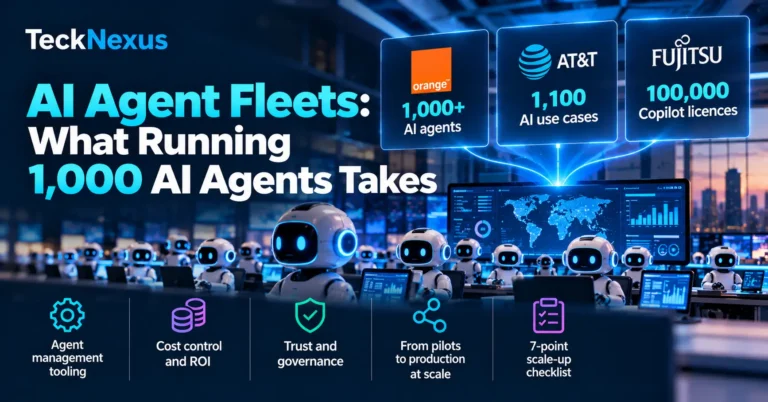
A year ago, most telecom AI agent stories were about a single use case: an assistant that summarised tickets, or a pilot that triaged alarms in one region. October 2026 showed how quickly that has changed. Orange Spain reported more than 1,000 custom AI agents in use across the business. Fujitsu described a rollout of around 100,000 Microsoft 365 Copilot licences, with AI agents now handling three quarters of its service desk’s initial responses and triage. AT&T set out an AI-native strategy spanning 1,100 use cases.

At this scale, building an agent is no longer the bottleneck. The challenge is running a fleet: knowing what each agent does, what it costs, what data it touches, who is accountable for its decisions, and how to retire or replace it. That shift is reshaping vendor roadmaps, industry standards and the economics of AI in telecom.
How AI Agent Fleets Reached Enterprise Scale
The organisations furthest ahead share a common pattern. They invested in a data foundation before agents arrived, then opened agent creation to a wide base of employees under central control. Orange Spain built its agents on Gemini Enterprise using a low-code framework, letting non-technical staff create agents for incident triage, root-cause analysis, knowledge search and request handling. It reported near-total licence activation within 30 days, and its agents answer from verified internal data consolidated on a cloud data platform it has been building since 2018.
Fujitsu followed a similar route at even larger headcount, using Copilot in Teams and Outlook as the front door to agents and business systems, and reporting usage above 90% among licensed employees. AT&T’s approach emphasises measurable return, open source models and cost efficiency across its portfolio of use cases. As our August AI & Automation Insights noted, its internal AI platform already processes about 45 billion tokens a day, with open source models handling roughly 40% of requests.
| Organisation | Scale reported | Build model | What stands out |
| Orange Spain | 1,000+ custom agents | Low-code agent creation by employees on a central platform | Near-total licence activation in 30 days; agents grounded in verified internal data |
| Fujitsu | About 100,000 Copilot licences | Copilot in Teams and Outlook as the interface to agents and systems | Agents handle 75% of service desk initial responses and triage |
| AT&T | 1,100 AI use cases | Model choice with heavy use of open source | Focus on measurable ROI and cost efficiency |
Vendors Are Building Tools to Manage AI Agent Fleets
The vendor market is responding to the same shift. In October, Plume launched Plume Console, which lets internet service providers investigate subscriber issues and deploy and manage the lifecycle of multiple AI agents. Adtran introduced agents within its Mosaic One platform for network management, customer care and business operations. Ericsson and AWS outlined agentic AI for proactive network operations, combining cloud services with Ericsson‘s operations software.
These launches reflect a move from selling individual agents to selling the platform that orchestrates them. That platform layer matters. As discussed in our September AI & Automation Insights, the agent orchestration and registration layer tends to be harder to change than the underlying language models, which makes interface choices and portability early design decisions rather than later concerns.
The Economics of AI Agent Fleets
Cost is where many agent programmes will succeed or stall. Bain has estimated that AI agents could account for 20% to 30% of a telecom operator’s operating costs if workflows are not redesigned around them. Analysis from Pegasystems, shared through TM Forum, found that total AI spending at operators is rising even as the price per token falls, driven by retrieval overhead that can make up around 40% of tokens, by agentic loops that call models repeatedly, and by growing context windows. One estimate put a workload of 10 million interactions a month at about $160,000.
The countermeasures are becoming clearer. Routing each task to the smallest model that can handle it, setting budgets per agent, and checking whether an agent should be invoked at all before it runs can cut costs sharply. AT&T has reported a 56% reduction in AI coding costs through model routing. Fleet economics, in other words, depend as much on architecture and policy as on model pricing.
Governance and Trust for AI Agent Fleets
Trust is the other constraint. In October, TM Forum and Accenture launched a Trustworthy AI Governance Certification, aimed at helping operators show that autonomous decisions and agent-to-agent interactions can be trusted. It will measure governance maturity, workforce readiness and operational accountability, and comes with an industry blueprint and training pathways. TM Forum research cited at the launch found that 72% of operators believe their AI capabilities are trustworthy, but only 14% can verify it.
Other efforts point the same way. A coalition of more than 120 organisations has proposed a common framework for reporting AI agent security and operational incidents, and the NGMN Alliance treats governance, security and operations as prerequisites for higher levels of network autonomy rather than add-ons. Platform vendors are also adding runtime controls designed to detect and contain agents that act outside their policies.
A Scale-Up Checklist for Managing AI Agent Fleets
For operators and enterprises moving from dozens of agents to hundreds or thousands, seven disciplines stand out:
- Maintain an agent registry: a single inventory of every agent, its owner, purpose, permissions and data sources.
- Fix the data foundation first: consolidated, governed data and retrieval from verified sources reduce errors and duplicated effort.
- Tier autonomy by risk: keep humans in the loop for actions that change networks, customers or finances, and expand autonomy as evidence builds.
- Manage cost per agent: route tasks to right-sized models, cap token budgets and track cost against measured outcomes.
- Instrument everything: log decisions, monitor behaviour and adopt consistent incident reporting so problems surface early.
- Design for portability: favour open interfaces between agents, tools and models so the orchestration layer does not become a lock-in point.
- Certify trust and train people: use emerging governance benchmarks and invest in the skills needed to supervise agents, not just build them.
Where AI Agent Fleets Go Next in Network Operations
The next step is moving fleets from internal productivity into the network itself. Verizon has reported more than 70 million autonomously executed configuration changes in 2025 and is targeting Level 4 autonomy in its core network, while vendors are building agents for alarm triage, root-cause analysis and closed-loop remediation. The same principles are reaching enterprise networks, as covered in our analysis of autonomous operations for private networks.
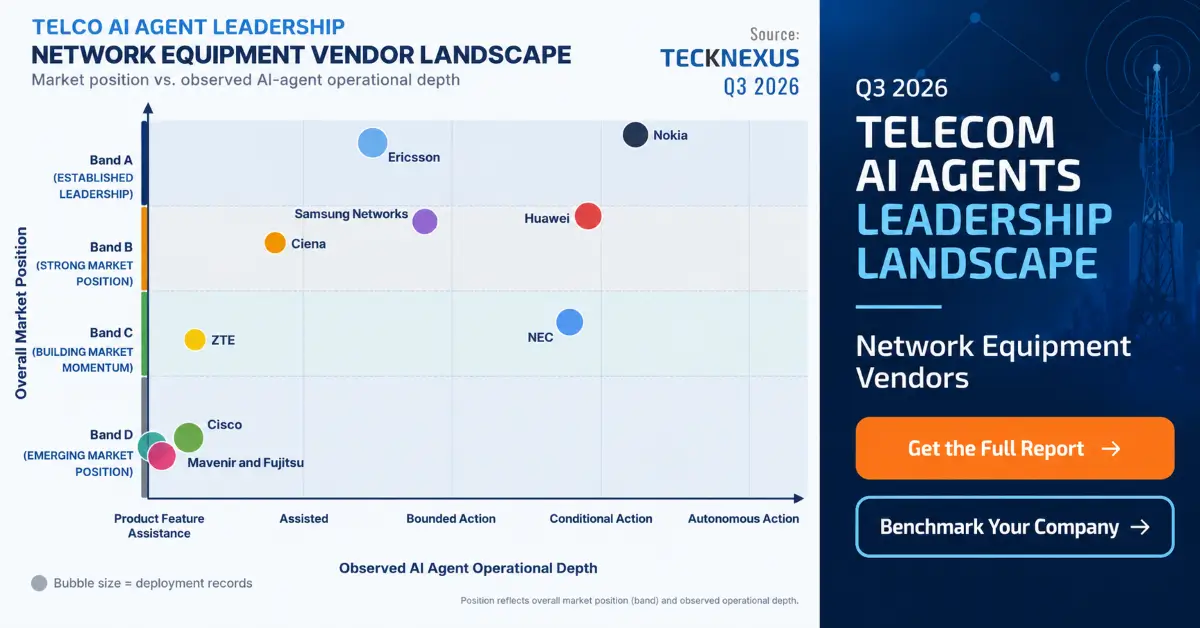
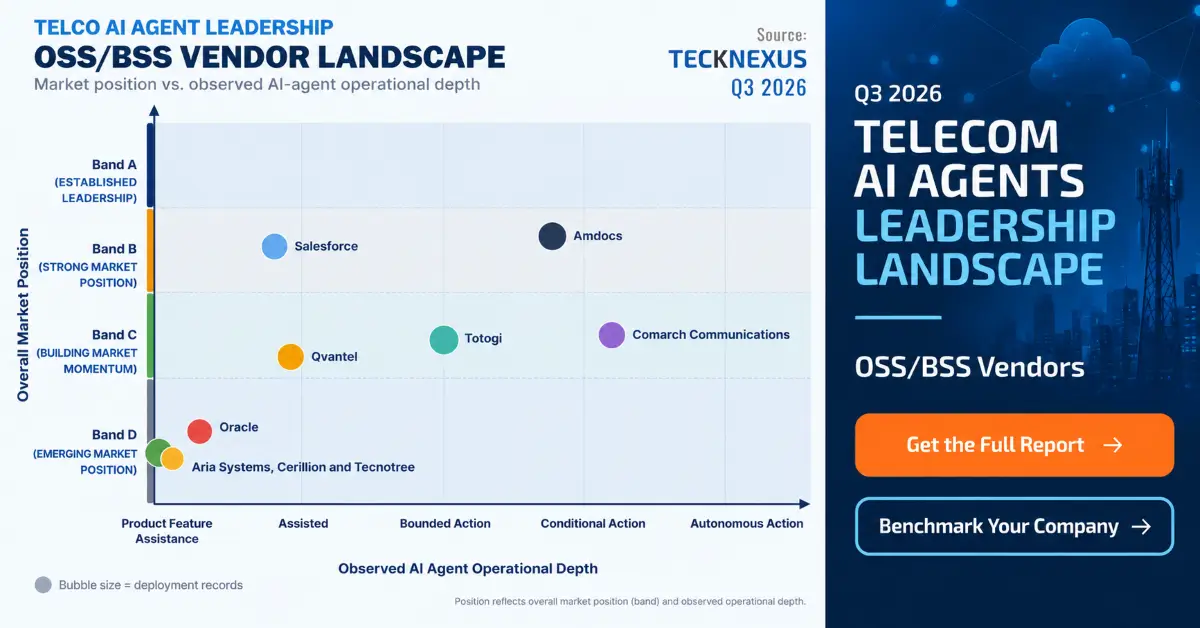
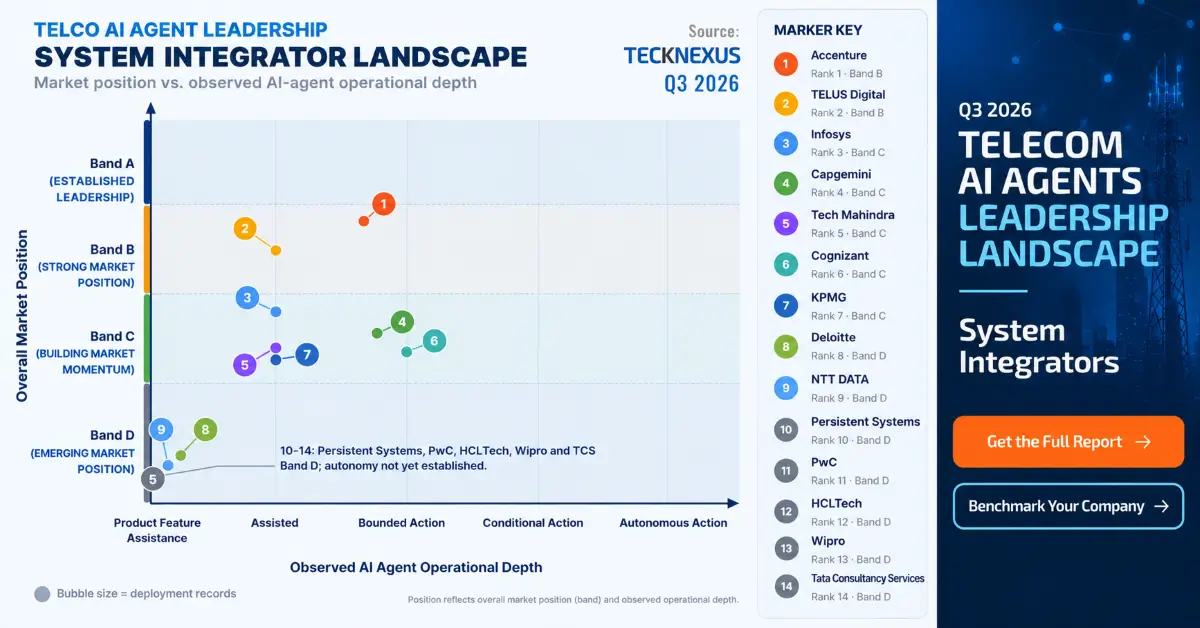
As agent capabilities become a core part of how vendors compete, TeckNexus tracks how network equipment vendors, OSS/BSS vendors and system integrators are positioning in its Telco AI Agent Leadership Landscape reports. The organisations that pull ahead will be those that treat agents as an operational fleet to be governed and measured, not a collection of experiments.
For more insights on advanced connectivity, explore the TeckNexus Monthly Insights, and to share your perspective with our audience and generate qualified leads, partner with TeckNexus through an Intelligence Program.