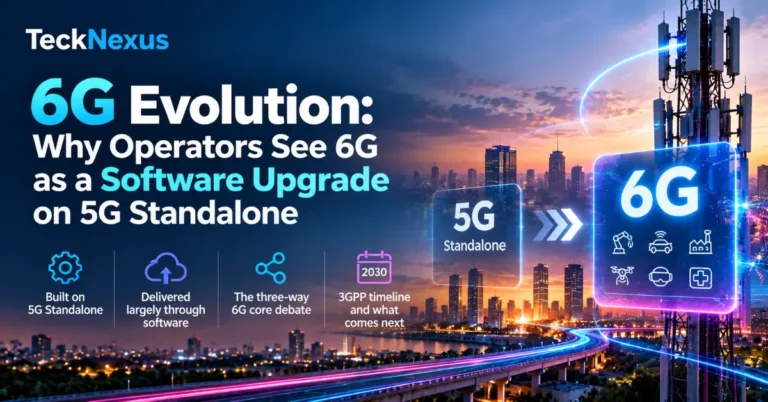
The sixth generation of mobile technology is beginning to look less like a new network and more like a long software release. Through October 2026, operators and vendors on three continents set out strikingly similar positions: protect what has already been built, finish the move to 5G Standalone, and treat 6G as the next step on that path rather than a clean break.

That consensus matters because the design choices being made now in the standards process will decide how much of today’s network spending carries forward into the 2030s. It also exposes a genuine fault line, because not every major player agrees that evolution is the right answer.

The 6G Evolution Consensus Taking Shape
Orange used October to argue against a big-bang shift, urging the industry to extract full value from 5G Standalone and 5G-Advanced before committing to large-scale upgrades, and to tie 6G investment to commercially viable services, sustainable monetisation and efficient use of spectrum. Its list of capabilities to explore, including AI-native networks, integrated sensing and communications, non-terrestrial networks and spectrum sharing, reads as a set of features to layer on rather than a replacement architecture.
In India, Jio set out the most explicit version of the idea during the run-up to its record IPO. Its leadership said the operator intends to deliver 6G as a software upgrade across a footprint of more than 360,000 towers and over one million route kilometres of fibre, building on its in-house network stack and spectrum holdings. Deutsche Telekom added a capital spending angle, signalling that AI-driven uplink traffic is not expected to require additional radio access network investment in the medium term.
The position has also been formalised inside the standards process. Ahead of a 3GPP plenary in September, 17 operators outside China, including the main European and US incumbents, submitted a joint paper describing evolution as the starting point for 6G system architecture and the 5G core as an important foundation for what follows.

Inside the 6G Core Debate: Three Directions for 6G Evolution
The real contest is over the core, the software brain of the network that handles signalling, mobility, sessions and policy. Three broad directions have emerged in standards discussions.
| Direction | Main backers | Role of AI | Implication |
| Evolutionary | Ericsson, Nokia and many European and US stakeholders | Kept in a separate domain alongside an evolved 5G core | Maximum reuse of 5G Standalone investment |
| Embedded | NTT Docomo, Vodafone, Samsung, NEC, LG Electronics | Built into dedicated network functions | Moderate change; a partial merge with Direction 1 is possible |
| Revolutionary | Huawei, ZTE, China Mobile | AI agents integrated deeply into core procedures, with streamlined signal routing | Cleaner design, but a larger break from 5G |
The case for the third direction deserves to be taken seriously. Its supporters argue that removing multi-hop signalling and designing AI in from the start could produce a cleaner, more efficient core. Some analysts compare evolutionary designs to early electric vehicles built on combustion-engine platforms: workable, but eventually overtaken by purpose-built designs. The counter-argument is economic. Operators that invested heavily in 5G, and are still working to monetise features such as network slicing, have little appetite for funding another architectural reset, particularly with the global RAN market expected to stay flat in 2026.
The larger risk is fragmentation. If the camps do not converge, operators could end up with a revolutionary, single-vendor core in China and an evolutionary, multi-vendor core elsewhere, an outcome that would dilute economies of scale for devices, software and roaming. With architecture decisions targeted for November, the coming weeks are decisive.
Why 5G Standalone Is the Real Starting Line for 6G Evolution
An evolutionary 6G only works if the 5G foundation is already in place, and much of the world is not there yet. GSA’s State of the Market report (April 2026) counted 95 operators with commercial 5G Standalone services and found that standalone accounted for 29% of 5G services, with the remainder still running in non-standalone mode on a 4G core.
For operators still on non-standalone, the evolution path compresses two migrations into one decade. Moving to a cloud-native 5G core becomes the prerequisite for any software-led 6G, which is why many in the industry now describe 5G Standalone as the baseline from which 6G will be deployed. For the laggards, 6G planning is effectively 5G Standalone planning.
What a Software-Led 6G Upgrade Can and Cannot Deliver
In the core and much of the management stack, the software upgrade framing is accurate. Cloud-native network functions can be updated, new features introduced through software releases and automation extended without touching the physical estate. A complete 6G service, however, still depends on elements that software cannot supply on its own.
- Reusable through software: cloud-native core functions, orchestration and automation layers, AI-driven operations, policy and charging, and many 5G-Advanced features already standardised.
- Reusable physical assets: tower sites, power, backhaul and fibre, which are typically the most expensive and slowest elements of any network to build.
- Likely to need new hardware: radios and antennas for new 6G spectrum such as the 7 GHz range, the leading US candidate for licensed 6G, where early field trials have relied on radios packing roughly four times the antenna elements of today’s massive MIMO units; baseband capacity for new air interface features; and 6G-capable devices.
- Dependent on regulators: assignments of new spectrum bands, which will set the pace of 6G coverage more than any single software release.
The practical conclusion is that the biggest savings from an evolutionary approach come from reusing sites, fibre and core software, while radio refresh cycles and device ecosystems will still determine when users actually experience 6G.
The 6G Evolution Timeline Operators Are Planning Around
The standards calendar is now firm enough to plan against. 3GPP confirmed the Release 21 timeline at its June 2026 plenary:
- Release 20 6G studies continue through mid-2027, running alongside further 5G-Advanced work.
- March 2027: approval of the 6G work item that defines the scope of the new radio.
- September and December 2028: functional freezes for the physical layer and protocol design.
- March 2029: final freeze completing the first 6G release.
- Around 2030: first commercial 6G systems expected.
Spectrum policy is moving on a parallel track, with US moves to speed up 6G spectrum among the September developments. That leaves roughly four years in which 5G-Advanced releases carry much of the innovation the industry wants, including early integrated sensing, AI-native air interface features and better uplink. In an evolutionary model, those releases are not a holding pattern. They are the first instalments of 6G.
Where 6G Evolution Still Has to Prove Its Value
The weakest link is not technology but revenue. At a 6G industry forum in October, panellists acknowledged that the winning use cases remain uncertain, with close to a thousand proposals submitted to the relevant 3GPP working group. Integrated sensing for drone and vehicle detection drew the most interest, and pilots on existing 5G networks suggest some sensing services can be built well before 6G arrives. Physical AI, covering robots, drones and connected machines that need more uplink and precise positioning, was another favourite, alongside non-terrestrial networks and private 6G for sectors such as utilities that prefer to own their infrastructure.
An evolutionary strategy suits this uncertainty. It lets operators test demand for sensing, positioning and AI-driven services on 5G-Advanced, then scale what works, instead of paying upfront for an architecture whose returns are unproven. The GSMA‘s call this month for closer international cooperation on 6G standards points the same way: a single, gradual global path is cheaper for everyone than competing clean slates.
The Bottom Line on 6G Evolution
The industry is converging on a pragmatic view of 6G: finish 5G Standalone, extract value from 5G-Advanced, and introduce 6G capabilities through software wherever the physical estate allows. The open questions are whether the core debate resolves into one global architecture, and whether services built on this evolving platform generate the returns that 5G struggled to deliver. Both will become clearer once Release 21 work begins in 2027.
For more insights on advanced connectivity, explore the TeckNexus Monthly Insights, and to share your perspective with our audience and generate qualified leads, partner with TeckNexus through an Intelligence Program.