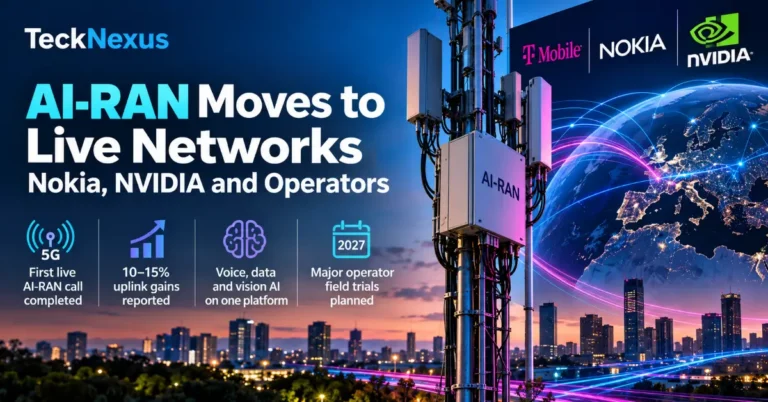
This week supplied a clear answer. At NVIDIA’s GTC event in Berlin, Nokia, NVIDIA and a group of leading operators set out a series of milestones that move AI–RAN firmly into the field. T-Mobile, Nokia and NVIDIA completed what they describe as the world’s first AI–RAN call on a live commercial network. Deutsche Telekom reported measurable throughput gains from AI-based channel estimation. Elisa completed a field trial running voice, data and vision AI on one platform. BT, Deutsche Telekom and SoftBank set out field trials for 2027, and nearly 20 operators worldwide have now announced AI-RAN collaborations built on Nokia’s anyRAN software and NVIDIA’s Aerial RAN Computer (ARC).

Taken together, these announcements do more than add to the list of trials. They show AI-RAN maturing along three tracks at once: as a way to make radio networks more efficient, as a platform for edge AI services, and as an operational model in which AI agents help run the network. Each track has its own milestones, and each will be tested in 2027.
AI-RAN Milestones at a Glance
| Operator | Market | AI-RAN status | Next step |
| T-Mobile | United States | First AI-RAN call on a live commercial network in Bellevue, Washington, using Nokia massive MIMO radio, anyRAN software and ARC servers, connected to a commercial 5G standalone core and smartphone | Further field phases across more spectrum bands and AI inferencing alongside RAN functions |
| Deutsche Telekom | Germany | Lab validation in Bonn and Oulu; AI-based uplink channel estimation delivered typical uplink throughput gains of 10% to 15%, higher in complex radio conditions | Field trials in 2027; physical AI proof of concept with Agile Robots |
| Elisa | Finland | Field trial in Helsinki running voice, mobile data and vision AI together on one accelerated platform over live 5G | Distributed deployment and commercial AI-RAN services in 2027 |
| BT | United Kingdom | Preparing first AI-RAN trial on EE‘s live network | Live trial in Birmingham in 2027 |
| Orange | France | Testing Nokia 5G software on ARC in live networks; distributed voice intelligence using Nemotron Speech | Spectral efficiency and edge service validation in lab and network conditions |
| SoftBank | Japan | Agreement to run Nokia anyRAN on SoftBank’s own AITRAS AI-RAN platform | Commercial field trial under live traffic in 2027 |
The momentum is notable given how recently the partnership began. NVIDIA invested $1 billion in Nokia a year ago, and the two companies set out to bring commercial-grade AI-RAN products into Nokia’s RAN portfolio. As NVIDIA’s Ronnie Vasishta put it, a year or two ago many in the industry would have scoffed at the idea. Nokia’s Chief Technology and AI Officer, Pallavi Mahajan, described the T-Mobile call as a moment from which there is no looking back.
Why the First Live AI-RAN Call Matters
A single call can look like a symbolic milestone. In radio engineering, it is a demanding one. To complete it, the partners had to run a full software-defined RAN on accelerated computing at a commercial cell site, with real spectrum, a production 5G standalone core and an unmodified commercial phone. Nokia describes months of work covering design, staging, site preparation, integration, configuration, testing, optimisation and final system bring-up.
That matters because the hardest questions about AI-RAN were never about whether AI can improve a signal-processing algorithm in simulation. They were about whether a GPU-based platform can meet the strict timing, reliability and integration requirements of a live carrier-grade network. The Bellevue call shows that the platform can carry real traffic in a real network. The next phase, which will explore additional spectrum bands and run AI inferencing alongside RAN functions, will test how far that capability extends.
The path to this point was methodical. T-Mobile opened its AI-RAN Innovation Center in Bellevue in September 2024. Nokia and NVIDIA formed their partnership in 2025, and T-Mobile began working with both on AI-RAN as part of its 6G development. Lab testing of anyRAN on the NVIDIA platform followed in early 2026, and the live call arrived in October. That sequence, from innovation centre to lab to live site, is the template other operators are now following.
The Three Jobs AI-RAN Is Being Asked to Do
Nokia frames its AI-RAN platform around three capabilities. Each corresponds to a different source of value for operators, and the announcements this week included evidence for all three.
| Capability | What it means | Evidence this week |
| AI-led spectral efficiency | AI models embedded in the signal-processing chain for channel estimation, beamforming, multi-user MIMO pairing and scheduling | Deutsche Telekom lab results showing 10% to 15% uplink throughput gains from AI channel estimation |
| Integrated sensing and communications | Using the radio network to detect and locate objects, interference and devices | Nokia demonstration of drone detection; DeepSig spectrum sensing and ZaiNar network-based positioning as dApps |
| Localised inference | Running AI workloads on the same accelerated platform as the RAN, close to users and machines | Elisa running voice, data and vision AI together; Orange voice intelligence and real-time translation; Deutsche Telekom physical AI with Agile Robots |
The spectral efficiency track is the one most directly tied to the operator business case. Spectrum is the most expensive and constrained input in mobile networking, and uplink performance in particular is becoming more important as cameras, sensors, robots and AI devices send more data into the network. Deutsche Telekom’s results are significant because the gains grew as radio conditions became more complex, which is exactly where conventional algorithms struggle most. Arash Ashouriha, SVP Group Technology at Deutsche Telekom, described the lab results as showing potential to improve network performance and efficiency, with field trials as the next step. Nokia’s President of Mobile Infrastructure, Emma Falck, summed up the shift: AI-RAN is moving from research to measurable operator value.
The sensing track is earlier but strategically interesting. Through Nokia’s E3 interface, distributed applications at the network edge get real-time access to RAN data. DeepSig is developing software to identify RF threats, interference and rogue transmitters using existing radio infrastructure. ZaiNar is integrating network-based positioning that requires no changes to devices or radio hardware. These are new services built on infrastructure the operator already owns, and they point towards the sensing capabilities expected to define 6G.
AI-RAN as a Distributed Intelligence Platform
The broader framing from NVIDIA was ambitious. Jensen Huang described telecom networks as having been built to carry the world’s conversations, and said they will now also carry the world’s intelligence. Behind that line is a concrete architectural idea: operators placing accelerated computing in central data centres, metro sites and cell sites, and using it both for the network and for AI services.
Several operators are already building out that model:
- Deutsche Telekom is expanding its Industrial AI Cloud, which hosts open models and serves robotics companies, and is running an ARC MGX 4U system at the network edge to host part of a physical AI use case with Agile Robots.
- Orange is hosting open models as a managed service on its Live Intelligence trusted AI platform and deploying ARC at distributed sites for voice intelligence, including real-time translation for emergency and field-service teams.
- Elisa has deployed ARC at a distributed network location for a voice intelligence enterprise assistant.
- Nine EMEA operators, including TIM, etisalat, CRA, Silknet, Cassava, Kazakhtelecom, Orion Telecom, Fastweb and Vodafone Italia, and Deutsche Telekom, are building or expanding NVIDIA-powered infrastructure, with several focused on sovereign AI.
This is where AI-RAN connects to one of the most important policy themes in Europe and beyond: sovereign AI. Operators already own the sites, power, backhaul and regulatory standing that AI inference at the edge requires. Hosting models within national networks, under local governance, is a natural extension of their role as critical infrastructure providers. Mahajan’s prediction that the distinction between networks and computing infrastructure will blur within a few years describes exactly this convergence.
AI-RAN Platform Flexibility and the Wider Ecosystem
One of the most significant announcements was SoftBank’s. Rather than adopting a single vendor stack, SoftBank will run Nokia’s anyRAN software on AITRAS, its own AI-RAN platform, developed with NVIDIA in 2024. AITRAS combines the ARC platform, built on an NVIDIA Grace CPU, RTX PRO 4500 GPU and ConnectX-8 networking, with the AITRAS Orchestrator, which will coordinate AI and RAN workloads and integrate with Nokia’s MantaRay management software. The trial will run in SoftBank’s commercial network under real traffic in 2027. SoftBank CTO Ryuji Wakikawa described it as a milestone in AI-RAN’s transition from concept to execution.
The significance lies in portability. If RAN software from a major vendor can run on an operator-designed AI platform, AI-RAN begins to look like a genuine cloud architecture, in which operators choose their infrastructure, orchestration and applications independently. The supporting ecosystem reinforces this:
- Server partners Dell Technologies, Quanta Cloud Technology and Supermicro are offering ARC-ready systems, including new MGX 2U and MGX 4U configurations for dense, centralised sites.
- Red Hat is bringing AI-RAN onto a common cloud-native platform with OpenShift.
- Network automation partners, including Cisco, TCS and NTT DATA, alongside Nokia’s own Autonomous Networks Suite, are building telco-specific AI agents using NVIDIA Nemotron models and Agent Toolkit, for fault detection, root cause analysis, site build validation and multilingual support.
That last point broadens the definition of AI-RAN. Operators such as BT are already using Nemotron to build agents that review field-installation photos and flag problems before they cause repeat site visits. AI in the radio and AI in network operations are developing in parallel, and the same infrastructure can support both.
AI in the RAN Is Advancing on More Than One Path
The Nokia and NVIDIA milestones arrived in the same week as another notable result at T-Mobile. Ericsson reported a large-scale commercial trial of AI-managed beamforming on T-Mobile’s 5G-Advanced network in New York, with a model running on Ericsson‘s own RAN compute and silicon. At activated sites during peak hours, T-Mobile saw a 16% improvement in downlink throughput and 12% better spectral efficiency, delivered through software updates to equipment already in the field.
The juxtaposition is instructive rather than competitive. It shows that AI in the RAN is no longer a question of whether, but of how. Two architectural approaches are now producing results on live networks:
| AI on purpose-built RAN silicon | AI-RAN on accelerated computing | |
| Core idea | Embed AI models in RAN compute designed specifically for radio processing | Run the RAN as software on general accelerated computing that can also host other AI workloads |
| Strength | Gains delivered through software updates to the installed base | Shared platform for RAN, edge inference, sensing and agentic services |
| Example this week | AI-managed beamforming on T-Mobile’s network in New York | First AI-RAN call on T-Mobile’s network in Bellevue |
T-Mobile is running milestones with both vendors, and many operators are likely to do the same. For the industry, the choice is less about picking a winner than about matching architecture to deployment scenario. Dense urban sites, centralised RAN hubs, enterprise campuses and sites with clear edge AI demand may favour different approaches.
What AI-RAN Trials Need to Prove in 2027
With field trials set across Europe, Japan and the United States, 2027 will be the year AI-RAN is measured on operator terms. The questions that matter apply to every architecture:
- Spectral efficiency at scale. Lab gains of 10% to 15% need to hold, and ideally grow, under real traffic, real interference and real mobility, and across multiple bands. Nokia has set out an ambition of doubling spectral efficiency over time.
- Utilisation of the compute. The economic case strengthens when accelerated infrastructure carries revenue-generating AI workloads alongside RAN processing, rather than sitting idle outside peak hours.
- Power and site footprint. Operators will need clear data on energy consumption, cooling and space at cell sites and centralised hubs, compared with existing deployments.
- Orchestration. Running AI and RAN workloads on one platform requires that radio performance is always protected. SoftBank’s AITRAS Orchestrator trial is designed to test exactly this.
- Commercial services. Elisa’s plan to launch commercial AI-RAN services in 2027 will be one of the first indicators of how edge AI services are packaged, priced and sold.
- The path to 6G. Sensing, localised inference and AI-native air interfaces are all expected to feature in 6G. Field experience gained now will shape both standards and investment decisions.
What AI-RAN Means for Enterprise and Industrial Networks
Much of the conversation around AI-RAN focuses on public networks, but several of the most compelling use cases are industrial. Deutsche Telekom’s physical AI work with Agile Robots explores how robot perception, coordination and fine-tuning can be split between the device, the network edge and a central AI cloud. SoftBank lists physical AI, robotics and autonomous systems among the use cases it will explore. Network-based positioning and sensing are directly relevant to factories, ports, logistics hubs and airports, where knowing where assets, vehicles and people are is as valuable as connecting them.
For industrial organisations, the important shift is architectural. If connectivity and AI inference can be delivered from the same edge platform, the line between a private network, an operator edge service and an on-premises AI cluster begins to move. Enterprises planning automation programmes for the late 2020s will increasingly evaluate connectivity and compute together rather than as separate procurements.
The Bigger Picture
AI-RAN has crossed an important threshold. A live call on a commercial network, quantified lab gains, a field trial combining network and AI services, a portable software stack running on an operator’s own platform and a dense schedule of 2027 trials together mark the transition from concept to engineering programme. Alongside it, AI models running on purpose-built RAN silicon are delivering gains in the field, confirming that AI is becoming a standard part of how radio networks are built and operated.
The next 12 to 18 months will determine how quickly that becomes commercial reality, and in what form. The operators leading these trials are not only testing a new radio platform. They are testing whether the mobile network can become a distributed intelligence platform, with the cell site as the furthest point of a national AI infrastructure. If the trials deliver, that will change how operators invest, how enterprises consume AI, and how the industry approaches 6G.