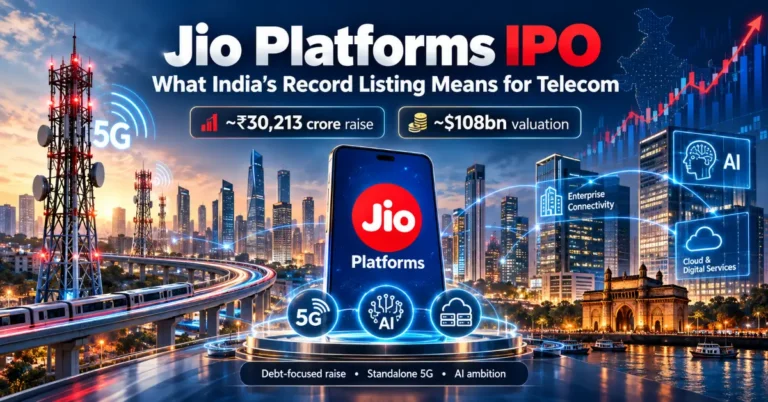
Jio Platforms, the digital and telecom arm of Reliance Industries, has filed its Red Herring Prospectus for what is set to be the largest initial public offering in Indian history. The company plans to raise about ₹30,213 crore (roughly $3.2 billion) through a fresh issue of up to 27 crore shares. At the top of the reported price band of ₹1,065 to ₹1,119, that implies a post-issue valuation of around ₹10.3 lakh crore, or about $108 billion.

The offer is significant for India‘s capital markets. It is just as significant for the telecom industry. Few operators anywhere have gone from launch to more than 500 million subscribers in under a decade, and fewer still have come to market with a standalone 5G network, a converged core running on commercial servers and an explicit plan to turn connectivity scale into an AI platform. How the market prices that combination will be watched well beyond Mumbai.
The Jio Platforms IPO at a Glance
| Item | Detail |
| Issuer | Jio Platforms Limited, a subsidiary of Reliance Industries |
| Issue type | 100% fresh issue of up to 27 crore shares (about 2.9% of post-issue equity); no offer for sale |
| Issue size | About ₹30,213 crore at the upper end of the price band |
| Price band (reported) | ₹1,065 to ₹1,119 per share |
| Implied valuation | About ₹10.3 lakh crore (around $108 billion) at the upper band |
| Reserved portions | Up to ₹2,500 crore for eligible Reliance Industries shareholders; up to ₹500 crore for eligible employees |
| Use of proceeds | Up to ₹27,500 crore to repay or prepay borrowings at Reliance Jio Infocomm; balance for general corporate purposes |
| Key dates | Anchor book 19 October; subscription 21 to 23 October; expected listing on BSE and NSE 28 October 2026 |
| Book-running lead managers | 19 banks, including Kotak Mahindra Capital, Morgan Stanley, BofA Securities, Axis Capital, BNP Paribas and Citigroup |
The issue overtakes Hyundai Motor India‘s share sale of October 2024, previously the country’s largest. The Red Herring Prospectus follows a draft filing in June 2026 and regulatory clearance in late August, almost seven years after a public listing for Jio was first signalled in 2019.
Why the Jio Platforms IPO Is a Balance Sheet Raise
The most distinctive feature of the offer is its structure. Many of India’s largest listings, including Hyundai Motor India and LIC, were offers for sale in which existing shareholders sold stock and the company received nothing. In Jio’s case, no existing shareholder is selling. Every rupee raised goes to the company, and most of it is earmarked for debt reduction at Reliance Jio Infocomm, the telecom operating company.
Up to ₹27,500 crore is set aside to repay or prepay borrowings. Against reported borrowings of about ₹71,500 crore at Reliance Jio Infocomm in March 2026, that would retire well over a third of the operating company’s debt in a single step. Jio’s net leverage has already fallen sharply over the past two years as cash generation has grown, and the IPO accelerates that trajectory.

For a network operator, this matters. Telecom is a business of recurring, lumpy capital spending: spectrum auctions, radio upgrades, core modernisation and, increasingly, data centre and AI infrastructure. An operator that enters its next investment cycle with a lighter debt load and a listed currency of its own has far more flexibility in how it funds 5G Advanced, 6G and the compute buildout that will sit alongside the network.
The cap table also stays intact. Reliance Industries holds about 66.4% before the issue, with Meta at close to 10% and Google at around 7.7%. Global investors including KKR, Silver Lake, Vista Equity Partners, General Atlantic, Mubadala, ADIA and PIF, who backed Jio in its 2020 fundraise, remain on the register. Strategic partners from social media, search and cloud stay invested in the listed company rather than using the IPO as an exit.
The Operating Base Behind the Jio Platforms IPO
The valuation rests on an operating business that has reached genuine continental scale. The figures for the year to March 2026 show how far it has come:
| Metric (FY26) | Figure |
| Total subscribers | 524.4 million, with 36.2 million net additions in the year |
| 5G subscribers | About 268 million |
| Share of India’s wireless data traffic | About 60% |
| Average monthly data use per user | 42.3 GB in the final quarter |
| Revenue from operations | ₹1,46,885 crore, up about 15% year on year |
| EBITDA | ₹76,255 crore, a margin of about 52% |
| Profit after tax | Just over ₹30,000 crore, up about 15% |
Two things stand out. The first is the margin. An EBITDA margin above 50% is unusual for a mass-market mobile operator and reflects the cost advantages of a network built recently, at scale, on a single generation of technology. The second is usage. At over 40 GB per user per month, Indian mobile customers consume far more data than subscribers in most developed markets, which makes Jio’s network one of the most intensively loaded in the world and gives it a large base for future pricing and service upgrades.
Standalone 5G and the Enterprise Case for the Jio Platforms IPO
Jio’s network architecture is one of the reasons the offer is relevant to the wider telecom industry. Jio deployed 5G in standalone mode from the outset, with a combined 4G and 5G core running on commercial off-the-shelf servers and its own cloud-native software. According to coverage of the prospectus, it already operates ten live network slices nationwide.
That architecture is what makes enterprise services possible at scale. Standalone 5G is the foundation for differentiated service levels, network slicing and edge-based applications that industrial and public sector customers increasingly expect. Enterprise digitisation is one of the five priorities Jio’s leadership set out at the June 2026 AGM, alongside 5G migration and 6G contribution, AirFiber expansion, AI for consumers and businesses, and taking Indian technology to international markets.
For enterprises in India, particularly manufacturers, ports, logistics hubs and utilities, a well-capitalised operator with a standalone core and a slicing-ready network widens the menu of options. Dedicated private networks, slices on the public network and hybrid models combining the two can all be considered as Indian industry digitises. Fixed wireless access through AirFiber also extends high-capacity connectivity to sites where fibre is slow or costly to reach.
The AI Ambition Alongside the Jio Platforms IPO
Mukesh Ambani has framed Reliance’s direction in a single line: “India cannot afford to rent intelligence.” Reliance and Jio have committed to invest around ₹10 lakh crore in AI over seven years, including AI data centre capacity at Jamnagar, the JioAICloud platform, and AI services for consumers and businesses across Indian languages.
The IPO is not designed to fund that programme. The proceeds go to telecom debt, while the AI buildout is financed through the wider Reliance balance sheet. That separation is deliberate and useful. Investors are being asked to value a cash-generative connectivity business, with AI as an adjacent growth option, rather than to underwrite a large capital programme whose returns are still ahead.
Strategically, the two are tightly linked. A network carrying around 60% of a country’s wireless data, with hundreds of millions of 5G users, is a natural distribution channel for AI services, from voice assistants to sector applications in agriculture, healthcare and small business. The operator that owns the access network, the edge and the cloud is unusually well placed to deliver AI as a national service rather than as an imported one.
How the Jio Platforms IPO Valuation Reads for Telecom
At around $108 billion, Jio would rank among the most valuable telecom operators in the world. The reported price band sits below several earlier brokerage estimates, which ranged from about $110 billion to well above $140 billion, and below the higher figures discussed when listing plans were first outlined. The pricing reflects a softer period for Indian equities in 2026, and it leaves room for the stock to be valued on its execution once listed.
For the global telecom industry, the more interesting signal is what the market is willing to pay for. The case for Jio is not built on connectivity alone. It rests on scale, a modern standalone network, a strong margin, a deleveraging balance sheet and a credible path into enterprise and AI services. Operators elsewhere that are trying to reposition from utility provider to platform will study how that combination is priced, both at listing and in the quarters that follow.
The competitive landscape is also evolving. Satellite broadband is approaching commercial launch in India, with several providers, including Jio’s own satellite venture, moving through final regulatory clearances. That adds another layer to how connectivity will be delivered across a country of India’s size and geography, and Jio has placed satellite connectivity on its own roadmap.
What to Watch After the Jio Platforms IPO
The timetable is short, and the signals worth tracking extend well beyond listing day:
- Anchor book, 19 October. The depth and mix of global and domestic institutional demand will set the tone for the public offer.
- Subscription, 21 to 23 October. Participation across the institutional, retail and Reliance shareholder portions will show how widely ownership is spread.
- Listing, expected 28 October. Jio becomes a directly traded telecom and digital infrastructure company, separate from its parent.
- ARPU and 5G migration. Average revenue per user and the pace of moving the base to 5G, which Jio targets for the whole subscriber base by 2030, will be the core operating metrics.
- Enterprise and AI revenue. Disclosures on slicing, enterprise connectivity, AirFiber and AI services will show how quickly the platform story converts into reported revenue.
The Bigger Picture
The Jio Platforms IPO is the culmination of one of the fastest network buildouts the industry has seen. It arrives in a form that strengthens the operator rather than rewarding sellers: fresh capital, applied to debt, with every strategic investor staying in. For India, it brings a national connectivity platform into the public markets. For the telecom sector, it offers a live test of how investors value an operator that combines scale, standalone 5G and a serious AI ambition.
For ongoing analysis of telecom, 5G, private networks and AI infrastructure, visit TeckNexus Intelligence at https://tecknexus.com/intelligence/ and https://tecknexus.com/reports/