U.S. 6G spectrum strategy comes into focus
Washington and industry have synchronized timelines and targets to identify, clear, and harmonize the mid-band spectrum that will underpin commercial 6G deployments in the early 2030s.

Policy actions accelerating the 6G spectrum timeline
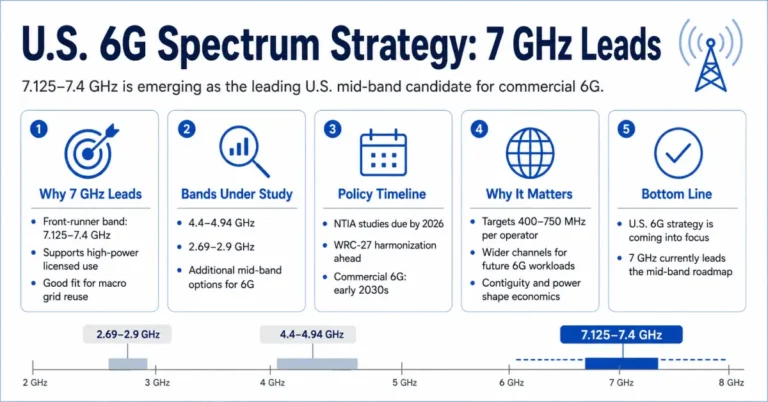
The Administration’s National Security Presidential Memorandum on 6G directs the National Telecommunications and Information Administration (NTIA) to reallocate 7.125–7.4 GHz for full‑power, licensed commercial use and to study federal relocation to 7.4–8.4 GHz where feasible; it also orders immediate feasibility studies in 2.69–2.9 GHz and 4.4–4.94 GHz.

These actions sit alongside the One Big Beautiful Bill Act (restoring FCC auction authority and creating an 800 MHz spectrum pipeline), including an upper C‑band auction mandate by mid‑2027, creating a multi‑band path to contiguous 6G capacity.
NTIA has launched public tracking for band studies and, per remarks from NTIA leadership, is pushing spectrum reconfiguration and efficiency measures, with the 7 GHz study due by year‑end 2026 and funding gated through the Spectrum Relocation Fund process.
In parallel, the State Department is tasked to build coalitions ahead of ITU WRC‑27 (Agenda Item 1.7), signaling a bid for regional alignment on upper‑mid‑band IMT identifications.

Industry coordination on 6G spectrum is maturing
The Next G Alliance Spectrum Working Group has standardized terminology, assessed current utilization, and quantified North American 6G needs, taking into account larger inter‑site distances and varied access models (exclusive licensed, shared, and unlicensed).
Its 2026 workstream is drafting recommendations on access, management, and policy to translate the federal pipeline into deployable 6G channels, complementing the U.S. National Spectrum Strategy.
6G mid-band candidates and rationale
Upper‑mid‑band spectrum is emerging as the global 6G “sweet spot” for wide channels, capacity and practical macro coverage.
7 GHz leads for capacity and macro grid reuse
The 7.125–7.4 GHz range is the U.S. front‑runner for high‑power licensed 6G, with NTIA studying federal relocation to clear contiguous bandwidth and enable 400–750 MHz per operator in a single swath.
Vendors and operators have trialed 6–8 GHz systems, showing macro‑grid reuse comparable to today’s C‑band with strong indoor performance; Nokia reports multiple European and Asia trials and cautions that co‑channel coexistence with Wi‑Fi in the same spectrum can degrade both technologies without strict coordination, reinforcing the case for dedicated, licensed IMT channels.
In the U.S., operators are already probing the band; for example, T‑Mobile received an FCC waiver to test 7 GHz equipment with Nokia to validate propagation and interference assumptions for future systems.
Complementary 4.4–4.94 GHz and 2.69–2.9 GHz under study
To broaden coverage options and ease uplink design, NTIA is evaluating 4.4–4.94 GHz and 2.69–2.9 GHz for possible reallocation; these bands could deliver additional contiguous blocks and better device power efficiency than higher frequencies.
Public NTIA tracking also indicates assessment activities in adjacent lower‑mid‑bands, reflecting pressure to assemble 2–3 GHz of total mid‑band for 6G over the decade.
Business impact for operators and enterprises
The decisions taken in 2026–2027 will set the capacity ceiling, latency profile, and economics of U.S. 6G networks well into the 2030s.
6G workloads demand wider mid-band channels
AI inference on the edge, uplink‑heavy sensing, and immersive XR push beyond the 1–1.2 GHz of low‑ and mid‑band used today; industry estimates point to an additional 2–3 GHz of mid‑band, enabling at least 400–750 MHz contiguous per operator to meet average and peak throughput needs and to cut control‑plane and time‑to‑first‑token latencies.
Upper‑mid‑band (6–8 GHz) hits a balance: big channels for capacity with propagation suitable for reuse of existing macro grids, accelerating time‑to‑service compared to millimeter wave densification.
Contiguity, power, and interference drive 6G economics
Business cases hinge on contiguous spectrum that simplifies radio design and carrier aggregation, licensing that supports high power on macro sites, and clear separation from heavy unlicensed deployments to minimize mutual interference and indoor performance erosion.
Federal relocation is the pacing item; Spectrum Relocation Fund governance (pipeline plans, Technical Panel review, OMB approval, and congressional notification) will determine when agencies can transition, and thus when mobile operators can integrate the band into nationwide plans.
Global 6G alignment ahead of WRC‑27
International momentum around upper‑mid‑bands improves device scale and roaming economics if the U.S. locks its plan soon.
Regions converge on upper 6–8 GHz for IMT‑2030
WRC‑23 set studies across 4.4–15.35 GHz for IMT‑2030 and advanced the upper 6 GHz mobile story; Europe’s RSPG long‑term view points to securing at least ~650 MHz in the upper 6 GHz by 2027, while the Middle East has made early allocations, with the UAE awarding full upper 6 GHz to mobile and Saudi Arabia exploring 7 GHz for IMT around 2030.
China added IMT identification for upper 6 GHz to its national table and Hong Kong completed the world’s first upper‑6 GHz auction, while Brazil is moving to award the full band; Japan’s XGMF and operators are evaluating 7 GHz; India confirmed IMT designation in upper 6 GHz in its updated national plan.
For the U.S., diplomatic engagement tied to WRC‑27 Agenda Item 1.7 will aim to anchor a harmonized 7/8 GHz outcome and to defend high‑power IMT operation.
Next steps for 6G planning
Network planners, vendors, and large enterprises can act ahead of final reallocations to de‑risk timelines and speed commercialization.
Actions for operators and vendors
Begin 7 GHz field trials on representative C‑band macro grids and dense urban clusters to stress‑test uplink budgets, indoor coverage, and mobility with 400–750 MHz channels, and to validate smart repeater or small‑cell fill‑in needs.
Model coexistence with incumbent services and adjacent unlicensed deployments; participate in NTIA and FCC technical working groups to shape protection criteria, power classes, and site‑by‑site coordination frameworks.
Plan RF front‑end roadmaps for 6–8 GHz and 4.4–5 GHz, including Massive MIMO arrays sized for wider bandwidths; align spectrum acquisition strategies to secure contiguous holdings across upper‑mid‑bands.
Guidance for enterprises and the 6G ecosystem
Track U.S. licensing models under discussion (e.g., exclusive macro licenses plus localized sharing for private/neutral‑host), and evaluate campus coverage plans that can migrate from 5G‑Advanced into upper‑mid‑band 6G without forklift upgrades.
Coordinate with chipset and module suppliers on early support for 7 GHz bands to ensure device readiness for pilots around 2028–2030, and assess interference management and indoor radio design given potential Wi‑Fi proximity in the wider 6 GHz range.
The bottom line: with 7.125–7.4 GHz positioned as the lead U.S. 6G band and complementary mid‑bands moving through study, decisions made over the next 18–24 months will determine U.S. 6G leadership, deployment cost curves, and competitiveness—so engagement in standards, policy, and trials should start now.