For any industrial site planning to run AI inference, computer vision, sensor fusion, or agentic monitoring over a private or public 5G connection, this is worth understanding before the next architecture decision gets locked in — because the constraint Ookla identified sits precisely where AI applications are most sensitive to it.

Why AI workloads invert the traffic assumption 5G was built around
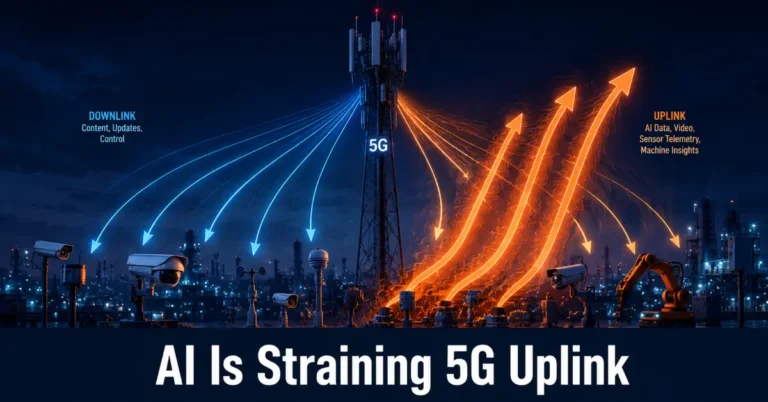
A video stream is a downlink-heavy workload: the network sends a large, continuous flow of data to the device, and the device sends back very little. An AI inference workload running at the edge often looks close to the opposite. A camera performing computer vision uploads continuous or near-continuous image and sensor data to a processing point, and gets back a comparatively small stream of results, alerts, or model outputs. Multiply that pattern across a site full of cameras, sensors, and AI-enabled equipment, and the uplink — the direction most networks were never optimised for — becomes the binding constraint.

Ookla‘s research confirms this isn’t a hypothetical edge case: current 5G deployment patterns are misaligned with mobile AI application requirements, creating capacity and latency constraints that show up specifically on uplink. That’s a structural mismatch between how most networks were planned and what AI workloads actually demand of them, and it’s the kind of gap that doesn’t announce itself until a deployment is already live and struggling to keep pace with the data volume AI applications are trying to push upstream.
Latency isn’t just about distance: what Ookla found on cloud responsiveness
A second, related finding from Ookla’s research complicates the usual shorthand for solving latency problems. The instinct is often “get closer to a data centre,” but Ookla found that cloud latency between users and major hyperscaler data centres — AWS, Google Cloud, Oracle, and Microsoft Azure among them — varies widely by location, with geography, fibre routing, and hyperscaler infrastructure exerting greater influence on responsiveness than population size or the presence of a local data centre.
That finding matters for site selection and connectivity planning in a way that’s easy to miss. Two sites with similar population density and similar proximity to a metro area can have meaningfully different latency to the same hyperscaler region, purely because of how fibre is routed between them and where the actual peering and interconnection points sit. For an AI workload with a genuine latency budget — real-time computer vision, closed-loop robotics control, safety-critical anomaly detection — that variability is a planning input, not a rounding error, and it’s one that a population-based rule of thumb will get wrong.
Three architecture levers that address the uplink and latency gap
Ookla’s research points toward three specific levers worth evaluating for any site planning AI workloads over 5G, rather than treating the uplink constraint as something to discover after deployment:
- 5G SA (Standalone): 5G Standalone architecture decouples the network from 4G anchor dependencies and gives operators and private network owners far more granular control over uplink scheduling and resource allocation — control that’s largely unavailable in non-standalone configurations still tuned around legacy downlink-heavy assumptions.
- Carrier aggregation: Combining multiple frequency carriers, including uplink-specific supplemental carriers where spectrum allows, increases the total uplink capacity available to a site rather than relying on a single carrier sized for downlink-dominant traffic.
- Edge compute placement: Given that fibre routing and hyperscaler proximity matter more than raw distance or population, placing compute closer to where AI inference actually needs to happen — rather than assuming a regional cloud region is close enough — directly addresses both the uplink volume problem and the latency variability Ookla identified.
None of these levers is a universal fix on its own — the right combination depends on spectrum availability, site density, and how latency-sensitive the specific AI workload actually is. But all three point in the same direction: uplink capacity and edge compute placement need to be first-order variables in site architecture planning, evaluated alongside coverage and downlink capacity rather than treated as an afterthought once the rest of the design is set.
The wider backhaul picture: why this isn’t just a radio problem
The uplink and latency pressure Ookla identified at the radio and cloud-connectivity layer is part of a broader pattern industry commentary has flagged this year: AI-driven traffic growth is stressing broadband backbone capacity more generally, with telecom executives calling for accelerated fibre deployment and streamlined permitting to keep pace. That’s a useful reminder that solving the uplink problem at the radio layer only helps if the backhaul and fibre connectivity behind it can actually carry the additional traffic through to wherever the AI workload’s compute or cloud endpoint sits. A site plan that fixes RAN-side uplink capacity but leaves backhaul sized for yesterday’s downlink-heavy traffic profile will simply move the bottleneck one hop further down the network.
Treating uplink as a first-order design variable, not a retrofit
The practical shift this research calls for is straightforward to state and easy to skip in practice: stop sizing radio and backhaul capacity primarily around downlink, and start sizing it around the actual traffic profile of the AI workloads a site intends to run. That means asking, before spectrum and carrier decisions are finalised, how much data cameras, sensors, and AI-enabled equipment will actually push upstream, how latency-sensitive the workload genuinely is, and where the nearest viable compute or cloud endpoint sits once fibre routing — not just distance — is accounted for. Sites that answer those questions during architecture planning avoid discovering the uplink ceiling the hard way, mid-deployment, when reconfiguring spectrum and carrier allocation is a far more disruptive exercise than specifying it correctly the first time.
| Related Tool: Radio Sizing Estimator & AI DCI Bandwidth Planner
Right-sizing a network for AI workloads means treating uplink and latency as first-order inputs, not derived afterthoughts. The TeckNexus Radio Sizing Estimator applies 75 calibrated assumptions across 15 environment types to size coverage and uplink capacity correctly from the outset, while the AI DCI Bandwidth Planner helps quantify the backhaul and interconnect capacity your AI workloads will actually need between site and cloud endpoint. Explore both tools on the TeckNexus Intelligence Platform. |