

What is happening with integrated sensing and communications in 5G networks?
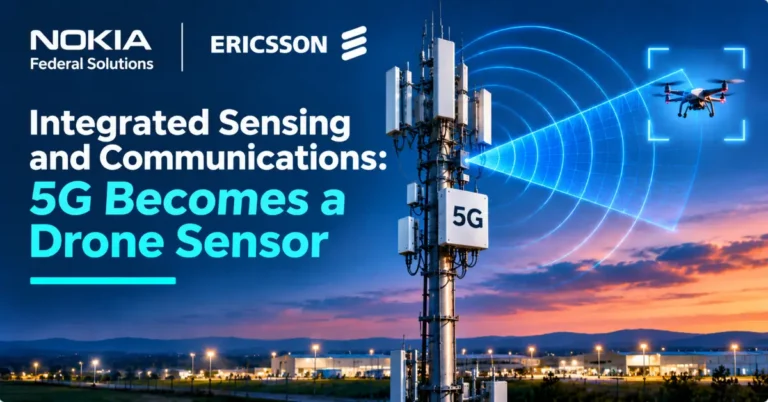
Integrated sensing and communications (ISAC) lets a mobile network detect and track objects, such as drones, using its own radio signals. In November 2026, Nokia Federal Solutions won a US Department of War contract to prototype ISAC on its AI–RAN platform, and Ericsson launched an ISAC System for drone detection on existing 5G infrastructure. Together they mark the shift from 6G research topic to funded prototypes and planned commercial pilots.

Why integrated sensing and communications matters
Mobile networks have always been built to do one job: carry traffic for connected devices. ISAC adds a second job. The same radios that serve subscribers can analyse how their signals bounce off the surrounding environment, which means the network can see objects that carry no SIM card and never connect to it.

That matters for three reasons. First, the infrastructure already exists. Towers, backhaul and licensed spectrum are sunk investments, and sensing gives them a new source of value that does not depend on subscriber growth. Second, there is a clear and urgent problem to solve. Small, low-cost drones fly low and fast over wide areas, which is a difficult profile for conventional air surveillance, and the owners of ports, power plants and other critical sites need wider coverage than a handful of dedicated sensors can provide. Third, the money is arriving from government. Defence funding is now pulling a technology that was pencilled in for 6G into the 5G era.
The combined effect is that sensing is becoming a candidate network service in its own right, with defence, public safety and critical infrastructure as the first customers.
How integrated sensing and communications works in a mobile network
A base station already transmits a constant stream of radio energy. Some of it reflects off objects in the surrounding airspace and returns to the network. ISAC treats those reflections as data. Ericsson’s description of its ISAC System breaks the process into four stages, which offer a useful general model of how network sensing is organised:

- Detect. Sensing-capable radios capture and analyse reflected signals to identify possible objects. The object does not need to be connected to the network or to be transmitting anything.
- Track. Detections from several sites are combined into confirmed tracks, which supports classification of what the object is.
- Integrate. Track data is passed through standardised interfaces to command-and-control and sensor-fusion platforms, where it sits alongside radar, camera and acoustic feeds.
- Manage. A common management platform handles configuration and orchestration of the sensing function across the network.
This is a different geometry from conventional radar, where transmitter and receiver sit together. In a multi-static design the sensing is spread across many sites, so coverage grows with the footprint of the network itself.
The engineering demands are significant, and they explain why ISAC is so closely tied to AI–RAN. A government-sponsored workshop report published by George Mason University in May 2025 lists them: precise clock alignment between sites, separating small targets from urban and terrain clutter, base station designs that were built to cover the ground instead of the sky, and very large volumes of raw signal data that must be reduced quickly at the edge. Accelerated computing in the radio network is the natural place to do that processing.
Integrated sensing and communications in practice: the two November announcements
Nokia Federal’s ISAC prototype contract
On 13 November 2026, Nokia Federal Solutions announced a contract under the Department of War’s RAPID project, short for Real-World Application Prototyping for ISAC Demonstration. The project is managed by the FutureG Office within the Office of the Under Secretary of War for Research and Engineering.
The scope is to develop, build and test ISAC capabilities and then demonstrate an end-to-end solution that uses 5G and future 6G infrastructure for object detection and tracking. The work is built on Nokia’s AI-RAN platform and brings together Nokia and third-party applications for sensing and spectrum threat awareness. It will combine several sensing modalities with sensor fusion to build a fuller picture of unmanned aerial vehicle activity. Nokia Federal’s team includes Texas Tech University, DeepSig, Hidden Level and Future Technologies. The announcement does not disclose a contract value, a timeline or demonstration locations.
The award sits inside a larger programme. On 3 November 2026, the National Spectrum Consortium, working with the FutureG Office, announced eleven RAPID awards totalling more than $50 million, issued through its Spectrum Forward Other Transaction Authority. The FutureG Office describes the selected teams as spanning nearly 30 organisations.
RAPID did not appear from nowhere. The George Mason University report came out of a national ISAC workshop held in April 2025, sponsored by the FutureG Office and the National Science Foundation, with participants that included Nokia’s federal division, Ericsson and Texas Tech University. It found that the United States may be as much as a decade behind other leading countries in deploying ISAC, and it recommended large-scale testbeds, milestone-based funding and an approach of prototyping early and often. Eighteen months later, RAPID is that recommendation in funded form, and several workshop participants are now on award teams.
Ericsson’s ISAC System for drone detection
On 2 November 2026, Ericsson introduced the Ericsson ISAC System, a product that adds sensing to existing mobile networks so they can detect and track moving objects, including drones that are not connected to the network. It combines sensing-capable 5G radios, edge computing, AI and signal processing, and it reuses the towers, backhaul and spectrum already in place.
The design is multi-static: transmission and reception are spread across several geographically separate sites, so an object is observed from more than one angle at once. Ericsson reports that in validated tests the system detected and tracked micro drones at kilometre-scale distances with 3D positioning. The announcement describes these results qualitatively and notes that performance depends on the target, flight profile, terrain and configuration.
Ericsson also lists three demonstrations during 2026: with AT&T in Arlington, Texas, in July, where sensing dashboards displayed multiple drones being detected, located and tracked; with Erillisverkot in Helsinki, where multiple 5G sites detected and tracked drones; and in Poland with Asseco and Play, where ISAC was combined with an acoustic detection system. The company positions the product as a complement to radar, cameras and acoustic sensors, and as a foundation for sensing in future 6G networks.
Integrated sensing and communications status check: facts versus plans
The two announcements mix completed work, reported outcomes and roadmap items. The table separates them and shows where each claim comes from.
| Item | Status | Source type |
| National ISAC workshop report recommending early prototyping | Completed: published May 2025 | Government-sponsored academic report |
| Eleven RAPID awards, more than $50 million in total | Completed: funding awarded, 3 November 2026 | Consortium and government announcement |
| Nokia Federal ISAC prototype on AI-RAN | Contract awarded; development, build, test and demonstration still ahead | Vendor announcement with government statement |
| Ericsson ISAC System | Product introduced, 2 November 2026 | Vendor announcement |
| Micro drone tracking at kilometre-scale distances with 3D positioning | Reported test outcome; no numerical accuracy figures published | Vendor-reported |
| Demonstrations with AT&T, Erillisverkot, and Asseco with Play | Completed trials and demonstrations | Vendor-reported, with partner statements |
| Small-scale, sensing-only commercial pilots | Planned for 2027 | Vendor roadmap |
| Broader-scale deployments | Expected from 2028 | Vendor roadmap |
| 3GPP sensing work | Release 19 requirements published; Release 20 system work under way | Standards body |
How standards bodies and industry alliances are shaping integrated sensing and communications
Products and prototypes are arriving while the standards are still being written. In 3GPP, Release 19 laid the groundwork with service requirements for sensing in TS 22.137 and a study that extended the existing channel models to cover sensing targets and their background environment. Release 20 carries the work into system design, including a Stage 2 specification, TS 23.137, first issued in September 2026.
ETSI is looking further out. Its ISAC Industry Specification Group published a first report on ISAC use cases for 6G, ETSI GR ISC 001, in April 2025. It describes 18 use cases, from human motion recognition and emergency rescue to autonomous vehicle navigation and industrial robotics, and it defines three integration levels and six sensing modes.
Industry alliances are framing the commercial model. A 5G Americas report, Transforming Industries with Integrated Sensing and Communication, published in June 2025, describes sensing as a service: operators exposing location, movement and object-recognition data to enterprises through APIs. It expects further 3GPP advances in Releases 20 and 21.
The contrast is useful. Drone detection is the first application to attract budget, but the standards and alliance work treats sensing as a general capability with industrial, transport and public safety uses. Today’s defence-led projects are likely to be the proving ground for a much wider set of services.
Where integrated sensing and communications could be used beyond drone detection
Drawing the vendor, alliance and standards material together gives a picture of where sensing could be applied. Only the first row has reached demonstration on live networks so far; the others are use cases identified in published reports.
| Sector | Example applications | Maturity |
| Defence and national security | Low-altitude monitoring around bases, borders and sensitive areas | Funded prototypes and vendor demonstrations |
| Critical infrastructure | Airspace awareness at airports, ports and energy facilities | Vendor demonstrations; pilots planned for 2027 |
| Public safety | Monitoring of public venues and transport hubs; emergency response and rescue | Vendor demonstrations; standards use cases |
| Low-altitude economy | Drone traffic management and urban airspace monitoring | Identified use case |
| Transport and smart cities | Traffic management, vehicle navigation support, urban digital twins | Identified use case |
| Industry | Industrial robotics and automation of site operations | Identified use case |
| Healthcare | Fall detection and remote monitoring | Identified use case |
What integrated sensing and communications means for operators, enterprises and technology providers
- Telecom operators: ISAC changes what a cell site is worth. Because multi-static sensing depends on several sites viewing the same airspace, site density and geographic spread become sensing assets as well as coverage assets. Operators will need to decide whether they sell sensing data through APIs, a managed awareness service, or access to the capability for a specialist partner. They will also need governance for data that describes non-subscribers, a privacy and security question that the George Mason University report says current standards do not yet address.
- Enterprises and critical infrastructure owners: Ports, airports, utilities and industrial campuses gain a potential wide-area layer to sit alongside radar, cameras and acoustic systems. Both announcements stress fusion with other sensors, so the practical question is how network sensing feeds into existing security and command systems. Sites that already run private 5G have a natural interest in whether the same network can later host sensing.
- Technology providers: The value chain is broader than radio equipment. Classification models, sensor fusion software, spectrum awareness tools and command-and-control integration all feature in the Nokia Federal team and in Ericsson’s description of standardised interfaces to external systems. That leaves room for specialist software and AI firms.
- The broader market: Government is acting as the anchor customer, which gives vendors a funded route to maturity before commercial demand is proven. It also ties ISAC to AI-RAN, since sensing is a compute-heavy workload that sits naturally at the network edge.
What comes next for integrated sensing and communications
The next 24 months should show whether ISAC can move from demonstrations to an operational service. Four developments are worth tracking:
- RAPID demonstrations. The eleven funded teams, including Nokia Federal, now have to turn awards into working end-to-end prototypes.
- Ericsson’s 2027 pilots. These are planned as small-scale and sensing-only, with broader deployments expected from 2028 and communications capability added as the product evolves toward 6G.
- Published performance data. Quantified detection range, positioning accuracy and classification results from live networks would give buyers a firmer basis for comparison with dedicated sensors.
- Release 20 and regulation. Progress on the 3GPP system specifications, together with national rules on who may operate sensing and how the resulting data is handled, will shape how quickly ISAC spreads beyond defence.
The direction is already visible. A capability that the industry had filed under 6G is being funded, productised and scheduled for commercial pilots on 5G infrastructure, and the networks that carry the world’s traffic are starting to be treated as instruments that can observe it.
For more analysis like this, subscribe to the TeckNexus Newsletter, explore our 2027 programs, or partner with us to share your perspective and generate leads.