

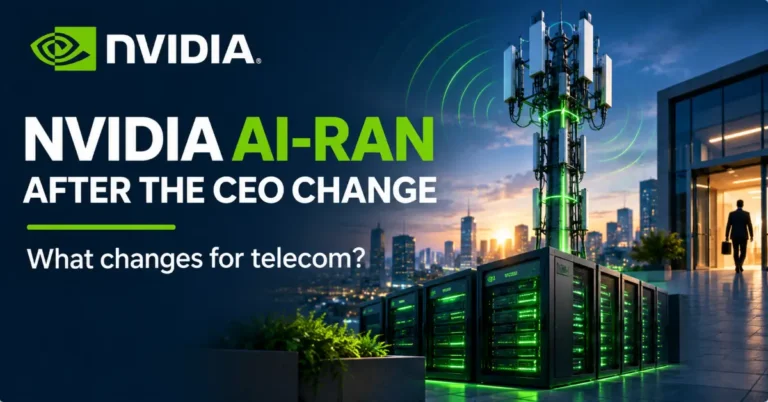
What does Nvidia’s CEO transition mean for telecom’s Nvidia AI-RAN plans?
Nvidia announced on 12 November 2026 that Jensen Huang had resigned as president, CEO and board member. CFO Colette Kress is interim CEO and Harvey C. Jones is the company’s first board chair. For telecom, the change comes three weeks after Nvidia said nearly 20 operators have AI–RAN collaborations using Nokia software on its platforms. Products, partnerships and 2027 trial plans are unchanged. What operators will now watch is how the next permanent CEO prioritises telecom.

Why the Nvidia AI-RAN relationship matters to telecom
AI-RAN moves radio processing onto general-purpose accelerated computing, so the same servers that run the radio access network can also run AI workloads at the edge. For an operator, adopting it is a long-horizon architectural decision, comparable in weight to choosing a radio vendor.
Over the past two years the industry has built three layers of that architecture around one compute supplier:
- Hardware: the Nvidia Aerial RAN Computer (ARC) platform, offered through server partners.
- RAN software: Nokia’s CUDA-accelerated anyRAN software, which runs on that platform.
- Models and agents: Nvidia Nemotron open models, now being built into network automation products.
Telecom is a small line of business for Nvidia when set against hyperscale data centres. Its investment in the sector has therefore reflected strategic intent as much as near-term revenue, and that intent has been closely associated with the company’s founder. This is why a leadership transition matters more to operators here than it would at a supplier whose core business is telecom.
Nvidia AI-RAN and the leadership change: what has been announced
The leadership transition
According to Nvidia’s announcement, the resignation took effect immediately. Colette Kress, CFO since September 2013, has agreed to serve as interim CEO and will keep her finance role until a permanent successor is named. The board has opened a search that will consider internal and external candidates, with no timeline given. Harvey C. Jones, a former chief executive and executive chairman of Synopsys, becomes the first chair in the company’s history.
The statement is built around continuity. The chair said the board expects operations, customer commitments and the product roadmap to carry on without interruption. Nvidia also confirmed that its third-quarter fiscal 2027 results will be reported on 17 November as previously scheduled.
Where Nvidia AI-RAN stood three weeks earlier
The most recent picture of telecom’s commitments comes from Nvidia’s GTC Berlin update on 21 October 2026. It reported that nearly 20 operators worldwide have publicly announced AI-RAN collaborations using Nokia anyRAN software and ARC, and that nine operators across Europe, the Middle East and Africa are building or expanding Nvidia-powered infrastructure.
The headline milestone was T-Mobile‘s completion of what the partners describe as the world’s first AI-RAN call on a live network, at a commercial cell site in Bellevue, Washington, connected to a 5G Standalone core and a commercial smartphone. Nokia’s account of the call says the next phase of field trials will extend to new AI-for-RAN algorithms and to AI workloads running alongside the radio network on shared accelerated computing.
The same update showed model adoption spreading into operations software. Nokia is integrating Nemotron into its Autonomous Networks Suite, and Cisco has fine-tuned Nemotron models for Crosswork AI. Nvidia also introduced two new ARC configurations, MGX 2U and MGX 4U, aimed at centralised RAN sites.
Nvidia AI-RAN status check: completed, in trial and planned
The table separates what has been done from what is scheduled. Operator items are as reported in the Nvidia and Nokia announcements.
| Item | Status | Type |
| CEO resignation, interim CEO and first board chair | Completed, 12 November 2026 | Company announcement |
| Permanent CEO | Search under way; no timeline given | Company announcement |
| T-Mobile AI-RAN call, Bellevue | Completed at one commercial cell site; further field trials to follow | Vendor-reported outcome |
| Elisa AI-RAN field trial | Completed; commercial AI-RAN services targeted for 2027 | Vendor-reported outcome and roadmap |
| Deutsche Telekom | Lab validation completed in Bonn and Oulu; field trials planned for 2027 | Outcome and roadmap |
| BT | Live AI-RAN trials in Birmingham planned for 2027 | Roadmap |
| Orange | Testing Nokia 5G software on ARC in live networks | Ongoing trial |
| Nine EMEA operators’ Nvidia-powered infrastructure | Building or expanding | Ongoing deployment |
| Spectral efficiency gains | A stated trial focus; no figures published in the update | Not yet reported |
| ARC MGX 2U and 4U configurations | Announced; no availability date stated | Roadmap |
What the Nvidia AI-RAN transition means for operators, vendors and enterprises
- Telecom operators: Nothing in the announcement alters contracts, product availability or trial schedules. The 2027 milestones sit with operator and Nokia engineering teams and should proceed on their own timelines. The longer-term variable is roadmap emphasis. AI-RAN depends on sustained investment in telecom-specific software and hardware configurations, so operators will look for an explicit restatement of that commitment from the interim team and, later, from the permanent CEO.
- Network equipment providers: The relationship with Nokia is structural as well as personal. The partnership announced in October 2025 included a $1 billion Nvidia investment in Nokia, and Nokia is the integration point through which most operators reach the platform. That gives the AI-RAN programme an institutional anchor that does not depend on any one executive.
- Enterprises: Services already running on operator infrastructure, such as Deutsche Telekom’s Industrial AI Cloud and Orange’s Live Intelligence platform, are operational offerings with their own contracts. Enterprise customers should see no near-term change.
- The broader market: The appointment of a first board chair signals a shift from founder-led to institution-led governance. For a sector making decade-long infrastructure decisions, a clearly governed supplier with a published roadmap is a sound basis for planning, provided telecom keeps its place in that roadmap.
What comes next for Nvidia AI-RAN
Five developments will show how the transition affects telecom:
- The 17 November earnings call. It is the first scheduled public forum for the interim leadership and an early opportunity to hear how telecom and AI-RAN are described.
- The permanent CEO appointment. The successor’s view of telecom as a distribution network for AI will shape investment beyond the current roadmap.
- The 2027 trial calendar. Deutsche Telekom’s field trials, BT’s Birmingham trials, Elisa’s commercial services and T-Mobile’s next trial phase are the practical test of momentum.
- Published performance data. Measured spectral efficiency, energy use and cost per site from live networks will matter more to operator business cases than any leadership statement.
- Roadmap communication at the major industry events of early 2027, where operators will expect an updated view of platform availability.
The near-term message for telecom is continuity. The trials, products and partnerships that defined AI-RAN in October are all still in place in November. What has changed is that the industry’s case for building radio networks on accelerated computing now has to stand on results and institutional commitment, which is where a technology at this stage needs to be heading in any case.
For more analysis like this, subscribe to the TeckNexus Newsletter, explore our 2027 programs, or partner with us to share your perspective and generate leads.