At a glance – Digital Infrastructure Insights for August 2026
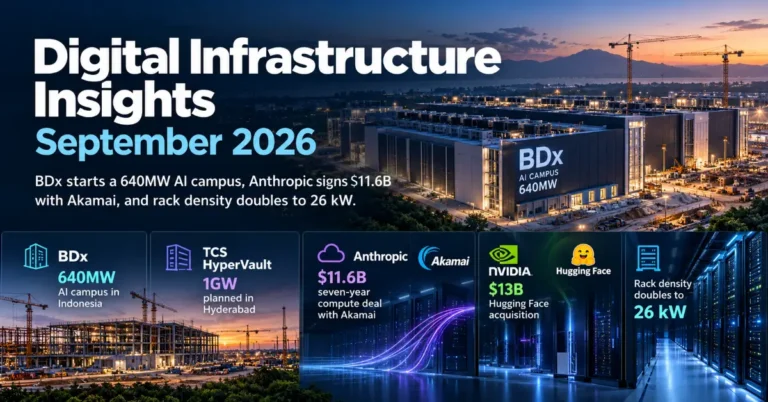
- Hyperscale AI data centre capacity kept expanding: Microsoft launched its fourth India cloud region in Hyderabad, and SK Telecom‘s SK Hyper unit is targeting 5GW of capacity by 2029 and 15GW by 2035.
- The custom silicon race widened and consolidated: OpenAI published benchmarks for its Jalapeno inference chip against Nvidia‘s GB300, and Nvidia reportedly agreed to acquire Hugging Face for $12.9 billion.
- AI compute financing reached unprecedented scale: Nvidia formed $500B+ financing platforms with Apollo, BlackRock, Blackstone, Brookfield, Goldman Sachs, and KKR to fund frontier AI infrastructure.
- Interconnect and fiber capacity emerged as a distinct investment category: Relativity Networks raised $22M and secured a $40M hyperscaler order for hollow-core fiber.
- Chip manufacturing became a live geopolitical contest: India launched a country-wide semiconductor scheme, while the US countered a Huawei-proposed 2,008-chip AI data centre bid in Egypt.
- Physical AI infrastructure pushed into space and the factory floor: SpaceX committed $16.8B to a Texas chip fab en route to orbital AI data centers, and SK hynix and Samsung began applying AI agents directly to chipmaking.
1. Hyperscalers and operators keep building AI data centre capacity
Hyperscale and telecom-operator AI data centre capacity kept expanding this month, with capital commitments now measured in the tens of billions.

- Microsoft: commissioned a new data centre in Hyderabad, activating its fourth India cloud region alongside Pune, Chennai, and Mumbai. Designed for AI workloads and sovereign cloud requirements, the Hyderabad region is planned with three availability zones and is positioned as Microsoft’s largest hyperscale region in India, part of a $20B+ India commitment including $17.5B allocated for 2026 to 2029.
- SK Telecom: under its SK Horizon AI initiative, is building SK Hyper, a dedicated AI data centre unit targeting 5GW of capacity by 2029 and 15GW by 2035, backed by a 750 billion won investment through 2030. SK Telecom is co-developing a data centre in Ulsan with AWS and aligning group capabilities across SK Hynix and SK Broadband; technically, it is integrating an Arm AGI CPU with Rebellions’ AI inference accelerator on a common server platform, and developing a CXL-based architecture with Panmnesia to pool CPU/GPU/memory resources, with Supermicro and Schneider Electric supporting power and cooling.
- KT & LG Uplus: are both reallocating capital from saturated mobile services toward AI infrastructure: KT is expected to reintegrate its spun-off KT Cloud under a reported $12.6B investment plan to become an AX platform company, while LG Uplus is committing nearly $1B in additional capex to expand AI data centre capacity.
- Anthropic: formed a strategic partnership with Macquarie Asset Management and GIC to develop AI computing sites in the United States via the Theseus Infrastructure platform — Macquarie and GIC will fund most project equity, while Anthropic leases the facilities long term and assumes exposure to consumer electricity price increases linked to the sites.
Why it matters for buyers: telecom operators building 5GW-plus AI data centre roadmaps, alongside a frontier AI lab structuring long-term leases rather than owning capacity outright, are two different capital strategies for the same underlying constraint: AI compute demand is outrunning available capacity, and financing structure is becoming as important as the build itself. → Model data centre capex and lease-vs-own economics with TeckNexus ROI/TCO calculators.
2. The custom silicon race accelerates — and consolidates
Custom silicon activity intensified on two fronts this month: AI labs and hyperscalers pushing further into chip design themselves, and Nvidia moving to consolidate adjacent parts of the AI stack.
- Marvell Technology & Google: expanded their custom chip development collaboration; Google issued a warrant granting the right to purchase up to 58.97 million Marvell shares at $206.58 per share, exercisable until August 2033, valued at $12.2 billion and tied to the expanded partnership.
- OpenAI: published benchmark data for its Jalapeno custom inference chip, co-developed with Broadcom, indicating higher speed and power efficiency than Nvidia’s Blackwell Ultra-based GB300 — reported package power of 700W versus 1,400W for GB300, using SemiAnalysis’s InferenceX end-to-end benchmark.
- Anthropic: confirmed formation of an internal silicon design team to develop custom AI chips co-designed with its Claude model, targeting faster and more efficient operation at customer scale.
- Nvidia: is reportedly in early talks with South Korea’s Rebellions on a technical partnership, equity investment, or acquisition, according to Bloomberg — no terms disclosed. Separately, Nvidia has agreed to acquire open-source AI platform Hugging Face for approximately $12.9 billion, gaining control of a large repository of AI models and datasets, according to The Information; Hugging Face’s annualised revenue is cited at around $150 million.
- GCT Semiconductor: advanced development and certification of 4G/5G chipsets enabling direct-to-device and hybrid satellite-cellular connectivity, working with Globalstar and another satellite provider; it also licensed chipsets to a satellite communications provider, partnered with Skylo on joint chip/module certification for satellite fallback, and signed a reference-platform supply agreement.
Why it matters for buyers: three AI labs now designing their own silicon (OpenAI, Anthropic, and implicitly Google via Marvell) is a meaningfully different competitive landscape than one where Nvidia is the default choice — and a reported Hugging Face acquisition would extend Nvidia’s reach from chips into the model and dataset layer itself. → Compare silicon and vendor options against your own workload profile with the TeckNexus Technology Selector.
3. AI compute financing reaches unprecedented scale
The capital structures behind AI infrastructure grew more elaborate this month, with financing platforms now operating at a scale that rivals the infrastructure spend itself.
- Nvidia: signed memorandums of understanding with Apollo, BlackRock, Blackstone, Brookfield, Goldman Sachs, and KKR to establish global AI compute infrastructure financing platforms aimed at mobilising more than $500 billion in third-party capital to fund frontier AI laboratories, cloud providers, and enterprises.
- Micron Technology: established Micron Research Labs in Boise, Idaho, committing $10 billion over ten years to advance memory and compute technology for AI, convening customers, academia, government, and start-ups to pursue innovations beyond current technology roadmaps, with a focus on critical memory technologies.
- Velaura AI: raised $110 million in Series A financing led by Seligman Ventures, valuing the chip designer at over $1 billion; funds will accelerate development of low-power AI data centre chips and its Titan Core chip design platform, and expand software for data centre and physical AI workloads.
Why it matters for buyers: Nvidia structuring itself as a financing intermediary — not just a chip vendor — for over half a trillion dollars in AI infrastructure capital is a signal that access to compute may increasingly run through Nvidia-orchestrated capital as much as through direct purchase. → Score financing and vendor-lock-in risk with the TeckNexus RFP Scorecard Generator.
4. Interconnect and fiber capacity becomes the new bottleneck
As compute capacity scales, the networks connecting it are drawing direct hyperscaler investment this month.
- Relativity Networks: closed a $22 million funding round with investors including Rhapsody Venture Partners, Bell Ventures, and Faster Than Glass LLC, and received a $40 million purchase order from an unnamed hyperscaler for hollow-core fiber.
- IBM: signed a $240 million agreement to provide AI-optimised cloud infrastructure capacity to Together AI.
Why it matters for buyers: a hyperscaler placing a direct, named purchase order for a next-generation fiber technology — rather than buying through an established supplier — suggests interconnect capacity is becoming a strategic bottleneck worth securing early, not just a commodity input. → Plan interconnect and fiber capacity requirements with TeckNexus Network Planning tools.
5. Chip manufacturing policy and trade competition intensify
Chip manufacturing became a more explicit arena for national policy and geopolitical competition this month.
- Government of India: launched a country-wide semiconductor scheme spanning six segments: chip design by Indian firms, capital equipment manufacturing units, semiconductor fabs, and assembly, packaging, and testing capabilities.
- Nvidia, AMD & Microsoft: are being engaged by the US State Department to form a competing offer for Egypt’s national AI infrastructure, countering a Huawei-proposed government AI data centre using 2,008 Ascend accelerators (1,408 Ascend 950-series for training and roughly 600 additional Ascend chips for inference) on a 12-month build schedule.
- Asia-Pacific governments: have implemented resource caps and efficiency measures — limiting energy and water use for data centres — reducing the likelihood of the kind of public and political pushback against AI-related facilities seen in the US.
Why it matters for buyers: a US-backed rival bid specifically countering a Huawei AI data centre proposal in Egypt shows chip supply chains are now a direct instrument of state competition, not just a commercial decision — worth factoring into any multi-country infrastructure planning. → Score geopolitical and supply-chain risk in vendor selection with the TeckNexus RFP Scorecard Generator.
6. Physical AI infrastructure pushes into space and the factory floor
AI infrastructure investment kept extending beyond the data centre this month — into orbit, and directly onto chipmaking production lines.
- SpaceX: is advancing an evolving infrastructure story: Elon Musk indicated the company intends to build AI chips at scale for both terrestrial and space deployments; SpaceX subsequently outlined the first phase of its Terafab project, committing over $16.8 billion to a Texas semiconductor fabrication facility supported by a $30 million Texas Enterprise Fund grant and projected to create 3,000 jobs; and Musk further stated SpaceX will begin deploying orbital AI data centers in Q4 2027 using a design powered by Nvidia chips, reaching significant scale in 2028.
- Qualcomm: is establishing the Qualcomm Japan Robotics Center to collaborate with Japanese technology companies on robotics and industrial automation, with a focus on open ecosystems and edge AI R&D.
- SK hynix & Samsung: are operationalising AI agents directly in semiconductor manufacturing workflows: SK hynix is piloting agent-based automation in back-end manufacturing (assembly, packaging, and test), while Samsung reports reducing SoC verification cycles to two days using AI-driven verification agents integrated with its EDA flows.
Why it matters for buyers: SpaceX’s chip-to-fab-to-orbit trajectory and Samsung’s two-day verification cycle both point at the same trend — physical AI infrastructure is no longer confined to conventional data centres, and the manufacturing processes that build AI hardware are themselves being automated by AI. → Evaluate emerging infrastructure vendor categories with the TeckNexus Technology Selector.
What Digital Infrastructure Insights for August 2026 means if you’re planning AI infrastructure investment
August’s throughline is capital structure becoming as strategically important as the physical infrastructure itself — financing platforms, custom silicon bets, and lease-vs-own decisions are now first-order questions, not implementation details. Six moves follow directly from the month:
- Treat compute financing structure as a vendor-lock-in question — Nvidia’s $500B+ financing platforms and Anthropic’s Theseus lease structure both show capital access increasingly running through specific intermediaries.
- Benchmark custom silicon claims against published, third-party benchmarks — OpenAI’s Jalapeno-vs-GB300 comparison used an independent test suite (SemiAnalysis’s InferenceX), a useful bar for evaluating other vendor performance claims.
- Watch interconnect and fiber capacity as a distinct line item, not a bundled cost — a hyperscaler placing a direct, named order for hollow-core fiber suggests early capacity-securing is now a competitive move.
- Factor geopolitical supply-chain risk into any multi-country infrastructure plan — the Egypt AI data centre contest between US and Chinese vendors is unlikely to be an isolated case.
- Consider resource constraints (energy, water) early in site selection — Asia-Pacific’s regulatory approach may be a preview of requirements elsewhere.
- Track AI-agent adoption inside your own supply chain, not just in customer-facing operations — SK hynix and Samsung applying agents to chipmaking itself is a leading indicator for where agentic AI delivers measurable operational gains.
For more on telecom operators entering the compute-provider role directly, see TeckNexus’s “When Your Connectivity Provider Becomes Your Compute Provider”, and our companion AI & Automation Insights, August 2026 and Advanced Connectivity Insights, August 2026 for this month’s related coverage.
Catching up? Last month’s signal is here: Chip Manufacturing Capital Hits Record Scale as SK hynix Debuts on Nasdaq: Digital Infrastructure Insights, July 2026 →
→ Start with the TeckNexus Intelligence Platform — independent, buyer-neutral tools for ROI, TCO, network planning, and RFP decisions.
This analysis is drawn from TeckNexus’s full curated Digital Infrastructure Monthly Insights for August 2026. See every deal, product, and partnership update →
The TeckNexus Intelligence Platform is buyer-neutral and TeckNexus-authored. Vendor co-branded Intelligence Packs are labelled as such and kept separate from the neutral core tools.