

Intelligence Journeys
AI Use Cases for Utilities
Private Broadband for Utilities

Globalstar

Telecom operators cutting headcount while pouring capital into AI infrastructure, and chipmakers financing fabs at infrastructure scale, are two sides of the same reallocation. TeckNexus traces the connections across SK Telecom, KT, LG Uplus, T-Mobile, AT&T, Verizon, Nvidia, SK hynix, and SpaceX to show how the AI buildout has become the organising logic the telecom and semiconductor industries are restructuring around.
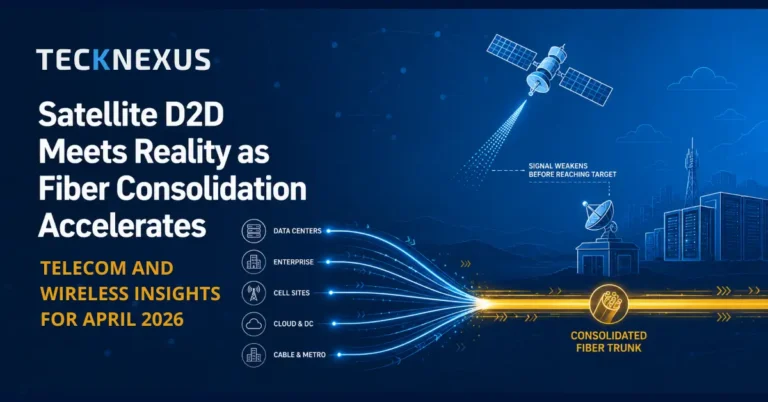
T-Mobile CEO Srini Gopalan admitted during Q1 2026 earnings that its T-Satellite direct-to-device service is seeing far less usage than projected, largely because T-Mobile's terrestrial network leaves few coverage gaps for consumers. With 1.8 million free beta sign-ups failing to translate into strong paid engagement, and Apple's free Globalstar satellite messaging compressing the addressable market, T-Mobile is pivoting toward enterprise connectivity. Its new SuperBroadband offering pairs 5G with Starlink LEO broadband, targeting businesses in healthcare, retail, and energy that require resilient, always-on connectivity across distributed locations.
Amazon will acquire Globalstar to accelerate Amazon Leo’s direct-to-device (D2D) roadmap, secure midband MSS spectrum, and extend satellite coverage to smartphones and IoT beyond terrestrial reach. Amazon is acquiring Globalstar in a cash-and-stock deal valued at roughly $11.5 billion, with Globalstar shareholders able to elect $90 per share in cash or Amazon stock subject to a cash cap and proration. Closing is targeted after regulatory approvals and satellite milestones, with Amazon guiding to 2027. Amazon plans to deploy a next-generation D2D system starting in 2028, delivering voice, messaging, and data to unmodified mobile devices.
Boingo Wireless is integrating Globalstar’s XCOM RAN to accelerate private 5G across airports, stadiums, hospitals, convention centers, transit hubs, and military bases. Globalstar said Boingo will add XCOM RAN, a software-defined private 5G platform built around the Supercell architecture, to its private network portfolio. A highlighted approach is overlaying XCOM RAN on existing distributed antenna system (DAS) infrastructure to preserve DAS coverage advantages while boosting capacity and performance. Enterprises are moving beyond pilot projects to operational private 5G in high-traffic, RF-challenged environments. This aligns with rising demand for low-latency, secure connectivity for IoT, video, automation, and mission-critical operations.
BlueBird 7 is slated to lift off in late February from Launch Complex 36 at Cape Canaveral Space Force Station on the New Glenn-3 mission. It is AST SpaceMobile’s first payload on New Glenn and the second satellite in its next-generation “Block 2” campaign, following BlueBird 6. BlueBird 7 mirrors BlueBird 6 and carries a deployable array of about 2,400 square feet—the company positions it as the largest commercial communications aperture in low Earth orbit. The design, backed by thousands of patent and patent-pending claims, is engineered to deliver peak downlink rates up to 120 Mbps directly to standard, unmodified devices for voice, data, and video.
New consumer research commissioned by Viasat and executed by GSMA Intelligence signals that non-terrestrial networks (NTN) are becoming a mainstream buying factor for mobile subscribers. The survey of more than 12,000 smartphone users across 12 countries finds persistent coverage gaps: over a third of respondents lose basic cellular service multiple times per month. That pain point is translating into intent. Roughly six in ten consumers say they would pay extra for satellite-enabled connectivity on their phones, and nearly half indicate they would switch operators if out‑of‑coverage service were included in their plan. On average, those willing to pay would accept a 5–7% uplift on their current monthly bill, with outliers such as India approaching a 9% premium.
Virgin Media O2 has struck a multi‑year agreement with Starlink Direct to Cell to deliver satellite‑to‑mobile service across rural UK not‑spots, positioning O2 as the first British operator to integrate Starlink’s constellation with licensed mobile spectrum. Branded as O2 Satellite, the service will initially support messaging and basic data on existing smartphones when users move beyond terrestrial signal. O2 is targeting landmass coverage beyond 95% within a year of launch, using Starlink’s 650+ low‑Earth orbit satellites to act as “cell sites in space.” Customer rollout is planned for early 2026, with pricing to follow and an extra monthly fee anticipated.
New usage data shows AT&T subscribers are tapping into T-Mobile’s Starlink-powered T-Satellite more than expected, signaling a rapid shift in how carriers and customers think about direct-to-device connectivity. Speedtest intelligence indicates T-Mobile users account for the majority of direct-to-device (D2D) connections to Starlink, roughly six in ten overall and more than seven in ten among devices reporting active service at connection time. The surprise is AT&T’s footprint: about a third of observed connections come from AT&T subscribers, while Verizon’s share is minimal.
EchoStar has reset its strategy after regulator-driven spectrum sales, trading long-cycle infrastructure bets for an asset-light, capital-rich posture focused on satcom growth. Federal Communications Commission scrutiny over spectrum utilization forced EchoStar to accelerate decisions it had hoped to phase over time. Complaints from rivals spurred investigations into whether the company was meeting buildout and use obligations. Even if EchoStar prevailed in court, the process risked tying up key licenses and stalling its direct-to-device (D2D) ambitions. The company opted to monetize holdings and remove uncertainty rather than fight a prolonged, value-destructive battle.
SpaceX’s $17 billion purchase of EchoStar spectrum signals a deliberate push to blend satellite and mobile connectivity at consumer scale. SpaceX is acquiring EchoStar’s AWS-4 and H-Block licenses, adding roughly 1.9–2.0 GHz spectrum into its portfolio for direct-to-device (D2D) service in the U.S. Owning licensed spectrum lets SpaceX widen capabilities beyond roaming-style add-ons, potentially toward a branded service that spans home broadband and handset connectivity. A two-year window for first compatible handsets is a realistic baseline. Analysts broadly expect Starlink to expand via partnerships: wholesale arrangements to MNOs for satellite fallback, and potentially an MVNO to bring a Starlink-branded phone plan to market.
Dive into our in-depth coverage of MWC 2025, highlighting the latest innovations in 5G, AI, IoT, and more. Discover how industry leaders are shaping the future of technology with groundbreaking announcements and developments unveiled during the event.

Partner Hubs

Download content, access intelligence tools, and hear from executives.

Partner Events

  • M360 ASEAN
  • FutureNet Asia 2026
  • Network X Vienna 2026
Scroll to Top