Intelligence Journeys
AI Use Cases for Utilities
Private Broadband for Utilities

Viasat

July 2026's roundup: Hughes Network Systems nears bankruptcy as SpaceX files to launch 100,000 satellites, Nokia's AI-RAN commercial deployments trail Ericsson's 15+ by a full order of magnitude, the FCC finalizes a $6.3B C-band incentive package and closes AT&T's $23B EchoStar spectrum deal, and fiber capital and industrial 5G both keep expanding globally.
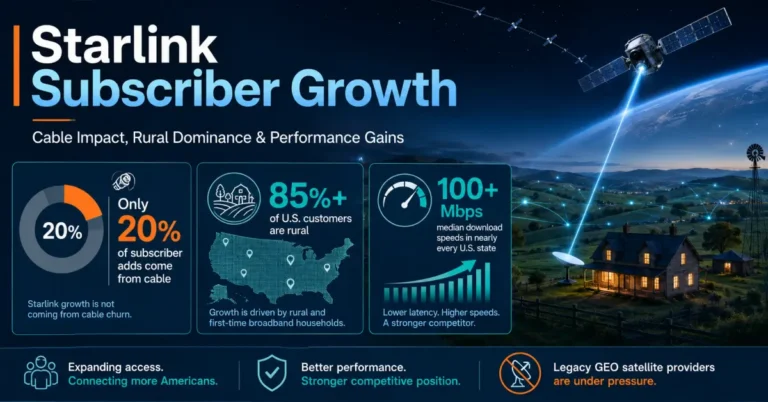
New research from New Street Research and Recon Analytics reveals that despite cable controlling roughly 60% of the US broadband market, only about 20% of Starlink's gross subscriber additions come from cable defectors. More than 85% of Starlink's US customer base is located in rural areas, and a significant share of its growth comes from first-time broadband subscribers. Meanwhile, Starlink's median download speeds now exceed 100 Mbps in nearly every US state, fundamentally shifting its competitive standing in the satellite and terrestrial broadband landscape.
New consumer research commissioned by Viasat and executed by GSMA Intelligence signals that non-terrestrial networks (NTN) are becoming a mainstream buying factor for mobile subscribers. The survey of more than 12,000 smartphone users across 12 countries finds persistent coverage gaps: over a third of respondents lose basic cellular service multiple times per month. That pain point is translating into intent. Roughly six in ten consumers say they would pay extra for satellite-enabled connectivity on their phones, and nearly half indicate they would switch operators if out‑of‑coverage service were included in their plan. On average, those willing to pay would accept a 5–7% uplift on their current monthly bill, with outliers such as India approaching a 9% premium.
A new joint plan from Vodafone and AST SpaceMobile aims to deliver satellite broadband directly to standard smartphones across Europe under a sovereign operational model. AST SpaceMobile has submitted plans through Germany for a space-based network designed to provide broadband directly to devices across Europe. Operations would run through SatCo, a Luxembourg-based joint venture with Vodafone announced earlier this year. The timing aligns with looming European spectrum decisions and intensifying competition in direct-to-device (D2D). S-band at 2 GHz is up for renewal across the region in 2027, and 700 MHz public protection and disaster relief (PPDR) frequencies are central to resilient communications strategy.
New usage data shows AT&T subscribers are tapping into T-Mobile’s Starlink-powered T-Satellite more than expected, signaling a rapid shift in how carriers and customers think about direct-to-device connectivity. Speedtest intelligence indicates T-Mobile users account for the majority of direct-to-device (D2D) connections to Starlink, roughly six in ten overall and more than seven in ten among devices reporting active service at connection time. The surprise is AT&T’s footprint: about a third of observed connections come from AT&T subscribers, while Verizon’s share is minimal.
Space42 and Viasat plan to form Equatys, a joint venture designed to deliver standards-based Direct-to-Device (D2D) connectivity to smartphones and IoT devices over a unified satellite–terrestrial network. The partners intend to launch a 3GPP Non-Terrestrial Network (NTN) platform that integrates with 5G networks and works with unmodified handsets and IoT modules. The companies say Equatys will aggregate well over 100 MHz of harmonized Mobile Satellite Services (MSS) spectrum already assigned across more than 160 markets, describing it as the largest coordinated block available for this purpose. Equatys positions itself as a neutral “space tower” operator that multiple licensed service providers can share.
Alaska Air Groups move to deploy SpaceX Starlink across Alaska Airlines and Hawaiian Airlines by 2027 signals a decisive pivot to low-latency, LEO-based inflight connectivity for U.S. carriers. Inflight WiFi has moved from perk to productivity platform, and latency not just bandwidth now defines user experience for video conferences, collaboration tools, and gaming. By standardizing on Starlink's low Earth orbit (LEO) network, Alaska is targeting ground-like performance gate-to-gate across regional, narrowbody, and widebody fleets. Alaska cites sub-100 ms latency and up to 500 Mbps per aircraft, enabling real-time messaging, cloud apps, and streaming on multiple devices without gating performance to a handful of users.

The FCC has launched a formal review to modernize its satellite spectrum sharing rules, addressing outdated EPFD limits and enabling more efficient broadband delivery. The proposed changes target the 10.7-12.7 GHz, 17.3-18.6 GHz, and 19.7-20.2 GHz bands, and follow calls from industry leaders like SpaceX for reforms that support next-generation satellite networks. The initiative is expected to enhance competition and fuel U.S. leadership in space innovation.
This edition dives into the evolving world of satellite technology and its synergy with modern communication networks, highlighting key developments and challenges. Seraphim opens the discussion with a detailed look at the global race in satellite connectivity, emphasizing its impact on the mobile phone industry. Astrocast then explores the economic aspects of Satellite IoT, underlining its growing importance in global connectivity.

Partner Hubs

Download content, access intelligence tools, and hear from executives.

Partner Events

  • M360 ASEAN
  • FutureNet Asia 2026
  • Network X Vienna 2026
Scroll to Top