Starlink Subscriber Growth: Unpacking the Real Data Behind the Numbers
New research from New Street Research and Recon Analytics offers a more nuanced picture of Starlink‘s competitive footprint than the headlines suggest — and for telecom strategists, the details matter more than the top-line narrative.

Why Cable Operators Are Not Starlink’s Primary Competitive Target
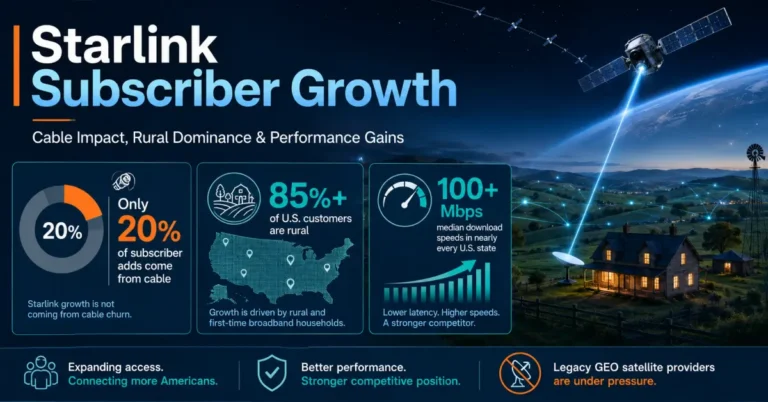
Despite controlling roughly 60% of the US broadband market, incumbent cable operators are contributing only about 20% of Starlink’s gross subscriber additions, according to New Street Research analysis based on Recon Analytics survey data. That figure is disproportionately low given cable’s market dominance. By comparison, cable accounts for approximately half of all broadband switchers across the industry at large.

The explanation is straightforward: customers with reliable access to wired broadband — whether cable, fiber, or even decent DSL — have limited incentive to switch to a service that still carries higher hardware costs, latency trade-offs, and variable performance in dense environments. Starlink’s value proposition remains strongest where terrestrial alternatives are weakest or absent entirely.
Rural Expansion and First-Time Broadband Households Drive Starlink’s True Growth
The more strategically significant finding is that a substantial portion of Starlink’s gross adds are customers who were previously unconnected — new to broadband entirely. Over the last three years, roughly 14% of Starlink’s gross additions were first-time broadband subscribers. In 2025 alone, satellite accounted for 15% of all net broadband adds, with 10% of those being new-to-broadband households.
Recon Analytics data reinforces this rural skew: more than 85% of Starlink’s US customer base is located in rural areas. This is not a company winning suburban defectors from Comcast or Charter — it is a company expanding the total addressable broadband market in geographies that wired infrastructure has historically underserved. That distinction has significant implications for how operators and policymakers should frame the competitive threat.

Starlink’s Retail Strategy and Network Improvements Point to Mass-Market Positioning
Even if Starlink’s current subscriber profile skews rural, the company is clearly positioning for a broader market play — and its improving network performance is giving that ambition credibility.
Big-Box Retail Partnerships Normalize Starlink as a Mainstream Broadband Option
Starlink has built a retail footprint across nearly a dozen US partners, including Best Buy, Walmart, Home Depot, Tractor Supply, Bass Pro Shops, and West Marine. Wave7 Research has confirmed consistent, highly visible Starlink displays in Best Buy locations nationwide. Home Depot has reportedly designated Starlink as a priority product for 2025, with strong online sales volumes.
This distribution strategy mirrors how fixed wireless access (FWA) providers have expanded reach without the capital burden of physical storefronts. However, analysts caution that big-box retail experiences tend to generate poor net promoter scores — most Starlink purchases still occur online, and the in-store experience remains inconsistent. The retail push is more about brand normalization and accessibility than it is a sales conversion engine in the near term.
Speed and Latency Improvements Reframe Starlink as a Legitimate Broadband Competitor
Ookla Speedtest data from the second half of 2025 tells a compelling performance story. Starlink users in every US state except Alaska are now achieving median download speeds exceeding 100 Mbps — more than double the number of states that crossed that threshold in the second half of 2024. Upload speeds have also improved dramatically, with users in 22 states now meeting or exceeding the FCC‘s 20 Mbps upload threshold for broadband designation.
Latency, historically Starlink’s Achilles’ heel, is also declining. Ten states recorded median multi-server latency below 40 milliseconds in the second half of 2025, compared to just one state a year earlier. SpaceX‘s acceleration of its Gen 3 (V3) satellite deployments — which deliver roughly 10 times the downlink capacity of earlier hardware — combined with improved inter-satellite links are the primary technical drivers. With more than 10,000 satellites in orbit as of early 2026, the constellation’s capacity advantages are compounding.
By Q4 2025, 44.7% of Starlink Speedtest users were meeting the FCC‘s minimum broadband standard of 100/20 Mbps, up from just 17.4% in Q1 2025. That is a meaningful shift from niche connectivity provider to legitimate broadband competitor in under twelve months.
Legacy GEO Satellite Providers Face Near-Total Displacement by Starlink
While Starlink’s competitive impact on cable remains modest, its displacement of legacy GEO satellite providers is near-total and accelerating.
Hughesnet and Viasat Subscriber Losses Signal a Structural Shift in Satellite Broadband
Hughesnet’s subscriber base has declined from approximately 1.56 million in December 2020 to roughly 681,000 as of Q1 2026 — a loss of more than half its customer base since Starlink began US consumer service. Viasat has similarly contracted from 590,000 global subscribers in fiscal Q4 2021 to an estimated 159,000 by Q4 2025. Both companies are now pivoting toward enterprise and wholesale markets, effectively ceding the residential satellite broadband segment to SpaceX.
The performance gap is stark. Starlink’s median download speed of 127 Mbps is more than 60% higher than Hughesnet’s 48 Mbps and more than 65% higher than Viasat’s 41 Mbps. On latency, the divergence is even more dramatic: Starlink’s 39 ms median compares to Hughesnet’s 674 ms and Viasat’s 750 ms. No amount of promotional pricing closes that gap. EchoStar‘s arrangement to refer Hughesnet customers directly to Starlink effectively formalizes the competitive surrender.
What Starlink’s Growth Trajectory Means for Telecom Strategy and Enterprise Connectivity Planning
For telecom executives and enterprise IT leaders, the Starlink data points toward a few actionable conclusions worth monitoring closely.
First, the competitive threat to cable and fiber is real but not yet material — the greater near-term risk is in rural market share and the new-to-broadband segment, where Starlink is establishing durable customer relationships ahead of any wired buildout. Cable operators like Charter, which are aggressively extending rural fiber and hybrid coax infrastructure, appear to be the most effective check on Starlink retention: 50% of Starlink churners are returning to cable, versus just 14% going to fiber.
Second, the partnership model is emerging as the dominant strategic response. Comcast, GCI, and T-Mobile have already integrated Starlink into enterprise and hybrid connectivity offerings. AT&T has moved toward Amazon‘s LEO service as a complementary play. The operators treating LEO satellite as a threat to be neutralized through partnership are better positioned than those waiting to compete head-on.
Third, Starlink’s performance trajectory — particularly in upload speeds and latency — is closing the gap with terrestrial broadband faster than most industry models anticipated. Enterprise architects designing hybrid WAN or edge connectivity strategies should factor LEO satellite into their resilience and redundancy planning, particularly for distributed or remote-site deployments where terrestrial options remain constrained.