Private Network
Intelligence
Intelligence Journeys
Utilities Private Broadband Planning
AI Use Case Planning for Utilities

Echostar

July 2026's roundup: Hughes Network Systems nears bankruptcy as SpaceX files to launch 100,000 satellites, Nokia's AI-RAN commercial deployments trail Ericsson's 15+ by a full order of magnitude, the FCC finalizes a $6.3B C-band incentive package and closes AT&T's $23B EchoStar spectrum deal, and fiber capital and industrial 5G both keep expanding globally.
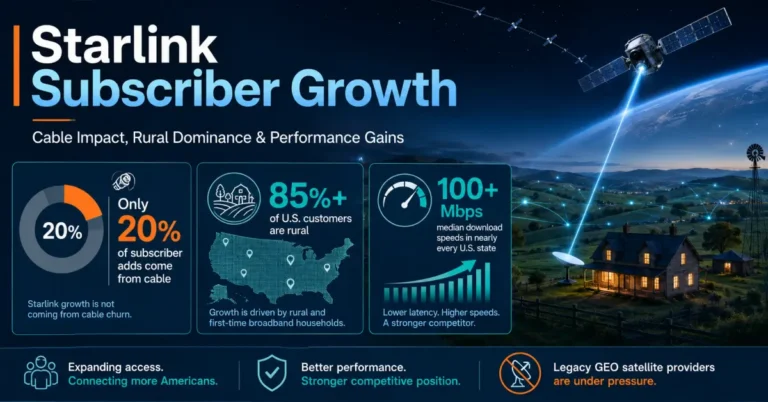
New research from New Street Research and Recon Analytics reveals that despite cable controlling roughly 60% of the US broadband market, only about 20% of Starlink's gross subscriber additions come from cable defectors. More than 85% of Starlink's US customer base is located in rural areas, and a significant share of its growth comes from first-time broadband subscribers. Meanwhile, Starlink's median download speeds now exceed 100 Mbps in nearly every US state, fundamentally shifting its competitive standing in the satellite and terrestrial broadband landscape.
The operators that control both dense fiber and performant 5G, and that package them coherently, will set the pace for the next telecom cycle. AT&T’s targets—more fiber passings, higher bundle attach, and measured wireless growth—put it squarely in the camp that sees integrated networks as the winning model. If the company executes on build cadence and cross-sell while keeping experience clean, expect continued share gains in fiber markets and a tougher environment for single-asset competitors. For buyers, the practical takeaway is to lean into converged sourcing now to lock in economics and resiliency as these footprints expand.
A new analysis of U.S. fixed wireless access shows subscriber momentum outpacing performance, a signal that capacity and management strategies are under pressure. Fixed wireless access from T-Mobile, Verizon, and AT&T added about 1.04 million net customers in Q3 2025, taking the U.S. FWA base to roughly 14.7 million. T-Mobile remains the U.S. FWA speed leader, posting a median download around 209 Mbps in Q3 2025. Median uploads dipped below 20 Mbps across providers, creating a hurdle for the FCC’s 100/20 benchmark. Urban FWA customers are more likely to meet the FCC’s 100/20 threshold than rural users due to radio geometry and site density.
AT&T has activated EchoStar’s 3.45 GHz spectrum across a massive swath of its macro network, delivering a step-change in speed and capacity that advances its 5G and fixed wireless agenda. AT&T has deployed the 3.45 GHz band on nearly 23,000 cell sites across the contiguous United States, touching more than 5,300 cities. Early field results point to up to 80% faster 5G download speeds in upgraded markets. The same spectrum injection is lifting AT&T’s fixed wireless access (FWA) product, Internet Air, with download speeds up by about 55%. Mid-band spectrum is the engine of 5G performance at scale.
A new joint plan from Vodafone and AST SpaceMobile aims to deliver satellite broadband directly to standard smartphones across Europe under a sovereign operational model. AST SpaceMobile has submitted plans through Germany for a space-based network designed to provide broadband directly to devices across Europe. Operations would run through SatCo, a Luxembourg-based joint venture with Vodafone announced earlier this year. The timing aligns with looming European spectrum decisions and intensifying competition in direct-to-device (D2D). S-band at 2 GHz is up for renewal across the region in 2027, and 700 MHz public protection and disaster relief (PPDR) frequencies are central to resilient communications strategy.
AT&T’s third quarter shows steady operational execution in wireless and fiber, supported by portfolio moves that aim to strengthen capacity, reach, and cash generation through 2027. AT&T reported Q3 2025 revenue of $30.7 billion, up 1.6% year over year, with diluted EPS of $1.29 boosted by a gain related to the sale of its DIRECTV investment; adjusted EPS was $0.54, roughly flat year over year. Free cash flow improved to $4.9 billion from $4.6 billion a year ago, a key metric for debt reduction and capital returns. AT&T’s cross-sell between fiber and mobility is showing tangible traction in both net additions and churn control.

A planned merger between Lynk Global and Omnispace aims to fuse spectrum assets, satellite technology, and SES’s multi-orbit infrastructure to scale 3GPP-compliant direct-to-device services worldwide. The combined company will pair Omnispace’s globally coordinated S-band holdings, about 60 MHz anchored by ITU filings and aligned to non-terrestrial network standards—with Lynk’s patented multi-spectrum D2D platform. SES, already an investor in both firms, will become a major strategic shareholder and provide access to its GEO and MEO assets and ground network to improve coverage, resiliency, and time-to-market. Lynk has already launched commercial messaging and alerting in small markets with a handful of LEO spacecraft.
New usage data shows AT&T subscribers are tapping into T-Mobile’s Starlink-powered T-Satellite more than expected, signaling a rapid shift in how carriers and customers think about direct-to-device connectivity. Speedtest intelligence indicates T-Mobile users account for the majority of direct-to-device (D2D) connections to Starlink, roughly six in ten overall and more than seven in ten among devices reporting active service at connection time. The surprise is AT&T’s footprint: about a third of observed connections come from AT&T subscribers, while Verizon’s share is minimal.
With the FCC under pressure to deliver 300 MHz of auctionable spectrum, a group of Senate Republicans is urging the agency to preserve the shared 3.5 GHz CBRS band and the unlicensed 6 GHz band that underpin private 5G and next‑gen Wi‑Fi. Ten Senate Republicans, including five members of the Senate Commerce Committee, sent a letter urging the FCC to ensure existing operations in the 6 GHz and Citizens Broadband Radio Service (CBRS) bands continue “without disruption.” NTIA Administrator Arielle Roth called for preserving 6 GHz for Wi‑Fi, a stance applauded by NCTA as a recognition that unlicensed spectrum is an economic engine.
TECKNEXUS PRIVATE NETWORKS
Congratulations to the 2026 Award Winners
Explore the Winners →

Partner Hubs

Telco AI Agent Leadership

Telco AI Agent Leadership Landscape - Network Equipment Vendors
Network Equipment Vendor Report
How are Amdocs, Salesforce, Comarch, Totogi, Qvantel, Oracle and other OSS/BSS vendors deploying telecom AI agents?
OSS/BSS Vendor Report
How are Amdocs, Salesforce, Comarch, Totogi, Qvantel, Oracle and other OSS/BSS vendors deploying telecom AI agents?
System Integrator Report
Scroll to Top