Residential connectivity has quietly become one of the most consequential pieces of infrastructure on a university campus. Students now arrive with a phone, a laptop, a tablet, a games console, a smart speaker and often a streaming stick, and they expect every one of them to connect from the first day, in every room, at any hour. Radford University in Virginia has answered that expectation with a decision that says as much about the future of campus IT operations as it does about Wi-Fi: it has handed the design, build and day-to-day running of its residential network to Boldyn Networks under a managed ResNet agreement covering every residence hall on campus.

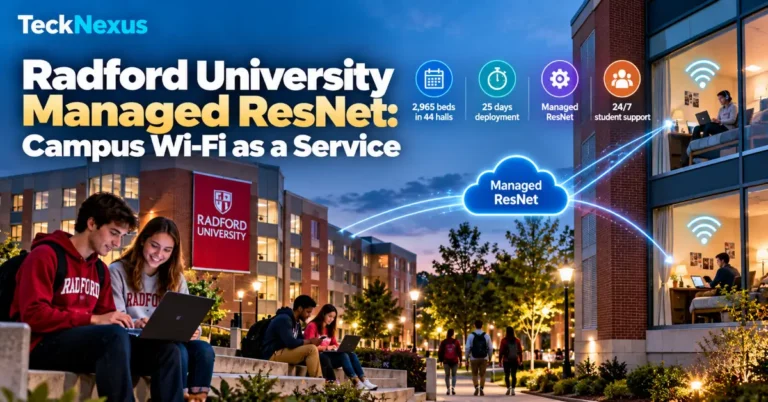
The scale is notable for a mid-sized public university. The new network spans 44 residential buildings and 2,965 beds, and it was deployed in 25 days. More significant than the speed, however, is the operating model behind it: a known five-year cost to serve, hardware lifecycle management built into the agreement, and round-the-clock student support. Together these turn residential connectivity from a recurring capital project into a predictable service line.

What Radford’s managed ResNet deployment covers
The agreement is broad in scope but simple in structure. Rather than buying equipment and running it in-house, the university has contracted for an outcome: consistent connectivity for every resident, supported continuously, at a fixed cost over a defined term. The core elements break down as follows.
| Element | What the agreement delivers |
| Coverage | All 44 residential buildings and 2,965 beds, upgraded together as a single campus-wide programme |
| Deployment | An entirely new residential network designed, installed and launched in 25 days |
| Operations | Day-to-day network management handled by the provider under its ResNet service |
| Student support | 24/7/365 help with connecting devices, accessed through a dedicated Radford ResNet portal |
| Lifecycle | Hardware refresh and lifecycle management built into the contract |
| Cost model | A known cost to serve and support the residence halls over five years |
Why a single-cutover managed ResNet matters for student equity
Many campuses refresh residential networks building by building, usually because capital budgets arrive in annual tranches. The consequence is a campus where connectivity quality depends on housing assignment. A student in a newly renovated hall enjoys modern coverage while a peer two buildings away contends with ageing access points and congested channels. Over a four-year refresh cycle, that gap can shape an entire cohort’s experience of campus life.

Radford chose to avoid that pattern by replacing the network in every building at once. The university’s IT infrastructure leadership has framed the goal around quick, intuitive onboarding for every device a student owns, in every hall. That is a service-consistency objective rather than a technology objective, and it explains why an all-at-once deployment made sense. Consistency is very hard to promise when the underlying estate is a patchwork of equipment generations.
The compressed timeline matters operationally too. A 25-day deployment window can fit inside the natural gaps in the academic calendar, limiting disruption to residents and avoiding a long period of running old and new networks side by side, with all the support confusion that brings.
Managed ResNet as a budgeting and lifecycle instrument
For university CIOs, the most valuable element of the agreement may be the one students never see. Residential networks carry a hidden cost curve. Equipment ages, device density climbs every year, and refresh projects compete for capital against teaching spaces, research computing and cyber security programmes. When a refresh is deferred, performance degrades and support tickets rise, which in turn consumes the staff time that strategic work depends on.
Building hardware lifecycle management into a five-year agreement with a known cost converts that unpredictable curve into a stable operating line. Finance teams can plan against a fixed figure, and IT leaders no longer need to argue for a large residential refresh every few years. Responsibility for keeping pace with growing device counts sits with the service provider, whose incentive is to keep the network performing well because it also carries the support load when it does not.
This is the same logic that has driven neutral-host and managed-service models in stadiums, airports, transit systems and commercial real estate. The asset owner defines the experience it wants its users to have, and a specialist operator takes responsibility for delivering and sustaining that experience over time.
How managed ResNet frees campus IT for ERP, LMS and AI work
The Radford agreement is explicit about the opportunity cost it addresses. By moving residential network operations to a partner, the university’s IT organisation can redirect its attention to strategic programmes, including complex ERP and LMS transitions and the rollout of AI capabilities across campus.
None of these are small undertakings. ERP migrations touch finance, HR, student records and admissions at the same time, and LMS transitions affect every course and every instructor. Campus AI rollouts bring their own demands: data governance, identity and access policy, vendor evaluation, faculty training and, increasingly, network and compute planning for AI-heavy workloads. Each of these needs the institution’s own people, because each depends on institutional knowledge that cannot be handed to a third party.
Residential Wi-Fi support, by contrast, is high-volume and highly repeatable. Device onboarding questions spike at the start of each term, arrive at all hours and follow predictable patterns. That profile suits a provider with a dedicated round-the-clock support operation far better than a lean in-house team working office hours. The division of labour Radford has adopted reflects a sound principle: keep in-house the work that differentiates the institution, and contract out the work that simply has to be done well, consistently, every day.
Managed ResNet momentum across US higher education
Radford’s deployment sits within a wider shift. It was one of 20 new and expanded higher-education agreements Boldyn disclosed in September, alongside institutions ranging from California community colleges to private universities in Texas and New Jersey and an academic medical centre in Nebraska. Residential network services anchor that portfolio, but the scope of the agreements extends well beyond the residence halls:
- Managed network services covering wider campus connectivity, not only student housing
- Managed IT services and continuous network monitoring
- Professional services, including executive advisory, cloud and security assessments, and full IT and network assessments
The pattern suggests that residential connectivity is often the entry point to a broader operating relationship. Once an institution has seen a managed model work in its highest-demand environment, extending it to monitoring, security assessment or campus-wide networking becomes a natural next step. With more than 300 colleges and universities now working with the company, and more than 25 years in the sector, higher education has become a substantial vertical for a business that many in the telecoms industry know first for neutral-host infrastructure in subways, venues and cities.
The underlying driver is consistent across institution types. Campus IT teams are being asked to support more users, more devices and more complex systems without proportionate growth in headcount or budget. Managed residential connectivity is one of the clearest places to relieve that pressure, because the service boundary is well defined and the student experience outcome is easy to observe.
What the Radford managed ResNet model leaves open
As with most early announcements, the public detail focuses on scope and operating model rather than technical specification or performance data. The Wi-Fi generation deployed, access point density, backhaul capacity and bandwidth commitments per bed have not been published, and no service-level metrics are yet available. Those details will matter to peer institutions weighing a similar move, and the most useful evidence will come after a full academic year of operation: support ticket volumes, onboarding times at the start of term, coverage consistency across older and newer buildings, and trends in student satisfaction.
There is a longer horizon to consider as well. A five-year term will span at least one Wi-Fi standard transition, a continued rise in per-student device counts and whatever new demands campus AI tools place on residential networks. How lifecycle management is exercised across that period is where the full value of the model will become visible, both for Radford and for the many institutions watching how agreements of this kind play out.
Radford’s decision shows that for a growing number of universities the residential network is no longer a project to be managed but an experience to be guaranteed, and the institutions making that shift are buying back the time their IT teams need for the work that will define the next decade.
For more analysis on connectivity, AI and digital infrastructure, subscribe to TeckNexus Monthly Insights. If your organisation is shaping campus or enterprise connectivity, partner with TeckNexus to share your perspective and generate leads.