


In the third quarter of 2026, operators began selling network slices with a committed speed, and the biggest spectrum deals closed. AT&T completed its purchase of EchoStar spectrum for about $23 billion, the FCC set $6.3 billion in payments to clear the upper C-band, and Charter closed its $34.5 billion Cox acquisition. In the UK, Vodafone Business launched slicing with a committed 15 Mbps minimum. In satellite, licences, filings and money arrived, while the dates for direct-to-device service at scale moved to 2028.
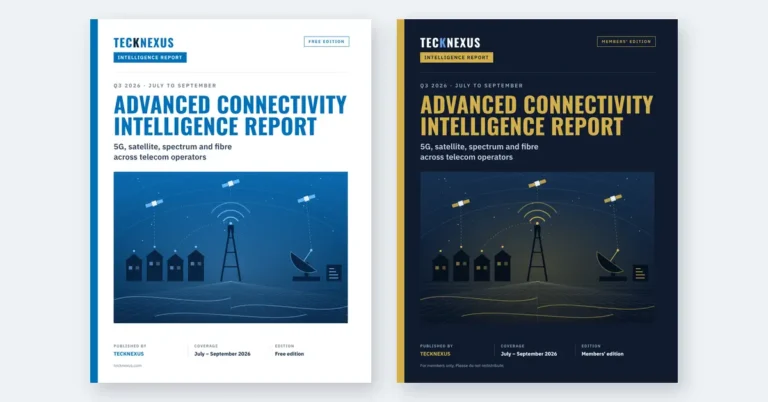
The TeckNexus Advanced Connectivity Intelligence Report, Q3 2026 brings those results together. It covers July, August and September, draws on 332 curated updates from the TeckNexus Advanced Connectivity Monthly Insights archive, and checks every figure against its original source. The free edition is available to download now, and the members’ edition adds four analysis panels, a research panel and three data annexes.
Why this report tracks value, not volume
Connectivity news is full of announcements: launches, trials, partnerships and filings. Counting them shows activity, not progress. This report tracks the figures that change a decision for an operator: what networks actually delivered, what is live against what is still a plan, what spectrum and fibre cost, and the dates that set when new capacity can reach customers.
Every figure is credited by name to the organisation it belongs to, and to whoever published it when that is someone else. Figures that are not measured results are marked as an estimate, target, plan or survey, so a projection is never read as an outcome. Third-party measurement and surveys sit in their own clearly marked research panel.
Key findings from Q3 2026
- The quarter’s biggest spectrum deal closed. AT&T completed its purchase of about 30 MHz at 3.45 GHz and 20 MHz at 600 MHz from EchoStar for about $23 billion, with $2.4 billion held in an FCC-ordered trust for those who built EchoStar’s 5G network.
- Slices went on sale with a floor. Vodafone Business launched 5G+ slicing in the UK with a committed minimum download speed of 15 Mbps, and EE launched Fast Lane for consumers and small businesses. AT&T gave FirstNet a dedicated standalone core, and India’s TRAI drafted per-slice tariff and quality rules.
- Upper C-band clearing was priced. The FCC adopted rules to reallocate 160 MHz at 3.98–4.14 GHz, with $6.3 billion in incentives for SES, Eutelsat and Telesat. The auction must finish by July 2027.
- Direct-to-device at scale moved to 2028. SpaceX now targets 5G-quality mobile service in the first half of 2028, Elveo commercial service by early 2028 and Amazon Leo D2D deployment from 2028. Hughes filed for Chapter 11, while AST SpaceMobile reported about $1.3 billion of backlog.
- Fixed consolidation closed. Charter completed its $34.5 billion Cox acquisition, Deutsche Telekom agreed to buy Fiberhost and Inea at about €1 billion, and Telenor agreed to buy a majority of Bahnhof.
- Fibre supply was locked in to 2032. Verizon contracted Corning for more than 80 million miles of fibre for 2027–2032, AT&T signed a Corning deal worth more than $3 billion, and Zayo saw long-haul dark-fibre demand from its largest customers double.
What the numbers mean for operators and suppliers
For operators, slicing now has a contract number attached. Vodafone’s committed 15 Mbps floor is the kind of figure enterprise buyers can hold a provider to, and India’s draft rules show how hard measuring slice performance will be. Satellite service at scale is now dated 2027–2028, so pilots today and contracts tied to dates make more sense than waiting. The report’s six operator moves set out what to do next, from buying slices by the floor rather than the peak to scoring resilience alongside coverage.
For suppliers, the openings are in slicing that comes with measurable guarantees, satellite services with clear dates and strong balance sheets, C-band transition work, and fibre and long-haul capacity for AI demand. The gaps the report flags are just as useful. Vodafone, EE and AT&T gave no take-up for slicing or Turbo Live, and no operator reported satellite usage. Telstra’s national outage, traced to its timing system, puts resilience evidence on every buyer’s list.
What’s inside the report
Free edition (7 pages): key findings, measured network outcomes, six operator moves and the methodology.
Members’ edition (16 pages): everything in the free edition, plus panels on 5G SA and slicing, satellite and direct-to-device, spectrum, fibre and money, and a spectrum and policy clock; a clearly marked research panel with Ookla, Zayo, Arelion and survey data; and three data annexes: a stat ledger with a linked source for every figure, a register of 43 named operator network activities from the quarter, and a benchmark worksheet.
Who the report is for
Operator leaders in network strategy, spectrum, wholesale, enterprise and product use the report to see which 5G, satellite and fibre moves are producing measurable results, and to plan around spectrum and policy dates. Network vendors, satellite operators, fibre suppliers, tower and infrastructure companies and integrators use it to see which proof points operators recognise and where demand is forming. Enterprise buyers of connectivity, investors and regulators use it as a sourced quarterly view of what operators are building, selling and spending.
How the report is built
The report is built from the TeckNexus Advanced Connectivity Monthly Insights archive for July, August and September 2026. Every figure was checked against its original source, with primary sources such as company releases, regulator orders and filings used wherever available. News first reported before July appears in the Q2 report instead. Figures appear as the source states them, including approximations, and currencies are not converted.
Operators and suppliers with measured network results can feature them in an upcoming edition through the 2027 Telecom AI & Next-Gen Networks program.





