


In the third quarter of 2026, telecom AI moved from trials into whole national networks and into operators’ budgets. Telstra completed a nationwide rollout of an AI radio scheduler, T-Mobile took its AutoPilot network automation nationwide, and Liberty Global began rolling out AI customer agents across about 80 million connections. At the same time, AT&T showed what AI now costs to run at scale, and Bain estimated that AI agents could become a fifth or more of an operator’s operating costs.
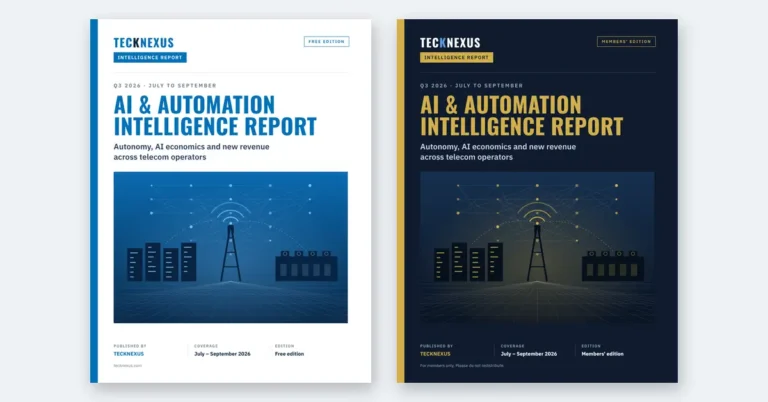
The TeckNexus AI & Automation Intelligence Report, Q3 2026 brings those results together. It covers July, August and September, draws on 197 curated updates from the TeckNexus AI & Automation Monthly Insights archive, and checks every figure against its original source. The free edition is available to download now, and the members’ edition adds four analysis panels and three data annexes.
Why this report tracks value, not volume
Telecom AI news is dominated by announcements: partnerships, platforms, model launches and capacity plans. Counting them shows activity, not results. This report tracks the figures that change a decision for an operator: how much work AI now does in the network, what it costs to run, what it earns, and how far AI-RAN has moved from lab to live traffic.
Every figure is credited by name to the organisation it belongs to, and to whoever published it when that is someone else. Figures that are not measured results are marked as an estimate, target, plan or survey, so a projection is never read as an outcome. Opinion surveys sit in their own clearly marked panel.
Key findings from Q3 2026
- Token volumes are now a managed cost. AT&T’s AI gateway routes about 45 billion tokens a day, up from 8 billion, and AT&T says cache-aware routing cuts AI costs by as much as 90%. It sends 25–40% of requests to open models and targets 65–70%.
- One operator disclosed AI revenue. SK Telecom’s AI data-centre revenue reached KRW 136.2 billion in Q2, up 92.5% year on year, the only AI revenue line an operator disclosed this quarter.
- Customer AI reached national scale. Liberty Global and Sierra began a phased rollout of conversational AI agents across about 80 million fixed and mobile connections in Europe, and Deutsche Telekom put AI call notes into its Business Mobil plans.
- Compute plans run ahead of what is live. Ooredoo’s Zankore targets 1 GW of AI capacity, with about 200 MW planned for the first half of 2027, while Indosat Ooredoo Hutchison operates around 28 MW of GPU capacity today.
- AI-RAN reported results and widened trials. NTT DOCOMO and Samsung cut how often users saw speed degradation from 13.1% to 7.2% in field validation. Nokia added eight operator trials, and SK Telecom and KT both selected Samsung for South Korea’s national AI-RAN projects.
- Network tasks compressed from weeks to minutes. Vodafone repositioned an antenna in 20–30 minutes instead of weeks or months, AT&T and D-Wave cut an optimisation job from about an hour to under 15 seconds, and T-Mobile says AutoPilot makes network adjustments in about half the time.
What the numbers mean for operators and suppliers
For operators, the quarter turns AI from a technology choice into a budget line. Bain’s scenario puts AI agents and tokens at 20–30% of operating costs within three to five years, which makes model routing, smaller models and portable orchestration finance decisions. On the network side, the strongest AI-RAN case is efficiency on today’s traffic, and T-Mobile says AI has not yet changed mobile network usage. The report’s six operator moves set out what to do next, from budgeting agents as a cost line to putting agent controls into contracts.
For suppliers, the openings are in routing and cost control, AI-RAN results that hold up on live networks, and the controls operators now expect around agents: approval, audit and rollback. The gaps the report flags are just as useful. Telstra’s nationwide scheduler, Liberty Global’s programme and China Telecom’s customer-service model were announced without performance figures, and no operator except SK Telecom disclosed what its AI services earn.
What’s inside the report
Free edition (7 pages): key findings, measured outcomes, six operator moves and the methodology.
Members’ edition (16 pages): everything in the free edition, plus panels on autonomous operations, AI economics, AI revenue and capacity, and AI-RAN with a standards and rules clock; a clearly marked survey panel with Ciena, Ofcom and One NZ data; and three data annexes: a stat ledger with a linked source for every figure, a register of 46 named operator AI activities from the quarter, and a benchmark worksheet.
Who the report is for
Operator leaders in network operations, IT and AI, customer experience, product and strategy use the report to see which AI uses are producing measurable results and to benchmark their own programmes. Network and OSS/BSS vendors, hyperscalers, model providers, chip makers and integrators use it to see which proof points operators recognise and how their own case studies compare. Investors, regulators and standards bodies use it as a sourced quarterly view of how operators are using, building and selling AI.
How the report is built
The report is built from the TeckNexus AI & Automation Monthly Insights archive for July, August and September 2026. Every figure was checked against its original source, with primary sources such as company releases and regulator publications used wherever available. News first reported before July appears in the Q2 report instead. Figures appear as the source states them, including approximations, and currencies are not converted.
Operators and suppliers with measured AI results can feature them in an upcoming edition through the 2027 Telecom AI & Next-Gen Networks program.





