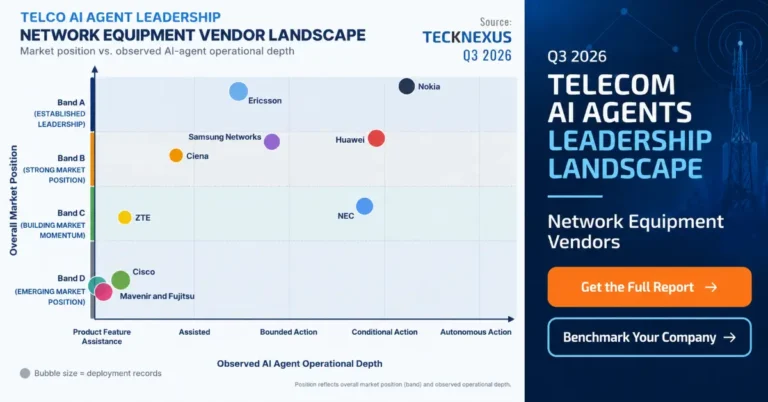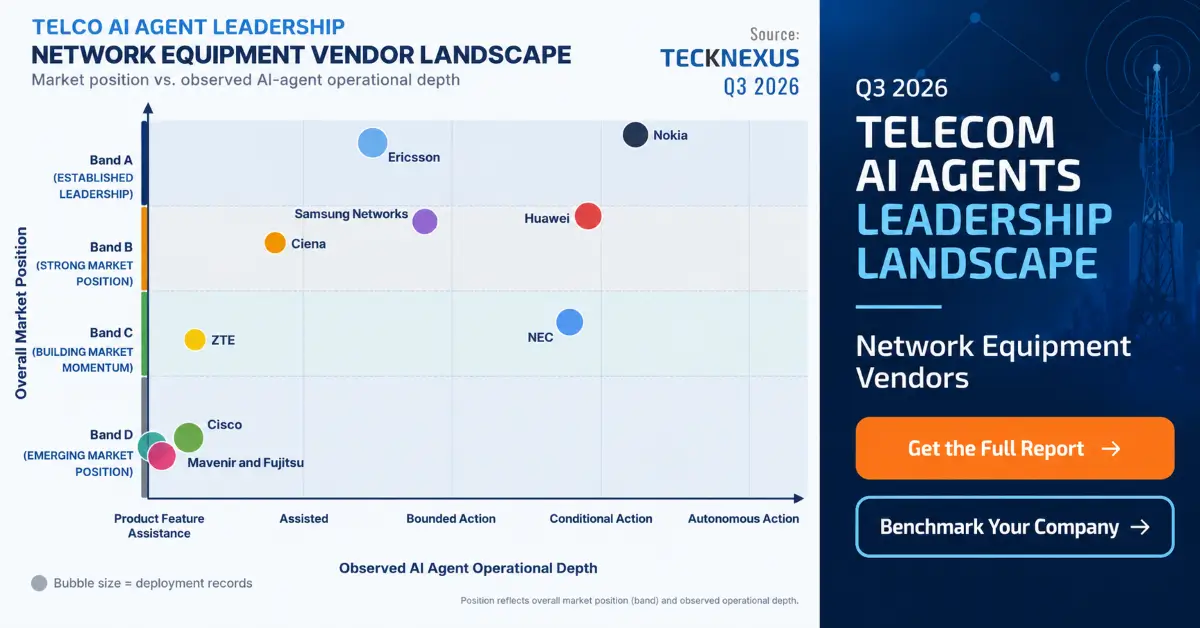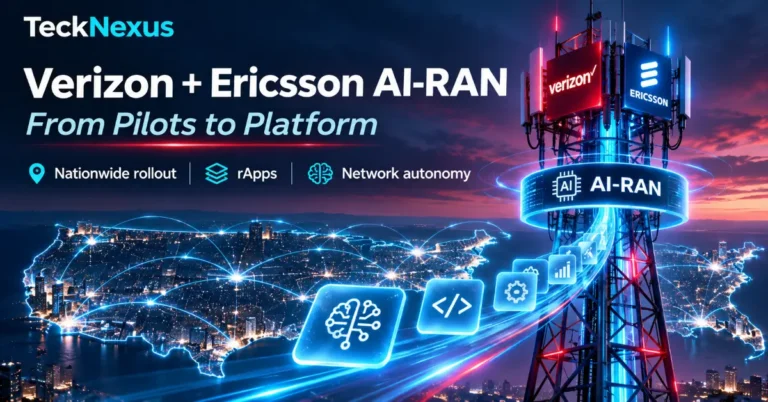
Verizon and Ericsson have expanded their long-running collaboration to bring AI-native automation into the radio access network. The next stage is a nationwide rollout of the Ericsson Intelligent Controller (EIC) across Verizon’s US network, planned for 2026. The platform will host AI-native rApps from both companies, including applications that Verizon has designed and built itself.

The announcement comes with live-network results. A field deployment of Ericsson‘s AAS Cell Shaper rApp, a fully autonomous closed-loop application that runs around the clock, delivered up to 8.9% higher downlink data radio bearer throughput and up to 8% higher uplink device throughput. Verizon also deployed its own rApp to automate handovers for Fixed Wireless Access (FWA) devices moving from LTE to Standalone 5G.
Read quickly, this is one more AI-in-the-network announcement in a year full of them. Read in context, it marks a more significant shift. AI in the RAN is moving from individual features proven in pilots to a nationwide platform where an operator can deploy, combine and write its own automation at scale. That is the step that turns AI-RAN from a set of promising results into an operating model.
The Verizon and Ericsson AI-RAN Announcement at a Glance
| Item | Detail |
| Platform | Ericsson Intelligent Controller (EIC), the non-real-time RAN Intelligent Controller within the Ericsson Intelligent Automation Platform (EIAP) |
| Rollout | Nationwide across Verizon’s US network, planned for 2026 |
| Field result: AAS Cell Shaper | Up to 8.9% gain in downlink data radio bearer throughput and up to 8% gain in uplink UE throughput |
| Verizon-built rApp | Connected-mode inter-RAT handover from LTE to Standalone 5G for FWA devices, removing manual intervention after handover failures |
| Next rApps to test and deploy | Cell Anomaly Detector, Root Cause Explainer and Anomaly General Optimizer, alongside further Verizon-designed rApps |
| Stated goal | Better network performance, greater operational efficiency and faster progress towards Level 4 network autonomy |
| Platform ecosystem | EIAP supports multi-vendor, multi-technology 4G and 5G RAN, with more than 100 rApps from more than 100 ecosystem members |
What the Verizon and Ericsson AI-RAN Platform Actually Does
The term AI-RAN is used for two related but different ideas. One is AI and RAN sharing accelerated computing hardware at the network edge. The other is AI for RAN: using machine learning to plan, optimise and operate the radio network itself. This announcement sits firmly in the second category, and it is where most operators are seeing measurable returns today.
Within AI for RAN, intelligence operates at two timescales. Real-time AI runs inside the base station, adjusting functions such as link adaptation and scheduling within milliseconds. Non-real-time AI runs centrally, looking across thousands of cells over seconds, minutes or hours to tune configurations, detect problems and steer traffic. The EIC is the second layer. It hosts rApps, small applications that read network data, decide on an action and push configuration changes back to the radios through standard interfaces.
| Layer | Where it runs | Typical timescale | Examples |
| Real-time AI | Inside the base station | Milliseconds | AI-native link adaptation, scheduling, beamforming decisions |
| Non-real-time AI (rApps) | Central controller such as the EIC | Seconds to hours | Cell shaping, traffic steering, anomaly detection, root cause analysis |
| Network management and orchestration | Service management and automation platform | Hours to days | Planning, policy, intent translation, lifecycle management |
The two layers complement each other. Verizon has worked with Ericsson on both, including AI-based link adaptation in the radio. The nationwide EIC deployment gives the central layer a common home across the network, so that improvements proven in one market can be rolled out everywhere.
Why Operator-Built rApps Matter in the Verizon and Ericsson AI-RAN Rollout
The most strategically interesting detail is not the throughput figure. It is the fact that Verizon wrote one of the rApps itself. Its FWA handover application addresses a specific operational problem: home broadband devices that need to move cleanly from LTE to Standalone 5G without an engineer stepping in when a handover fails. That is exactly the kind of operator-specific issue a general-purpose vendor feature is unlikely to prioritise.
An open, standards-based controller changes who can build network intelligence. For decades, radio optimisation logic lived inside vendor software and changed on vendor release cycles. With a programmable platform, the operator can encode its own priorities and know-how directly, and can do it alongside a vendor’s ready-made applications rather than instead of them. Three benefits follow:
- Speed. Operator engineering teams can respond to local problems, such as an FWA handover pattern, without waiting for a feature to reach a vendor roadmap.
- Differentiation. Automation logic becomes something an operator can own and refine as a competitive asset, much as software does in other industries.
- Ecosystem choice. A platform with a broad rApp ecosystem lets the operator combine vendor, partner and in-house applications on one controller.
Verizon has framed this capability as preparation for 6G, where AI is expected to be native to network design from the outset. Building in-house rApp skills on today’s 4G and 5G network develops the people and processes that will be needed when that happens.
Verizon and Ericsson AI-RAN and the Road to Level 4 Autonomy
The companies position the rollout as a step towards Level 4 network autonomy. The industry commonly describes autonomy in six levels, from fully manual operation to a network that runs itself across all scenarios:
| Level | Description | Role of people |
| L0: Manual | All operations performed by engineers | Do everything |
| L1: Assisted | Tools support individual tasks | Decide and act, with tool support |
| L2: Partial | Some closed loops automated in defined scenarios | Set rules and supervise |
| L3: Conditional | The system senses and adapts in real time within specific domains | Approve and handle exceptions |
| L4: High | Predictive, intent-driven closed loops across multiple domains | Set intent and oversee outcomes |
| L5: Full | Autonomous across all services, domains and scenarios | Set business objectives |
The next set of rApps maps neatly onto the operational loop that Level 4 requires. A network has to notice that something is wrong, understand why, and then fix it, ideally before customers feel the impact:
- Detect. The Cell Anomaly Detector identifies cells behaving abnormally.
- Diagnose. The Root Cause Explainer works out what is driving the anomaly.
- Resolve. The Anomaly General Optimizer applies corrective changes automatically.
- Optimise continuously. Applications such as the AAS Cell Shaper keep tuning performance around the clock, even when nothing is wrong.
Each step on its own saves engineering time. Chained together on a common platform, they form a closed loop that shifts network operations from reacting to alarms towards predicting and preventing issues. That is the practical meaning of Level 4.
What the Verizon and Ericsson AI-RAN Results Signal for the Industry
Gains of up to 8.9% in downlink throughput and 8% in uplink may sound modest next to the headline numbers often attached to AI. In a mature national network, they are significant. They come from software running on spectrum and radios that are already deployed, without new sites or new licences, and they compound across every cell where the rApp runs. For operators facing rising traffic and tight capital budgets, extracting more capacity from existing assets is one of the most valuable things AI can do.
Verizon is not alone in moving in this direction. Operators across North America and Europe are deploying AI-native features both in the radio and in central controllers, and Ericsson is extending AI-native link adaptation to other networks, including VodafoneThree in the UK. The common thread is a move from proving that AI works in a handful of cells to deciding how to run it everywhere.
That shift brings a different set of questions to the fore. How do multiple rApps coordinate so they do not work against each other? How are AI-driven changes governed, monitored and rolled back? How do operators build the skills to write and maintain their own applications? A nationwide platform is where those questions get answered in practice, which is why this deployment is worth watching closely.
What to Watch Next
- Rollout pace. How quickly the EIC reaches full national coverage across Verizon’s network.
- Results at scale. Whether gains seen in field deployments hold as rApps run across the whole footprint.
- Verizon’s in-house pipeline. Which additional operator-built rApps reach production, and in which domains.
- Closed-loop maturity. How the detect, diagnose and resolve rApps perform together as a chain.
- Real-time and non-real-time together. How embedded radio AI and central rApps are combined as the network moves towards Level 4.
The Bigger Picture
The Verizon and Ericsson AI-RAN rollout is a clear marker of where network AI stands at the end of 2026. The question is no longer whether machine learning can improve a radio network. It can, and the gains are measurable. The question is how to industrialise it: on what platform, with which applications, written by whom, and under what level of human oversight.
By putting a common intelligent controller across its national network and writing its own rApps on top, Verizon is answering those questions in a way that keeps both vendor innovation and operator know-how in play. For the wider industry, that combination of an open platform, an ecosystem of applications and in-house engineering capability looks increasingly like the template for reaching autonomous networks.
For more analysis of telecom AI, RAN automation and autonomous networks, read TeckNexus Monthly Insights. Have a perspective on AI-RAN or network automation to share? Partner with TeckNexus to put your insight in front of decision-makers and generate leads.