

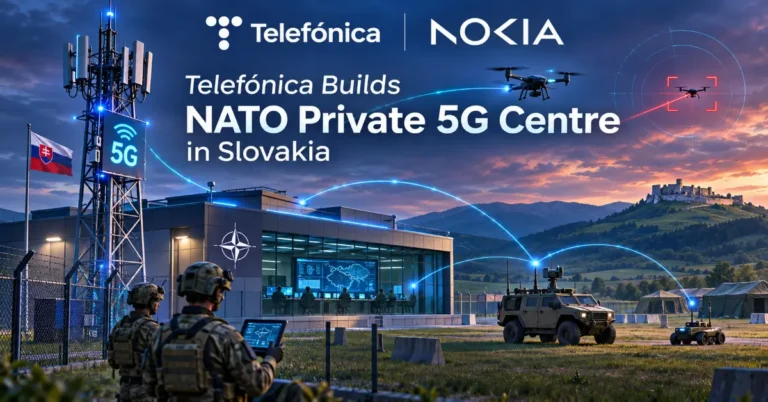
Spain’s Ministry of Defence has selected Telefónica to design, supply, deploy, integrate and maintain a complete private 5G network for a new Controlled Experimentation Centre for 5G technologies in Slovakia, established under a NATO mandate. The network will serve deployed personnel and give allied forces a live environment to test artificial intelligence, extended reality, secure communications, drones and capabilities against non-allied drones, all tied together by a command and control system for exercises at strategic, operational and tactical levels.

On its own, the award is a significant defence contract. Set against Telefónica’s activity over the past four years, it is something more telling. Defence private 5G is moving from portable networks that appear for an exercise and leave with it, towards permanent, operated infrastructure designed for continuous experimentation. That transition, from event to platform, is what makes the Slovakia centre worth close attention across the private network industry.

What the Slovakia defence private 5G centre includes
The scope goes well beyond radio coverage. Telefónica is delivering a full operating environment, built with a small group of specialist partners, and will run it for three years.
| Element | What is being delivered |
| Network | Complete private 5G infrastructure, from design and engineering through installation, configuration and commissioning |
| Radio | 5G radio solutions from Nokia |
| Command and control | A C2 system from XRF for strategic, operational and tactical exercises |
| Devices | Ruggedised terminals from Zebra Technologies, plus tablets and 5G SIM cards |
| Delivery partner | Atika, working alongside Telefónica on project execution |
| Assurance | Functional and cybersecurity testing before operation |
| People | User training and knowledge transfer to Ministry of Defence personnel |
| Lifecycle | Three years of support, operation and maintenance, including warranty and technology evolution |
The financial value of the contract has not been disclosed, and the specific military site has not been named publicly, which is typical for defence programmes of this kind.
How Telefónica built a defence private 5G track record
The Slovakia award did not arrive in isolation. Since 2022, Telefónica has taken part in more than 15 operational testing exercises within the Alliance, steadily extending private 5G across every domain in which armed forces operate. The sequence shows a deliberate progression from proof of concept to persistent capability.

| Timing | Milestone | Domain |
| 2022 onwards | Defence 5G programme begins with Spain’s armed forces | Multi-domain |
| Late 2025 | Airborne 5G bubble on a Spanish Air and Space Force C-295, with secure VoNR, video and air-to-air video links | Air |
| Late 2025 | Four-month 5G node aboard a ship of NATO’s Standing Naval Forces, connecting the group and unmanned units without public networks or satellite | Sea |
| March 2026 | 5G Cyber Defence Centre with the Ministry of Defence in Madrid, selected for integration into the NATO Digital Foundry | Cyber |
| March 2026 | Agreement with Airbus Helicopters to integrate 5G standalone into helicopters and unmanned systems | Air |
| April 2026 | Partnership with Sateliot on 5G non-terrestrial networks via low Earth orbit satellites for remote and maritime areas | Space |
| 2026 | LOLE 2026 exercise links two allied land headquarters in Spain and Slovakia over a tactical 5G bubble, radio links and satellite | Land |
| October 2026 | Agreement with Portugal’s NOS on interoperable defence connectivity, following joint work at the REPMUS maritime unmanned systems exercise | Sea |
| November 2026 | Selected for the NATO-mandated Controlled Experimentation Centre in Slovakia | Land / multi-domain |
Two patterns stand out. First, the tactical bubble has been proven in every domain: on aircraft, at sea, on land and through satellite extension. Second, the later milestones are less about connectivity and more about the systems that run on top of it: cyber defence, command and control, interoperability between operators, and secure applications. Slovakia combines both.
Why defence private 5G is shifting from exercises to permanent platforms
Tactical bubbles answer an urgent question: can forces bring secure, high-capacity connectivity to a place with no infrastructure, quickly? Telefónica’s exercises have repeatedly answered yes. But a bubble deployed for a fortnight-long exercise leaves little time to iterate on the applications that actually change military outcomes, such as AI-assisted video analysis, drone swarms, counter-drone sensing or XR-based training.
A standing experimentation centre removes that constraint. With a permanent network, a resident C2 environment and a three-year operating mandate, allied units can run repeated trials, compare results over time and move promising capabilities towards operational use with a much stronger evidence base. It also builds skills, since the contract explicitly includes training and knowledge transfer so that military personnel can operate and evolve the environment themselves.
The counter-drone emphasis is particularly timely. Drone and counter-drone capability has become a European defence priority, and testing detection and response against non-allied drones depends on dense sensor coverage, low-latency links and fast data movement to analytics. Those are precisely the characteristics a private 5G network with integrated C2 is designed to provide.
The sovereignty and interoperability case for defence private 5G
Sovereignty runs through the Slovakia project and the wider programme around it. A private network operated for the Ministry of Defence keeps traffic, identities and data under national control, while the Spanish-led ecosystem of operator, integrator and C2 provider reduces reliance on external platforms for a mission-critical capability. The agreement with NOS extends the same logic across borders, framing secure, interoperable connectivity between allied operators as a building block of European technological sovereignty.
Interoperability is the other half of the equation. Coalition operations depend on forces from different nations exchanging voice, video and data in real time. The LOLE 2026 link between land headquarters in Spain and Slovakia, the joint work with NOS at sea and the cyber defence centre’s integration into NATO’s innovation platform all point the same way: national 5G capabilities designed from the outset to plug into allied structures.
Several building blocks now recur across the programme:
- Deployable bubbles that create self-contained, secure 5G zones on vehicles, ships and aircraft.
- Standalone 5G and VoNR for mission-critical voice and video without dependence on public networks.
- Satellite extension through government satellite backhaul and non-terrestrial 5G for remote and maritime coverage.
- Secure application layers such as end-to-end encrypted multi-connectivity suites and shared operational pictures.
- Cyber defence testing to harden 5G connected radars, drones, weapons systems and personnel.
What defence private 5G means for the wider private network market
Defence is one of the most demanding private network environments there is, and lessons learned there tend to travel. Telefónica describes much of this work as dual-use, and the overlap with civil sectors is direct. Emergency services, disaster response, critical infrastructure operators, ports and remote industrial sites all need deployable coverage, resilience without public networks, satellite fallback and secure applications that run consistently across network types.
The Slovakia model also mirrors a pattern now visible in enterprise private networks: a long-term operated service with an ecosystem of partners and a structured use case programme, rather than a one-off network build. For operators, it shows that defence is becoming a credible growth vertical for private 5G, provided they invest in the security accreditation, multi-domain engineering and specialist partnerships the sector requires.
Several groups have reason to watch how the centre develops:
- Defence ministries and NATO bodies planning persistent test and training environments.
- Telecom operators building defence and public safety private network businesses.
- Equipment and device vendors supplying ruggedised, security-accredited 5G hardware.
- Critical infrastructure and emergency services seeking deployable, resilient mission-critical connectivity.
The next phase for Telefónica’s defence private 5G strategy
With the network in Slovakia set to run for three years, the next markers to watch are which AI, drone and counter-drone applications move from trial to doctrine, how the centre connects with the cyber defence centre in Madrid and with allied partners such as NOS, and whether the model is replicated at other NATO locations. Telefónica’s stated aim is to explore the full potential of 5G and its evolution towards future network generations, and a permanent, NATO-mandated platform gives it the right setting to do exactly that.
If the centre delivers a steady flow of validated capabilities, it could become the reference design for how allied forces adopt advanced connectivity: deploy quickly with bubbles, then test, harden and scale on standing infrastructure.
TeckNexus tracks private network deployments, use cases and vendor strategies across defence, public safety and critical infrastructure – explore Private Networks & Industrial AI Intelligence.
For more insights, read the latest TeckNexus Monthly Insights newsletters.