

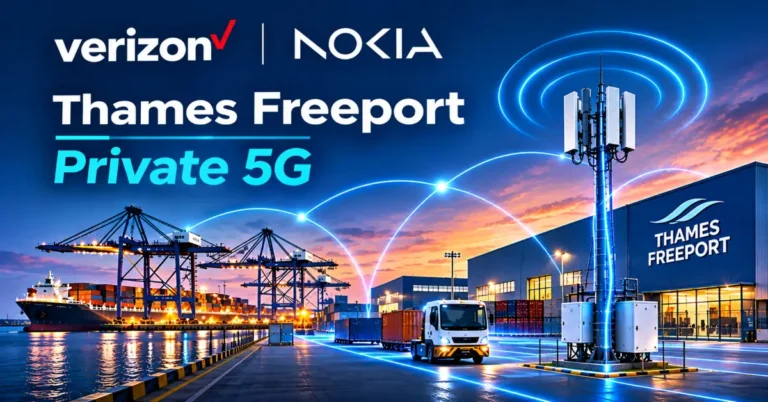
Verizon Business and Thames Freeport have completed a private 5G platform spanning five industrial sites in the Thames Estuary, built with Nokia’s Digital Automation Cloud (DAC) and MX Industrial Edge (MXIE). Read quickly, it is another large campus network. Read closely, it is something the private network market has discussed for years but rarely delivered at this scale: a single commercial hub offering industrial-grade wireless as shared economic infrastructure, while every tenant keeps its own network core and its own data.

That distinction is the real story. Freeports, industrial parks, airport estates and port clusters all live with the same tension. Tenants want advanced connectivity for automation and AI, yet none of them wants to pool operational data with neighbours, and few want to fund, staff and run a cellular network on their own. Thames Freeport’s answer, a common platform with a sovereign core per tenant, is the part of this announcement most likely to be studied and repeated elsewhere.

What the Thames Freeport private 5G network covers
The platform connects five independently operated locations, each with its own operational profile and its own reasons for adopting private 5G. Port, logistics and automotive manufacturing environments sit side by side on the same commercial footprint, which is precisely what makes the deployment a useful reference.
| Site | Operational profile | Private 5G focus |
| DP World London Gateway | Deep-sea container terminal | Connected terminal operations, asset tracking, video analytics, autonomous systems |
| DP World Logistics Park | Integrated logistics and distribution park | Coordinated logistics workflows, asset visibility, automation readiness |
| Ford Dagenham | London’s largest manufacturing site, with a long engine and vehicle production history | Connected assets, robotics, vision-based applications, production intelligence |
| Port of Tilbury (two locations) | Multi-cargo port hosting 135 supply chain businesses | Cargo operations, connected workers, site monitoring, safety, future automation |
When the project was first unveiled in mid-2025, the plan described roughly 1,700 acres of industrial land, around 80 radio units and a 5G-only design in the 3.8 to 4.2 GHz band. A detailed final configuration, including an updated radio count, has not been published, so those original figures are best read as an indication of scale rather than a final specification.
Why sovereign cores make the Thames Freeport private 5G model replicable
Most multi-tenant wireless models in industrial settings have leaned on a shared core or a neutral host arrangement, which keeps costs down but raises hard questions about data separation, change control and security responsibility. The Thames Freeport design takes a different route. Each tenant network runs on an independent core, so traffic, subscriber data and operational telemetry stay inside the tenant’s own boundary, while the platform, the operating partner and the innovation programme are shared.

This produces a three-layer structure that other economic zones can map directly onto their own estates:
- Platform layer: a single operator and a single technology stack across the estate, which simplifies procurement, spectrum planning, security baselines and lifecycle management.
- Tenant layer: dedicated cores that give each organisation data sovereignty and the freedom to prioritise its own applications, at its own pace.
- Ecosystem layer: the Freeport’s Connectivity Innovation Lab, which brings technology providers and tenants together to test and validate use cases before they reach live operations.
The ecosystem layer is easy to overlook, but it may prove the most valuable. Individual tenants rarely have the appetite to run structured trials of emerging applications alone. A shared lab spreads that effort, builds a common evidence base and shortens the path from pilot to production for everyone on the estate.
There is also an interesting design question ahead. Several of the most valuable workflows cross tenant boundaries. Trucks move between depots, logistics parks and terminals; containers flow from yard to vessel. Sovereign cores protect each party, so future cross-site applications will depend on well-governed, deliberate data exchange between tenants rather than a shared network. How Thames Freeport structures that exchange will be worth watching closely.
From connectivity to physical AI: the Thames Freeport private 5G use case pipeline
The use case programme is staged, and its shape says a lot about where industrial private networks are heading.
| Use case | Stage | Operational problem addressed |
| AI vehicle and trailer damage detection | Phase 1 trial | Manual inspections that are slow and miss damage |
| Digital truck processing | Phase 1 trial | Poor visibility of truck movements and gate queues during incidents |
| Mission-critical field communications | Phase 1 trial | Field staff coordination, incident alerting and manual reporting |
| Digital map of the container yard | Phase 1, in progress | Incomplete real-time view of container location, age and planned moves |
| Digital twin and scenario simulation | Phase 2, identified | Testing layout, volume and sequencing changes before committing |
| AI estate monitoring with cameras and drones | Phase 2, identified | Finding estate defects and blind spots, then raising tickets automatically |
| NLP operational decision support | Phase 2, identified | Shift managers interpreting fragmented terminal data under pressure |
| Predictive maintenance and condition monitoring | Phase 2, identified | Unplanned breakdowns of critical plant and mobile equipment |
| Environmental monitoring | Phase 2, identified | Emissions, dust and air-quality tracking for sustainability reporting |
The first phase is largely about perception: cameras and sensors that let the estate see itself in real time. The second phase moves towards reasoning and action, with digital twins that test decisions before they are made, and an AI data layer that lets shift managers ask operational questions in plain language and receive scenario-based recommendations instead of dashboards. That progression, from seeing to deciding, is the practical arc of physical AI in industrial operations.
It also explains why the network choice matters. Vision workloads generate heavy uplink traffic from many moving and fixed sources, and decision support depends on fresh data arriving reliably from across a large site. Pairing a private 5G radio layer with industrial edge compute keeps inference and data processing close to the operation, which is the architecture these applications need as they scale from a handful of cameras to an estate-wide service.
At this stage the published results are qualitative. The damage detection trial found defects that manual checks had missed, and the truck processing trial pinpointed where gate queues form when incidents slow access. Quantified outcomes such as throughput gains, inspection time savings or availability figures have not yet been released, which is normal for a programme that has only just moved from build to operation. The next set of announcements will be most useful if they carry those numbers.
What the Thames Freeport private 5G rollout signals for the market
For Verizon Business, the completed deployment is a substantial multi-site European reference built outside its home market, in a country where domestic mobile operators might have been expected to hold the advantage. It extends Verizon‘s track record in UK port environments and aligns with its recognition as a Leader in the 2026 Gartner Magic Quadrant for 4G and 5G Private Mobile Network Services, the second consecutive year it has held that position.
For Nokia‘s Enterprise Campus Edge business, which supplies DAC and MXIE and is subject to a planned sale to AURELIUS, the project is a high-profile reference at an important moment. Enterprise customers evaluating campus platforms place real weight on large, live, multi-site deployments, and this one spans port, logistics and manufacturing environments in a single programme.
For freeports and economic zones, the message is that connectivity is moving into the same category as power, roads and rail. Thames Freeport reports more than £2.13 billion of private investment secured since 2021 and is targeting up to £4.9 billion more, alongside as many as 28,000 jobs by 2045. Positioning AI-ready private 5G as built-in infrastructure gives it a concrete offer for incoming investors: a site where automation and physical AI projects can start without first solving the network problem.
Several groups have particular reason to study the model:
- Other UK and international freeports looking for a connectivity proposition that supports inward investment.
- Port authorities and landlord ports that host many independent operators on one estate.
- Industrial park and campus owners weighing shared infrastructure against tenant-by-tenant networks.
- Operators and integrators building repeatable multi-tenant private 5G offers for enterprise estates.
The next test for Thames Freeport private 5G: trials into daily operations
Completing the build is a milestone; the more important phase starts now. The value of the Thames Freeport private 5G platform will be measured by how many trialled applications become standard practice across tenant sites, how quickly second-phase use cases such as digital twins and NLP decision support reach live operations, and whether cross-tenant workflows can be enabled without diluting the data sovereignty that makes the model attractive.
If those pieces come together, Thames Freeport will have shown something the private network sector has needed for some time: a repeatable way to deliver industrial connectivity and physical AI across an entire economic zone, rather than one site at a time.
For more insights, read the latest TeckNexus Monthly Insights newsletters at https://tecknexus.com/contenttype/newsletters/.