

What is Nokia Fiber on the Go and why is it launching now?
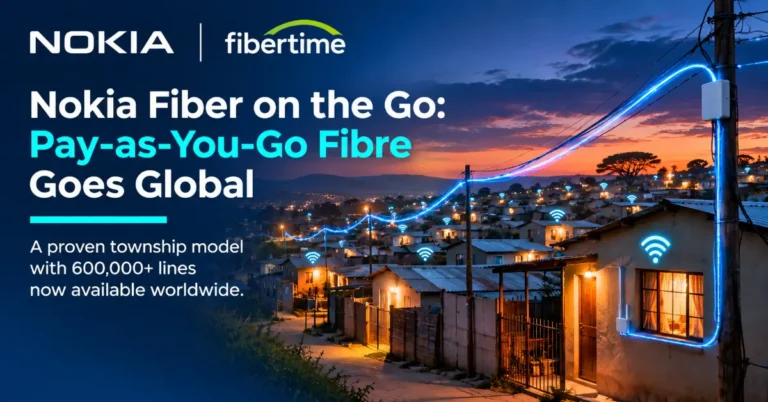
Nokia Fiber on the Go is an end-to-end fibre broadband package that lets operators sell fibre on a pay-as-you-go basis, the way prepaid mobile data is sold. Developed with South African operator fibertime, which reports more than 600,000 lines in service across mostly township communities, it is now available to operators worldwide, starting with Africa, Latin America and Asia.

Why This Matters: Pay-as-You-Go Fibre Changes the Business Case
Fibre has always been easy to justify in wealthy suburbs and hard to justify almost everywhere else. The obstacle in low-income communities is rarely the technology. It is the commercial model: monthly contracts, credit checks and debit orders exclude households in cash-based economies, so operators never sign up enough subscribers to pay back the build. Nokia says more than 250 million homes in developing markets lack reliable broadband.
The affordability gap is well documented. The ITU’s Facts and Figures 2026 found that a fixed broadband subscription costs more than a quarter of average income in a low-income economy, against a target of two per cent of gross national income per capita, and that three in ten economies meet neither the fixed nor the mobile broadband affordability target.
Fiber on the Go addresses the business model rather than the access technology. By packaging fibre equipment with a subscriber payment portal and automation software, Nokia is effectively productising an operating model that one operator has already proven in the field. That is a different proposition from selling optical line terminals and modems and leaving the operator to work out how to make the economics close.
For Nokia, it also opens a growth market in fixed access at a time when developed-market fibre builds are maturing. For operators and investors in Africa, Latin America and Asia, it offers a reference design that has been tested at scale rather than a concept.
What Is Inside Nokia Fiber on the Go
The solution combines Nokia’s existing fixed access portfolio with software for payments and automation:
- Lightspan fibre access: access nodes in the fibre exchange and Wi-Fi enabled fibre terminals at the customer end.
- IP gateway: the routing layer connecting the access network to the internet.
- Subscriber payment portal: the component that makes prepaid, pay-as-you-go access possible.
- Altiplano, Broadband Easy and Corteca: Nokia’s automation, activation and home software platforms, which Nokia says apply AI-driven automation across deployment, activation and network operations to lower costs and shorten time to revenue.
Altiplano’s role is worth noting. Nokia has been adding AI tools to the platform, including the Fiber Health Analyzer for spotting faults before they affect service, as covered in TeckNexus’s analysis of Nokia’s FTTH digital twin and AI tools. In a low-cost model, avoiding truck rolls and first-time-fix failures matters as much as the price of the hardware.
How fibertime Proved the Pay-as-You-Go Fibre Model
Fiber on the Go is built on fibertime’s experience in South African townships, where the operator sells uncapped access in daily increments. Customers buy vouchers for R5 a day for a single device, or R15 a day for up to five devices, and activate them through an app, much like topping up prepaid airtime. Vouchers are available through local spaza shops and banking apps, and there are no contracts or credit checks.
| When | Milestone |
| August 2022 | Fibertime Group begins a pilot in Kayamandi township near Stellenbosch |
| November 2023 | Finnfund invests EUR 2 million in Fibertime Group, with Nokia as technology provider |
| November 2024 | Nokia announces fibertime will deploy its fibre solution across 5 cities and 14 townships |
| March 2025 | Finnfund makes a EUR 2 million follow-on investment; about 65,000 households connected by then |
| October 2025 | Nokia and fibertime announce expansion to an additional 400,000 homes, towards a goal of 2 million homes by 2028 |
| July 2026 | Fibertime reports more than 500,000 homes connected across 65 townships |
| November 2026 | More than 600,000 lines in service; Nokia launches Fiber on the Go globally |
Usage figures suggest each connection reaches well beyond a single user. In July 2026, fibertime’s founder reported that daily active users had passed 1.55 million against roughly half a million connected homes, which indicates that a single fibre line serves several people and devices.
Pay-as-You-Go Fibre Compared With Contract Fibre and Mobile Data
The model sits between two familiar options, and the comparison explains why it has grown so quickly.
| Contract fibre | Pay-as-you-go fibre | Prepaid mobile data | |
| How customers pay | Monthly debit order or invoice | Daily or short-term vouchers | Prepaid bundles |
| Entry requirements | Credit check, bank account, contract | None beyond buying a voucher | None beyond buying airtime |
| Usage | Uncapped, fixed location | Uncapped | Capped by bundle size |
| Cost per gigabyte for heavy users | Low | Low | High |
| Operator risk | Low churn, but low take-up in low-income areas | Higher churn risk, offset by much wider take-up | High churn, low infrastructure cost per user |
For heavy users, the cost difference can be stark. Fibertime’s founders have argued that mobile data in townships can cost up to 70 times more per gigabyte than fibre. Daily fibre pricing gives households the cost profile of fibre with the payment flexibility of prepaid mobile.
Fiber on the Go: What Is Proven and What Is Still Unknown
Separating what has been demonstrated from what is still claimed or unknown helps operators judge how far the model has been tested:
| Status | Detail |
| Proven in the field | Large-scale pay-as-you-go fibre in South African townships, with more than 600,000 lines in service according to Nokia |
| Available now | Fiber on the Go offered to operators worldwide, with an initial focus on Africa, Latin America and Asia |
| Company claims | AI-driven automation lowers deployment and operating costs and shortens time to revenue |
| Not published | ARPU, churn, take-up rates, deployment cost per home, and pricing of the Nokia solution |
| Not yet known | Which operators outside South Africa will adopt it, and how the model adapts to different payment systems and regulation |
The absence of unit economics is the main gap. The fibertime story shows strong adoption, but operators considering the model will want evidence on revenue per line, churn under daily pricing and payback periods. Those numbers have not been independently published.
What Pay-as-You-Go Fibre Means for the Market
Operators in developing markets
Operators that have treated low-income areas as mobile-only territory now have a fibre option with a tested commercial model. The most natural candidates are fixed and converged operators with access to cheap aerial deployment routes and strong local retail and payment channels. Integration with mobile money and local payment ecosystems will be important wherever households already pay for services through their phones.
Mobile operators
Where pay-as-you-go fibre arrives, heavy data users are likely to shift home usage onto fibre-fed Wi-Fi. That puts pressure on prepaid data revenue but could also relieve congested mobile networks. Mobile operators that also own fibre assets are best placed to treat the model as an opportunity rather than a threat.
Vendors and investors
For Nokia, Fiber on the Go is an example of a vendor packaging a customer’s business model alongside its equipment. Development finance has played a role too: Finland’s development financier Finnfund has invested in Fibertime Group since 2023, with Nokia as the technology provider. Similar partnerships between vendors, operators and development investors may become the way such models spread.
What Comes Next for Nokia Fiber on the Go
Four developments will show whether Fiber on the Go can repeat fibertime’s results beyond South Africa:
- First operators outside South Africa: announcements from operators in Africa, Latin America or Asia will show whether the model travels.
- Unit economics: published figures on ARPU, churn and cost per home will determine how quickly investors back new deployments.
- Payments integration: adapting the payment portal to mobile money and local wallets in each market.
- Fibertime’s own target: fibertime aims to connect 2 million homes by 2028, which would make it one of the largest consumer fibre networks in Africa.
For more analysis like this, subscribe to the TeckNexus Newsletter, explore our 2027 programs, or partner with us to share your perspective and generate leads.