




What did Telia, Nokia and QMill demonstrate with quantum-powered 5G encryption?
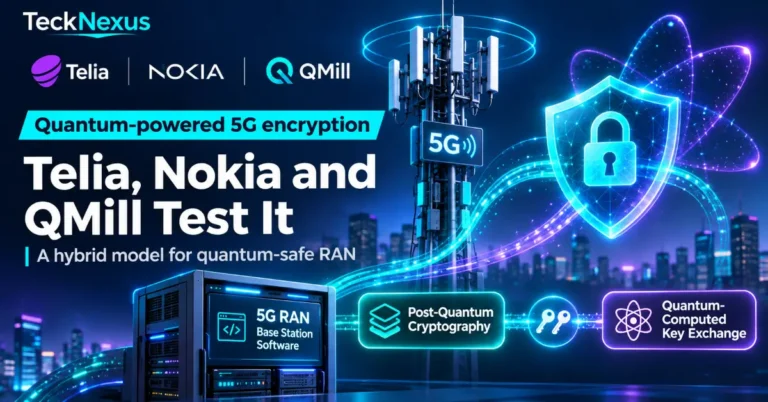
Telia Finland, Nokia and Finnish start-up QMill have run quantum-powered encryption inside Nokia’s 5G base station software, using commercial equipment in Telia’s 5G innovation environment. The proof of concept pairs the standardised ML-KEM post-quantum algorithm with QMill’s quantum-computed key exchange to protect the link between a base station and the network’s security gateway. The partners took it from concept to a working demonstration in under 90 days.

Why This Matters for Quantum-Safe 5G Networks
The threat driving this work is usually summarised as “harvest now, decrypt later”. Traffic that is intercepted and stored today could be decrypted once cryptographically relevant quantum computers arrive. For mobile operators that carry government, defence, financial and critical infrastructure traffic, the exposure starts now, not on the day a capable quantum machine is switched on.
The connection the partners chose to protect is significant. The IPsec tunnel between a base station and the security gateway is the route by which user and control traffic enters the operator’s core network. It is replicated at every cell site, which makes the radio access network the largest and most distributed cryptographic estate an operator runs. Upgrading thousands of sites takes years, so proving that new protection can be delivered as base station software, rather than new hardware, matters as much as the cryptography itself.
The demonstration also settles an architectural question in favour of layering rather than replacement. The partners position standards-defined post-quantum cryptography (PQC) as the foundation and QMill’s method as an additional layer on top. Their release states that “standards-defined post-quantum cryptography will be the foundation for critical networks”. For operators, that removes the need to choose between following standards and adopting newer quantum techniques: the second can be added without abandoning the first.
There is a commercial dimension too. Telia Finland is reported to invest around EUR 200 million a year in nationwide secure ICT services, and security-sensitive customers increasingly ask how long their data will stay protected, not just whether it is encrypted today. A credible, demonstrable quantum-safe roadmap is becoming part of how operators compete for that business.
How the Quantum-Powered 5G Encryption Works
The proof of concept combines two independent layers of protection with a new source of randomness.
Layer one: standardised post-quantum cryptography
The base station and its IPsec peer establish a shared key using ML-KEM, the post-quantum key encapsulation mechanism standardised by NIST in FIPS 203. ML-KEM is designed to resist attacks from both classical and quantum computers and is the algorithm most operators and vendors are building their post-quantum migration around.
Layer two: QMill’s quantum-computed key exchange
Alongside ML-KEM, QMill’s key exchange algorithm runs on quantum computation, using local or cloud-accessible quantum computers. Because it rests on different mathematical foundations from ML-KEM, the two layers fail independently. An attacker would need to compromise both before any cleartext data could be exposed.
Verified quantum randomness
The key exchange is seeded with fresh random numbers drawn from a quantum computer through the QMill Cloud service. QMill says these numbers are user-verifiable: their quality can be checked mathematically using ordinary classical computing, rather than taken on trust. Weak randomness is a long-standing source of cryptographic failure, so verifiability is a meaningful design choice.
The partners describe two firsts: a quantum-powered key exchange working alongside standard PQC, and user-verifiable quantum random numbers used to seed that exchange.
Quantum-Powered 5G Encryption: What Is Proven and What Is Not
This is a proof of concept, and the distinction between what has been demonstrated, what is claimed and what is still to come is important for anyone assessing it.
| Status | Detail |
| Completed | QMill’s solution integrated into Nokia’s 5G base station software |
| Completed | End-to-end demonstration on a 5G network built from commercial equipment in Telia’s 5G innovation environment (a testbed, not the live commercial network) |
| Completed | Concept to working proof of concept, including base station integration, in under 90 days |
| Company claims | “World’s first” quantum-powered encryption in a 5G network; works on standard network equipment without costly dedicated infrastructure |
| Not yet published | Latency or throughput overhead, key establishment rates, cost, and the quantum hardware used |
| Planned | Identify concrete use cases in security-sensitive sectors on the path to commercialisation; no availability date announced |
The missing performance data is the most important gap. Base station security has to work at scale and without degrading service, and a key exchange that depends on reaching a quantum computer through a cloud service introduces timing and availability questions that a lab demonstration does not answer. Those are the figures to look for as the partners move towards commercial use cases.
Telia’s Three Steps Towards Quantum-Safe Mobile Networks
The November demonstration is the latest stage in a sequence that shows Telia testing each of the main approaches to quantum security in turn.
| When | Milestone | Approach |
| November 2024 | Telia tests quantum key distribution in its Helsinki network as part of NaQCI.fi, Finland’s national quantum secure network led by VTT | Quantum key distribution (QKD) over fibre |
| May 2026 | Telia and QMill demonstrate quantum-enhanced message encryption over standard mobile channels; the framework is audited and demonstrated to the C5 Division of the Defence Command Finland | Software-based quantum layer, point to point |
| November 2026 | Telia, Nokia and QMill integrate the approach into Nokia’s 5G base station software | Hybrid of ML-KEM PQC and a quantum-computed key exchange |
The progression matters more than any single step. QKD needs dedicated fibre and specialised hardware, which limits it to a small number of high-value links. The May 2026 work showed that a software-based quantum layer could run over ordinary mobile channels, but as a standalone application. The November step puts that capability inside a major vendor’s base station software, which is where it would need to live to reach thousands of sites.
Three Routes to Quantum-Safe 5G Networks Compared
Operators now have three broad options for quantum-era security, and they are complementary rather than competing. Nokia has public work in all three.
| Approach | How it works | What it needs | Example | Best fit |
| Post-quantum cryptography | New algorithms resistant to quantum attack, such as ML-KEM | Software and firmware updates | Nokia and Turkcell quantum-safe IPsec in a mobile transport network (December 2024) | Baseline protection across every interface |
| Quantum key distribution | Keys exchanged through quantum states of light | Dedicated fibre and QKD hardware | Telia in NaQCI.fi (2024); Proximus and Nokia hybrid trial between Brussels and Mechelen data centres | High-value fixed links between sites |
| Quantum-computed key layer | Additional key exchange computed on quantum computers, combined with PQC | Existing network equipment plus access to quantum computing | Telia, Nokia and QMill (November 2026) | Added assurance on sensitive links, defence and government |
Read together, these examples suggest that vendors are building portfolios rather than betting on a single technique. The practical question for an operator is not which approach wins, but which links get which layers. PQC is the default everywhere; QKD suits a handful of fibre routes; a quantum-computed layer could become a premium option for the traffic that needs the strongest assurance.
What Quantum-Powered 5G Encryption Means for the Market
Telecom operators
The most immediate lesson is about sequencing. Operators that have already started cryptographic inventories and PQC migration can treat additional quantum layers as an option on top, rather than a separate programme. The base station to security gateway link is a logical place to start because it concentrates traffic and is controlled entirely by the operator and its vendor. Crypto agility, the ability to swap or add algorithms through software, is the capability that makes all of this possible.
Enterprises and critical infrastructure
Utilities, ports, defence sites and government agencies running private or dedicated mobile networks face the same long-lived data risk as public operators. For them, the useful questions are when their network supplier’s post-quantum roadmap reaches the interfaces they depend on, and whether additional layers will be available for their most sensitive traffic.
Technology providers
The project shows a route to market for quantum software companies: partnering with an established vendor and operator to get inside a commercial product, rather than selling standalone systems. For network equipment vendors, it reinforces security as a differentiator in the 5G Advanced and 6G cycle. Commercial versions will need to address how a cloud-delivered quantum service is provisioned, monitored and kept available at network scale.
What Comes Next for Quantum-Safe 5G
Five developments will determine how quickly quantum-powered encryption moves from proof of concept to commercial networks:
- Use case selection: the partners say they are now identifying concrete use cases in security-sensitive sectors on the path to commercialisation.
- Performance evidence: published figures on latency, throughput and key establishment will determine where the approach is practical.
- Scaling beyond point to point: the May 2026 work set out an ambition to extend from a single validated link to a multi-node architecture across the Nordic and Baltic regions.
- Standards alignment: RAN post-quantum migration is following the 3GPP path, and any additional quantum layer will need to sit cleanly alongside it.
- 6G security design: the partners expect the approach to become more relevant as networks move towards 6G and security requirements evolve.
For earlier TeckNexus coverage of how Nokia is building quantum-safe capability with partners, see Nokia, Honeywell and Numana Partner for Quantum-Safe Network Solutions.
For more analysis like this, subscribe to the TeckNexus Newsletter, explore our 2027 programs, or partner with us to share your perspective and generate leads.