Crypto

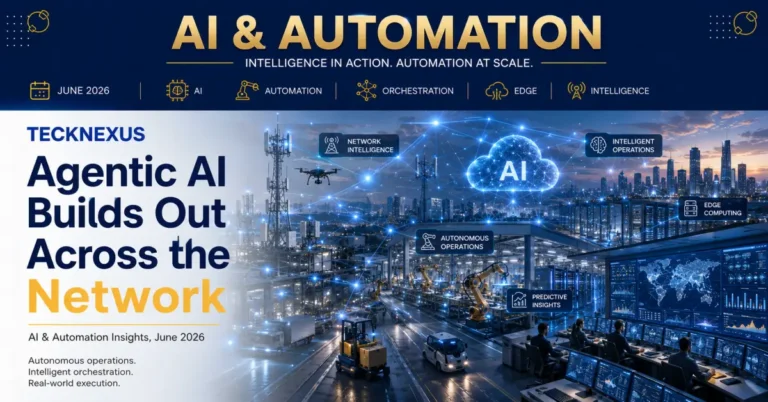
June 2026 showed agentic AI scaling from pilot to platform: industry-wide standards momentum, AI-RAN field trials from Nokia, Amdocs and KDDI, and fresh capital across data centers on three continents. This full roundup covers every deployment, partnership, funding round and governance move from the month, with tools to prioritise AI use cases and plan the network around them.
Intel and Google expanded a multiyear partnership that doubles down on Xeon CPUs and custom infrastructure processing units to scale AI with better efficiency and predictability. Google committed to multiple generations of Intel Xeon for AI, inference, and general-purpose workloads across its global cloud. The latest Xeon 6 processors are already powering Google Cloud’s workload-optimized instances, including C4 and N4, to coordinate large-scale training, serve latency-sensitive inference, and run mainstream compute. In parallel, the companies will broaden co-development of custom ASIC-based IPUs that offload networking, storage, and security from host CPUs to improve utilization and deliver more stable performance at hyperscale.
KDDI and Nokia validated quantum-safe optical transport at KDDI’s new Sakai Data Center, a facility built to support real-time AI training, inference, and analytics. The demonstration used Nokia’s 1830 Photonic Service Switch with C+L band capabilities for capacity scaling and the 1830 Security Management Server for centralized key and policy control. The goal is clear: deliver high-throughput, low-latency, and line-rate encrypted data center interconnect (DCI) that is resilient against both today’s threats and tomorrow’s quantum-era risks. Encrypting at the optical layer removes the performance penalties of application or IP-layer encryption and avoids fragmenting security by workload.
The latest 3GPP cycle consolidates 5G-Advanced (Release 18), sets the agenda for Release 19, and frames early 6G studies, with direct implications for operator investment, enterprise use cases, and vendor roadmaps. Release 18, the first phase of 5G-Advanced, is moving from standards completion into implementation, bringing carrier-grade enhancements in spectral efficiency, energy savings, and mobility performance. Release 19 now builds on these foundations, prioritizing further RAN efficiency, XR and video delivery at scale, richer analytics/exposure in the core (NWDAF, NEF/CAPIF), and enterprise-grade reliability across private and public networks.
The FAA has tapped Peraton as prime integrator for a multi‑year modernization of the National Airspace System (NAS), setting in motion a telecom-heavy refresh of networks, radios, and control systems at national scale. The FAA selected Peraton, owned by Veritas Capital, as the single program integrator to manage an initial $12.5 billion upgrade of the aging U.S. air traffic control system. Officials are targeting a three-year execution window to cut outages, improve efficiency, and reinforce safety across the NAS, with additional funding in the $19–20 billion range likely required to fully complete the plan.
Versant’s lineup spans USA Network, CNBC, MS NOW (formerly MSNBC), Oxygen, E!, SYFY and Golf Channel, plus Fandango, Rotten Tomatoes, GolfNow, GolfPass and SportsEngine. Management argues the reach of up to ~65 million households and a 62% live programming mix gives it durable leverage in news and sports while it builds digital and direct-to-consumer (DTC) revenue. For MVPDs, vMVPDs and broadband providers, this is a new negotiating counterparty with incentives to protect affiliate value while expanding FAST, OTA and DTC channels that can bypass bundles. Versant stock will trade on Nasdaq as VSNT starting January 5, 2026.
Nokia is making a multi‑year, $4 billion push to expand US R&D and manufacturing as it pivots to AI‑native networks under CEO Justin Hotard. The company will invest roughly $3.5 billion in US‑based R&D spanning networking technologies, defense applications, automation, quantum‑safe networking, and semiconductor development. A further $500 million targets manufacturing and R&D expansion in Texas, New Jersey, and Pennsylvania, strengthening domestic supply chains for critical telecom gear. The plan follows Nokia’s strategy revamp and creation of a Mobile Infrastructure unit to advance an AI‑native network portfolio across RAN, transport, IP, and cloud.
Hewlett Packard Enterprise and seven partners have formed a global consortium to accelerate fault-tolerant, hybrid quantum computing that can be deployed alongside today’s high performance computing and semiconductor ecosystems. Dr. Masoud Mohseni of HPE Labs serves as quantum system architect, coordinating a full-stack effort to design a practically useful, cost-effective “quantum supercomputer,” with the near-term emphasis on hybrid integration, error-correction maturity, and manufacturability. The Alliance is structuring work around the most stubborn barriers to scale: error correction, orchestration with classical systems, and semiconductor-grade design and manufacturing. Aligning supercomputing and semiconductor leaders around a single roadmap increases the odds of reaching fault tolerance on economically viable timelines.
OpenAI has acquired Roi, a New York–based personal finance startup founded in 2022 that built an AI companion to aggregate and advise on a user’s full financial footprint across stocks, crypto, DeFi, real estate, and NFTs. The move extends a year of acqui-hires at OpenAI, following Context.ai, Crossing Minds, and Alex. Personalization is becoming the moat for AI consumer products. Models are converging in capability, so durable advantage shifts to data, context, and engagement design. OpenAI’s Roi acqui-hire is less about a finance app and more about owning the personalization layer across consumer AI.
Salesforce is moving to close the gap between slick AI demos and operational reality by stress-testing agents inside simulated business environments before they ever touch production. Salesforce introduced CRMArenaPro (a digital twin for enterprise workflows), an Agentic Benchmark for CRM (to compare agents across business-centric metrics), and new Account Matching capabilities (to unify records and clean underlying data). The Agentic Benchmark for CRM evaluates accuracy, cost, speed, trust and safety, and environmental sustainability. Stand up a sandbox that mirrors production and run agents through end-to-end scenarios with synthetic-but-realistic data. Tighten OAuth and third-party risk controls before expanding agent privileges
Web3 is redefining the telecom industry by introducing decentralized infrastructure, blockchain-based billing, smart contracts, NFTs, and digital identity. This article explores how telcos can evolve from connectivity providers to key players in Web3 ecosystems—offering programmable services, token economies, and secure, user-centric digital experiences.

Partner Hubs

Download content, access intelligence tools, and hear from executives.

Partner Events

  • M360 ASEAN
  • FutureNet Asia 2026
  • Network X Vienna 2026
Scroll to Top