

What is the Fulton-Liberty Line private wireless network?
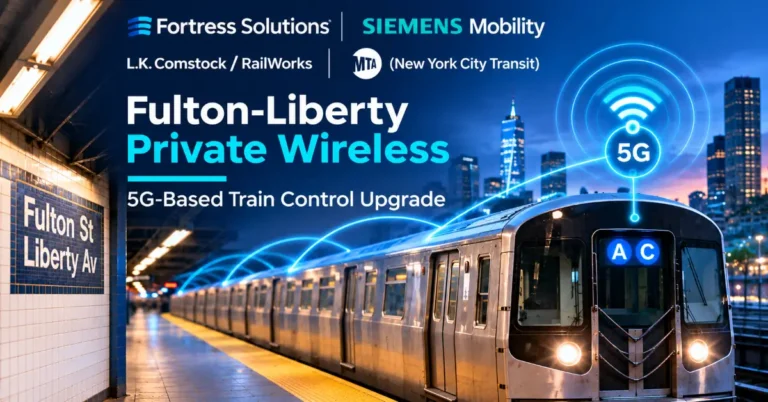
Fortress Solutions has been selected to deliver private wireless network integration for the Communications-Based Train Control (CBTC) upgrade on New York City’s Fulton-Liberty Line, which carries the A and C trains. The network will be the communications backbone for Siemens Mobility’s Trainguard MT system, which uses 5G-based radio, as part of a $1.9 billion MTA project led by L.K. Comstock.

The 17 November 2026 announcement adds another piece to a contracting picture that has built up over the past year. L.K. Comstock and Railworks won the design-build contract in December 2025, Siemens Mobility and L.K. Comstock announced the CBTC award in April 2026, and Governor Kathy Hochul marked the start of construction in October 2026. Fortress now takes on the wireless layer that connects every train to the control system.
Why private wireless on the Fulton-Liberty Line matters
In CBTC, the radio network is not a convenience. It is part of the signalling system. Trains report their position and speed continuously over the wireless link, and the control system sends back movement authorities in real time. If the network fails, trains fall back to restricted operation. That puts private wireless in the same category as track, power and interlockings: safety-critical infrastructure that has to work every second of every day.
The Fulton-Liberty project matters for three reasons:
- Scale. The MTA describes it as the largest signal and track replacement project in its history, covering 42 track miles and 23 stations from High St in Brooklyn to Ozone Park-Lefferts Blvd in Queens.
- Technology shift. Siemens Mobility’s system integrates interlocking and train control functions and introduces 5G-based radio communications for train control, alongside axle counters that replace older track circuits.
- Ridership. About 350,000 weekday riders use the stations in the project area, and the A and C lines serve 750,000 weekday riders across their full routes.
Signal problems are the leading cause of subway delays in New York, and much of the equipment being replaced dates from the 1930s. Replacing it with CBTC is a reliability project first. But it is also one of the largest examples in North America of a transit authority placing a private cellular network at the centre of train operations.
Who does what in the Fulton-Liberty Line private wireless and CBTC project
The project brings together a transit owner, a prime contractor, a signalling vendor and a wireless integrator. Their roles, as described in their own announcements, are set out below:
| Organisation | Role | Key details |
| MTA (New York City Transit) | Owner and funder | $1.9 billion project funded through congestion pricing; completion expected in Q2 2032 |
| L.K. Comstock and Railworks | Design-build contractor | Awarded December 2025; design-build model shifts much of the project risk to the contractor |
| Siemens Mobility | CBTC technology provider | Trainguard MT CBTC with 5G-based wireless communication; nearly $390 million contract announced April 2026 |
| Fortress Solutions | Private wireless integrator | RF design, product planning and acquisition, and network integration for the wireless network supporting CBTC |
Fortress describes the network it is integrating as compliant with the New York Subway Interoperability Interface Specifications (I2S), the standard that allows equipment from different CBTC suppliers to work together across the subway. Interoperability matters in a system where trains and lines are upgraded over decades by different vendors, and the I2S requirement means the wireless layer has to fit a wider architecture, not just one line.
John Shelnutt, CEO of Fortress Solutions, described private wireless as the backbone of modern train control and said the company is helping enable the reliable, real-time communications the project depends on.
Tobias Bauer, CEO of Siemens Mobility North America, said when the CBTC contract was announced that the modernisation is a step to improve the everyday commute for millions of New Yorkers.
What the Fulton-Liberty Line private wireless network will enable
The performance case for CBTC is well documented on the New York subway itself. After CBTC was activated on the 7 line, on-time performance rose from 68% to 91%, and on the E line in Queens train speeds increased by about 10%. Those are MTA-reported results from earlier projects, and they set the benchmark for what Fulton-Liberty is expected to deliver.
For the A and C lines, the new system is designed to support:
- Closer train spacing. Trainguard MT is designed to allow trains to run as close as 90 seconds apart, increasing capacity on a busy corridor.
- Lower maintenance. CBTC equipment is less expensive and easier to maintain than the legacy signals, and axle counters reduce reliance on trackside track circuits.
- Rider connectivity. The project includes infrastructure to support future cell service for riders, with 5G connectivity referenced by both Siemens Mobility and Fortress.
- Lower cost per mile. The MTA expects the project to cut signal modernisation costs per mile by a third compared with the average for earlier CBTC projects, by installing only CBTC rather than maintaining legacy signals in parallel and by maximising planned service outages.
What the Fulton-Liberty Line says about private wireless in rail
Many first-generation CBTC systems around the world were built on Wi-Fi-derived radio links in unlicensed spectrum. Newer projects are increasingly moving to cellular technology, first LTE and now 5G, because it offers better handover performance at speed, stronger quality-of-service controls and a clearer long-term roadmap. Fulton-Liberty adds a high-profile North American example to that trend.
The same direction is visible on mainline railways, where the Future Railway Mobile Communication System (FRMCS) is being built on 5G to replace GSM-R. Urban metros and national railways are converging on the view that cellular private networks are the long-term foundation for train control, operational voice and data, and passenger services.
The project also shows how the private wireless supply chain is forming in rail. A signalling vendor defines the train control system and its radio requirements, a prime contractor carries delivery risk, and a specialist integrator designs and builds the RF layer to meet them. For transit agencies planning their own upgrades, that division of responsibility is a useful reference point, especially around who owns radio performance once the system is live.
What comes next for the Fulton-Liberty Line private wireless rollout
Construction has started, and the first phase covers aging switches and more than 250 feet of specialised track between 104 St and 99 St in Queens. The milestones to watch over the coming years include:
- RF design and site work for the private wireless network along the underground and elevated sections of the corridor.
- Integration testing between the wireless layer and Siemens Mobility’s Trainguard MT system, including I2S interoperability.
- Phased CBTC cutovers on the A and C lines, with planned service outages to speed installation.
- Deployment of infrastructure for rider cell service within the project footprint.
- Full project completion, expected in the second quarter of 2032.
Some details are not yet public. The announcements do not specify the spectrum band or the radio equipment vendor for the private network, nor the value of Fortress’s contract. Those details, along with performance data once sections go live, will show how the 5G-based design performs in one of the world’s most demanding subway environments.
Fulton-Liberty is part of a wider programme. Congestion pricing is funding nearly 85 miles of signal modernisation, and the MTA’s 2025-2029 Capital Plan allocates $5.4 billion for more than 75 miles of CBTC on further lines. If the private wireless approach on the A and C lines delivers, it is likely to shape how the rest of that programme is built. For deeper coverage of private network deployments across transport and critical infrastructure, explore TeckNexus Private Network Intelligence.
For more analysis like this, subscribe to the TeckNexus Newsletter, explore our 2027 programs, or partner with us to share your perspective and generate leads.