


What is the Keysight and Cohere multi-drone ISAC testing platform?
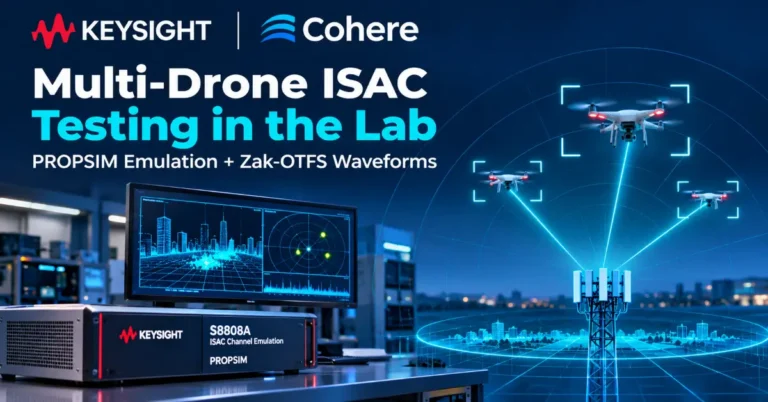
Keysight Technologies has expanded its integrated sensing and communications (ISAC) emulation tools and is working with Cohere Technologies to validate multi-drone sensing in the lab. The pairing combines Keysight‘s S8808A ISAC Channel Emulation Toolset, built around its PROPSIM real-time channel emulator, with Cohere’s multi-waveform physical layer, which supports both 5G OFDM and Cohere’s Zak-OTFS-based Pulsone technology. The aim is to test drone detection and tracking repeatably before field trials.

The 17 November 2026 announcement adds a missing step to the ISAC story. Earlier this month, defence contracts and vendor launches showed that mobile networks can be turned into drone sensors. This collaboration focuses on how those systems get tested and validated before they go anywhere near a live network.

Why multi-drone ISAC testing matters
ISAC lets a mobile network use its own radio signals to detect objects that are not connected to it, such as drones. As TeckNexus covered in our analysis of Nokia Federal’s and Ericsson’s November ISAC announcements, defence funding and critical infrastructure protection are pulling this capability from 6G research into the 5G era.
The hardest case is not a single drone. It is several drones flying close together, changing speed and direction quickly. That creates fast-changing, high-Doppler radio conditions with many closely spaced moving targets, which are expensive and difficult to recreate in field tests. Flying real drone swarms through a cellular test site is slow, weather-dependent and hard to repeat exactly, which makes it a poor way to compare algorithms or waveforms.
Lab emulation addresses three problems at once:

- Repeatability. The same scenario can be replayed many times, so developers can compare waveforms, algorithms and software versions fairly.
- Scale. Keysight’s toolset supports hundreds of simultaneous sensing targets, far more than most field trials can stage.
- Risk and cost. Problems found in the lab are cheaper to fix than problems found during a live demonstration for a defence or infrastructure customer.
What the Keysight ISAC emulation toolset does for multi-drone testing
The S8808A combines real-time radio frequency channel emulation in PROPSIM, site-specific modelling and automated test workflows. Its main capabilities are summarised below:
| Capability | What Keysight says it supports | Why it matters for drone sensing |
| Target scale | Hundreds of simultaneous sensing targets | Recreates swarms and crowded airspace, not just single drones |
| Sensing geometry | Monostatic, bistatic and multistatic configurations | Matches how a network might use one site or several cooperating sites to sense |
| Target modelling | Radar cross-section (RCS) models for different real-world targets | Helps distinguish drones from birds, vehicles and other objects |
| RF digital twins | Site-specific, ray-traced environments | Tests performance against the real layout of a city, port or base |
| Antennas | Massive MIMO, including large antenna arrays for 6G research | Reflects the beamforming used in modern radio units |
| Spectrum | 5G FR1, FR2 and FR3 up to 18 GHz, with up to 400 MHz instantaneous bandwidth | Covers today’s bands and the upper mid-band being studied for 6G |
| Automation | APIs for agentic AI tools and automated test flows | Allows large test campaigns to run with less manual effort |
Peng Cao, Vice President and General Manager of Keysight’s Wireless Test Group, said the company is helping the 6G ecosystem accelerate innovation with greater confidence, and that the collaboration supports more repeatable ISAC validation while reducing risk in moving from research to deployment.
How Cohere’s waveform fits into multi-drone ISAC testing
Cohere’s contribution is the physical layer under test. Its multi-waveform stack runs on the open OCUDU software stack and supports both conventional 5G OFDM and Pulsone, Cohere’s technology based on Zak-OTFS (Zak-Orthogonal Time Frequency Space).
The difference matters for sensing. OFDM, the waveform used in 4G and 5G, was designed for communications. Zak-OTFS works natively in the delay-Doppler domain, which is the same way radar systems describe the range and speed of a target. That makes it a natural fit for tracking fast-moving objects such as drones, and it is exactly the kind of high-Doppler behaviour the Keysight emulator is designed to recreate.
Dr Anton Monk, SVP Technology Strategy at Cohere Technologies, described Cohere’s Multi-Waveform RAN programme as turning a commercial cellular base station into an integrated sensing and communications platform, able to detect, classify and track drones while carrying normal 5G traffic. He added that lab validation comes before moving to field testing.
The defence programme behind Cohere’s ISAC work
The collaboration is closely tied to US defence funding. In July 2026, Cohere announced a $28 million contract from the FutureG Office within the US Department of War for the procurement of a multi-waveform RAN for ISAC. The award expands on a National Science Foundation VINES Phase 2 project.
The prototype under that contract is designed to deliver:
- Detection, classification, tracking and defeat-cueing of drone threats in commercial spectrum bands.
- Sensing on existing and future commercial 5G and 6G infrastructure, which makes the sensing activity hard to distinguish from normal cellular traffic.
- Layered inference that converts raw delay-Doppler data into real-time 3D tracks with classification and confidence scoring.
- Testing across monostatic, bistatic and multistatic set-ups, including a mobile test platform and realistic outdoor sites.
The contract also requires compliance with the FutureG Office’s OCUDU platform and Zero Trust security requirements. Alongside defence uses such as battlefield awareness, border security and critical infrastructure protection, Cohere lists commercial applications including advanced air mobility, smart city traffic management and public safety.
Multi-drone ISAC testing: what is available and what is still planned
As with much of the ISAC market, it is important to separate what exists today from what comes next:
| Status | Item |
| Available now | Keysight’s S8808A toolset with FR1, FR2 and FR3 support up to 18 GHz and 400 MHz bandwidth |
| Enabled by the collaboration | Lab-based validation of Zak-OTFS waveforms for multi-drone ISAC use cases |
| Funded and under way | Cohere’s $28 million FutureG Office prototype programme for multi-waveform ISAC |
| Planned | Field testing of Cohere’s physical layer after lab validation |
| Not yet published | Multi-drone test results, pricing and field-test timelines |
What multi-drone ISAC testing means for the wider market
For operators, the arrival of dedicated ISAC test tools is a sign that sensing is becoming an engineering discipline rather than a research demo. Any operator offering sensing as a service to defence, airports, ports or energy sites will need evidence that the system performs to a defined level, and repeatable lab validation is how that evidence is built.
For network equipment vendors, the Keysight platform offers a common way to compare approaches. The industry is currently exploring ISAC on standard 5G OFDM, on AI-RAN platforms and on new waveforms such as Zak-OTFS. A shared emulation environment makes it easier to show customers how each approach performs under the same conditions.
For defence and critical infrastructure buyers, the multistatic and RF digital twin capabilities are especially relevant. Protecting a large site from drones usually means combining several base stations, and testing that cooperation against a model of the real site is far more practical in a lab than in the field.
For standards work, waveform choice will be one of the most important ISAC questions for 6G. Lab platforms that can test OFDM and alternative waveforms side by side will help produce the evidence that standards bodies need to make that call.
What comes next for multi-drone ISAC testing
Several developments will show how quickly lab validation turns into deployable capability:
- Publication of multi-drone test results from the Keysight and Cohere collaboration.
- Field testing of Cohere’s multi-waveform physical layer under the FutureG Office programme.
- Adoption of the S8808A toolset by other ISAC developers, including vendors working on ISAC over standard 5G and AI-RAN platforms.
- Progress in 3GPP and other standards bodies on sensing requirements and the role of new waveforms in 6G.
This month has shown ISAC moving on three fronts at once: defence contracts, vendor products and now test and validation tools. The last of these gets the least attention, but it is what allows the first two to move from promising demonstrations to systems that customers can trust.
For more analysis like this, subscribe to the TeckNexus Newsletter, explore our 2027 programs, or partner with us to share your perspective and generate leads.