Zero Trust

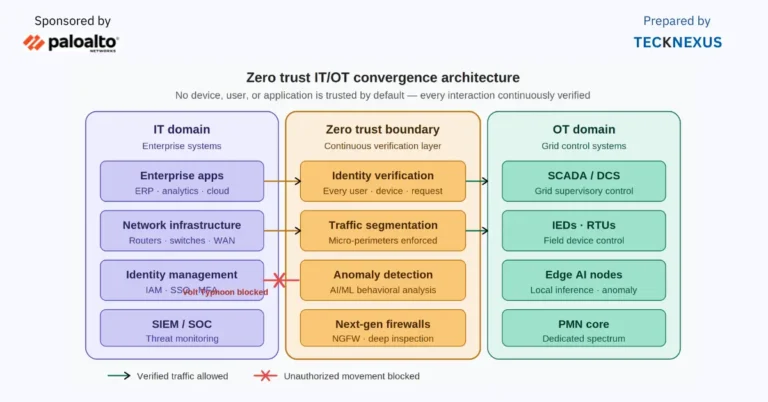
Volt Typhoon wasn't just a cyberattack - it was a strategic warning about the IT/OT boundary every utility now operates across. Zero trust is the only security model built for this threat environment, and private mobile networks are the foundation that makes it implementable. Here's what utilities need to know — and act on now.
AT&T’s five-year, $250 billion U.S. network commitment sets the tone for the next phase of fiber, 5G, and satellite convergence as traffic, AI workloads, and resilience requirements climb sharply. The 2026–2030 window aligns with the industry’s transition into 5G-Advanced (3GPP Release 18/19), the scaling of edge AI, and increased cloud traffic between homes, enterprises, and hyperscalers. Data growth is no longer linear, and the cost of downtime is rising. Large, front-loaded builds in fiber and 5G Radio Access Network (RAN), paired with new satellite overlays, are how national carriers will chase coverage, performance, and reliability targets simultaneously.
NTT DATA’s private 5G rollout across 50 Cargill facilities signals that industrial connectivity is moving from pilot projects to standardized, multi-site execution. NTT DATA has deployed private 5G at Cargill manufacturing and processing locations worldwide—mostly in the United States with live sites in Europe—enabling a connected workforce, robotics, and edge AI across plants that are often too large and complex for conventional Wi‑Fi or wired networks to cover reliably. Manufacturers are consolidating on common digital platforms and need predictable, low-latency wireless for operational data, mobile human–machine interfaces, and autonomous systems; private 5G—built on 3GPP standards with SIM-based security and policy-based QoS—offers deterministic performance at scale where legacy networks struggle.
SK Telecom introduced ATHENA—an architecture grounded in AI-native operations, Zero Trust security, hyper-connectivity, openness, and cloud-native design—to guide mid- to long-term evolution across RAN, core, transport, and network data platforms. The operator positions “AI for network” and “network for AI” as dual tracks: the former embeds AI into decision loops for autonomous optimization, while the latter tunes the network fabric to serve AI workloads efficiently. SK Telecom will showcase related technologies at MWC Barcelona 2026, including AI agents for networks, AI-RAN for combined connectivity and compute, device-side AI for antenna tuning, and integrated sensing-and-communications.
KDDI and Nokia validated quantum-safe optical transport at KDDI’s new Sakai Data Center, a facility built to support real-time AI training, inference, and analytics. The demonstration used Nokia’s 1830 Photonic Service Switch with C+L band capabilities for capacity scaling and the 1830 Security Management Server for centralized key and policy control. The goal is clear: deliver high-throughput, low-latency, and line-rate encrypted data center interconnect (DCI) that is resilient against both today’s threats and tomorrow’s quantum-era risks. Encrypting at the optical layer removes the performance penalties of application or IP-layer encryption and avoids fragmenting security by workload.
Private LTE, 5G, and CBRS networks are becoming the backbone of industrial operations. This article maps private network security vendors to a Four Pillars framework—Core Controls, Device Visibility, Detection & Response, and Orchestration—revealing where structural gaps emerge in real-world industrial deployments. From slice isolation and SIM lifecycle governance to OT micro-segmentation and SOC integration, it explains why layered enforcement—not vendor breadth—determines private 5G security resilience.
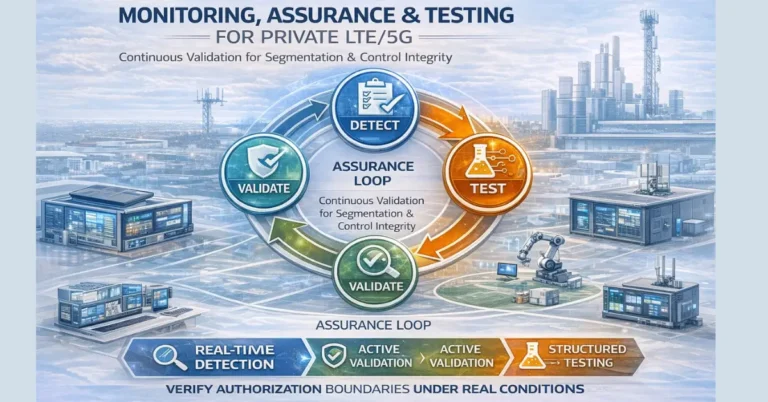
Private LTE and 5G security does not fail because of flawed architecture—it fails when enforcement controls degrade silently. This guide explains how enterprises implement continuous monitoring, assurance, and testing loops across control-plane signaling, user-plane routing, identity governance, and industrial OT environments. Learn how to validate segmentation integrity, detect policy drift, test Zero Trust enforcement, and produce audit-ready evidence across multi-site private cellular deployments.
Private LTE and 5G networks strengthen authentication at the transport layer—but device identity, lifecycle governance, and OT/IoT realities determine whether containment holds. This in-depth guide explains SIM and eSIM authentication models, service-profile authorization, identity drift risks, industrial gateway mediation, and Zero Trust containment strategies across multi-site private cellular deployments.
This Zero Trust security blueprint for Private LTE and 5G networks explains how session-based authorization, control-plane policy decisions, and user-plane enforcement create deterministic micro-segmentation across industrial and OT environments. Mapping private cellular architecture to NIST SP 800-207, the article details how operational zones, service profiles, and containment principles protect production-critical systems under mobility and scale.
Private LTE and 5G networks introduce new security challenges as they become the foundation for industrial automation, critical infrastructure, and enterprise campuses. Unlike Wi-Fi and traditional IT networks, private cellular environments blend telecom infrastructure, IT systems, and operational technology, creating distinct threat surfaces across the RAN, core, edge, devices, and management planes. This article establishes a security-first architectural lens for private LTE/5G, explaining who needs it, where risks emerge, and what secure-by-design looks like before moving into Zero Trust and implementation frameworks.
Boingo Wireless is integrating Globalstar’s XCOM RAN to accelerate private 5G across airports, stadiums, hospitals, convention centers, transit hubs, and military bases. Globalstar said Boingo will add XCOM RAN, a software-defined private 5G platform built around the Supercell architecture, to its private network portfolio. A highlighted approach is overlaying XCOM RAN on existing distributed antenna system (DAS) infrastructure to preserve DAS coverage advantages while boosting capacity and performance. Enterprises are moving beyond pilot projects to operational private 5G in high-traffic, RF-challenged environments. This aligns with rising demand for low-latency, secure connectivity for IoT, video, automation, and mission-critical operations.
Airspan plans to supply a 5G Air-to-Ground (ATG) system for Space Compass’s High-Altitude Platform Station (HAPS) program, using an aircraft operating around 16–18 km to act as a stratospheric node for maritime monitoring. The end-to-end solution—airborne radios and antennas, onboard 5G processing, and a complete ground-based 5G RAN, core, and management stack—targets secure command-and-control plus real-time sensor data exchange between the HAPS and ground stations up to roughly 300 km away. After lab and pre-flight work, the team intends to validate the system on a light aircraft in 2026, followed by stratospheric trials in 2027.

Your Brand. Our Intelligence Tools.

Capture leads at the point of evaluation. Talk to Us →

Sponsored by Palo Alto Networks
⚡ Utilities ⏱ 8 min ✓ Free
This tool is built and hosted by TeckNexus.
Launch Tool →
Whitepaper
This whitepaper explains how utilities can use secure AI-enabled private mobile networks to modernize operations, support distributed intelligence, improve resilience, and strengthen cybersecurity across critical infrastructure. It covers AI applications, private network advantages, zero trust principles, multilayered security architecture, and governance considerations for AI-ready utility environments....
Whitepaper
Non-terrestrial networks are rapidly evolving from experimental satellite systems into an increasingly important part of the global 5G connectivity landscape. This eBook, developed by Radisys in collaboration with TeckNexus, explores how 3GPP standardization, satellite architecture innovation, and software-driven network design are reshaping NTN deployment models. It examines the transition from...
Whitepaper
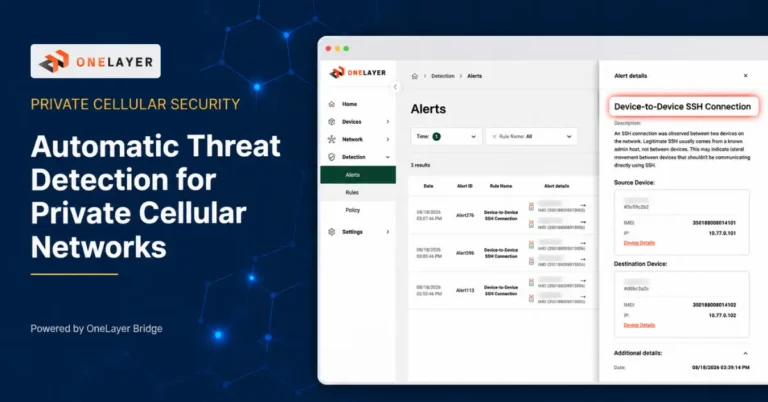
Private cellular networks are transforming industrial operations, but securing private 5G, LTE, and CBRS infrastructure requires more than legacy IT/OT tools. This whitepaper by TeckNexus and sponsored by OneLayer outlines a 4-pillar framework to protect critical systems, offering clear guidance for evaluating security vendors, deploying zero trust, and integrating IT,...
Scroll to Top

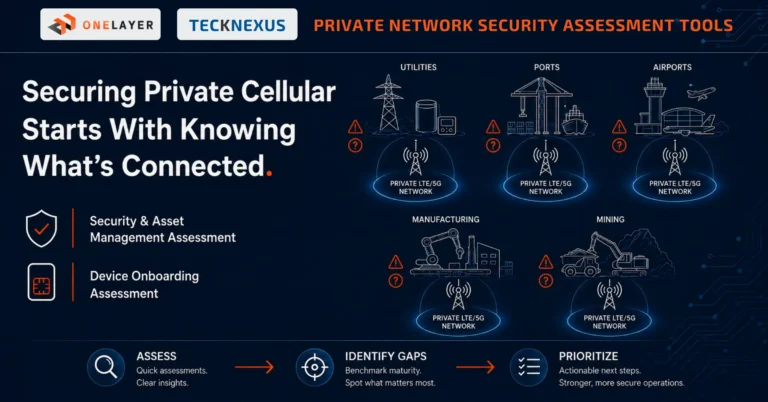
Map your security gaps to real threat scenarios – including Salt Typhoon, Volt Typhoon, AI data poisoning, rogue devices, and unencrypted OT traffic.

Take the free 8-minute assessment built for utility operators evaluating AI-enabled private mobile networks. Get a readiness score across five critical domains, see where your gaps are, and receive a prioritized action plan for what to fix first.

Free • 8 minutes • Built for private network security