AI Agent Competitive
Intelligence
Intelligence Journeys
AI Use Cases for Utilities
Private Broadband for Utilities

Zero Trust

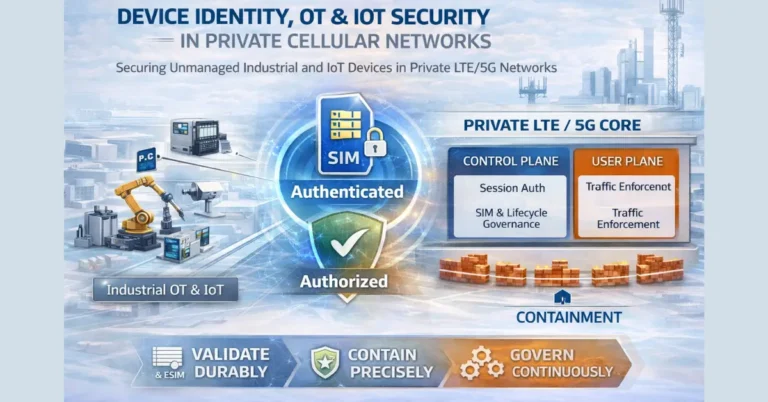
Private LTE and 5G networks strengthen authentication at the transport layer—but device identity, lifecycle governance, and OT/IoT realities determine whether containment holds. This in-depth guide explains SIM and eSIM authentication models, service-profile authorization, identity drift risks, industrial gateway mediation, and Zero Trust containment strategies across multi-site private cellular deployments.
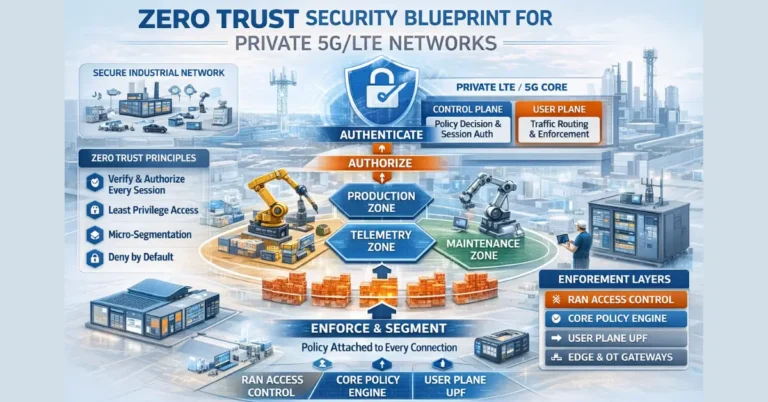
This Zero Trust security blueprint for Private LTE and 5G networks explains how session-based authorization, control-plane policy decisions, and user-plane enforcement create deterministic micro-segmentation across industrial and OT environments. Mapping private cellular architecture to NIST SP 800-207, the article details how operational zones, service profiles, and containment principles protect production-critical systems under mobility and scale.
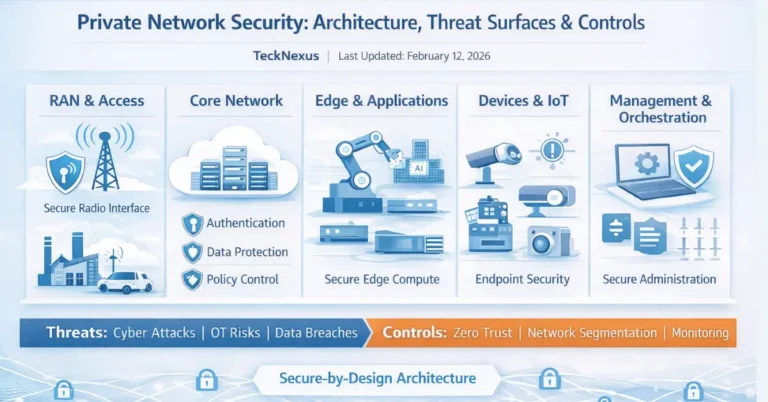
Private LTE and 5G networks introduce new security challenges as they become the foundation for industrial automation, critical infrastructure, and enterprise campuses. Unlike Wi-Fi and traditional IT networks, private cellular environments blend telecom infrastructure, IT systems, and operational technology, creating distinct threat surfaces across the RAN, core, edge, devices, and management planes. This article establishes a security-first architectural lens for private LTE/5G, explaining who needs it, where risks emerge, and what secure-by-design looks like before moving into Zero Trust and implementation frameworks.
Boingo Wireless is integrating Globalstar’s XCOM RAN to accelerate private 5G across airports, stadiums, hospitals, convention centers, transit hubs, and military bases. Globalstar said Boingo will add XCOM RAN, a software-defined private 5G platform built around the Supercell architecture, to its private network portfolio. A highlighted approach is overlaying XCOM RAN on existing distributed antenna system (DAS) infrastructure to preserve DAS coverage advantages while boosting capacity and performance. Enterprises are moving beyond pilot projects to operational private 5G in high-traffic, RF-challenged environments. This aligns with rising demand for low-latency, secure connectivity for IoT, video, automation, and mission-critical operations.
Airspan plans to supply a 5G Air-to-Ground (ATG) system for Space Compass’s High-Altitude Platform Station (HAPS) program, using an aircraft operating around 16–18 km to act as a stratospheric node for maritime monitoring. The end-to-end solution—airborne radios and antennas, onboard 5G processing, and a complete ground-based 5G RAN, core, and management stack—targets secure command-and-control plus real-time sensor data exchange between the HAPS and ground stations up to roughly 300 km away. After lab and pre-flight work, the team intends to validate the system on a light aircraft in 2026, followed by stratospheric trials in 2027.
The next wave of digital transformation will be defined by AI workloads riding on cloud and edge infrastructure over 5G networks, and that shift will change how networks are built, monetized, and secured. Generative and agentic AI move more compute into the network, creating persistent, uplink-heavy, low-latency flows rather than the mostly downlink, best-effort traffic of the smartphone era. Video from cameras, glasses, and sensors feeds models at the edge and in the cloud; results return in milliseconds to people and machines. That means tighter latency budgets, deterministic jitter control, and stronger guarantees for both throughput and reliability.
TeraWave combines 5,280 low Earth orbit satellites with 128 medium Earth orbit satellites—5,408 spacecraft in total—tied together via optical inter-satellite links. The design targets global coverage with two distinct performance tiers: up to 144 Gbps symmetrical RF links per enterprise customer using Q/V-band in LEO, and optical links in MEO delivering up to 6 Tbps for high-throughput trunking between hubs. Blue Origin positions the service for point-to-point private links and enterprise-grade internet access, with an initial target of up to 100,000 customers. The company intends to launch on its own New Glenn vehicles and leverage reusable engines to scale deployment.
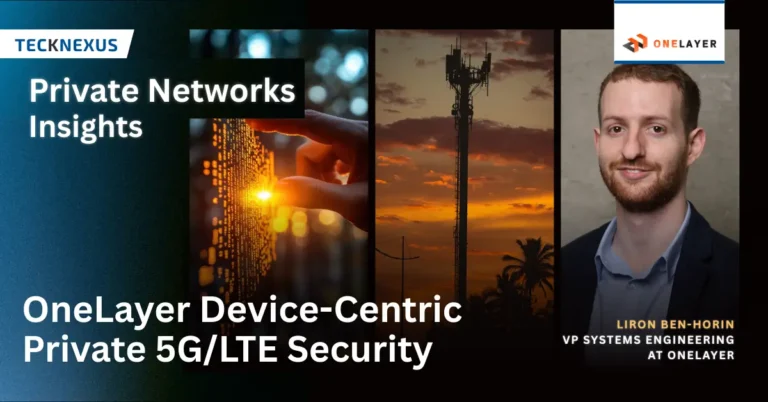
OneLayer wins “Excellence in Private Network Security” for its innovative platform providing device-level visibility, Zero Trust access control, and real-time threat detection across LTE and 5G enterprise environments. Purpose-built for private cellular networks, OneLayer enables IT and OT teams to secure and manage all connected assets—including non-cellular devices—through unified device identities and context-aware security.
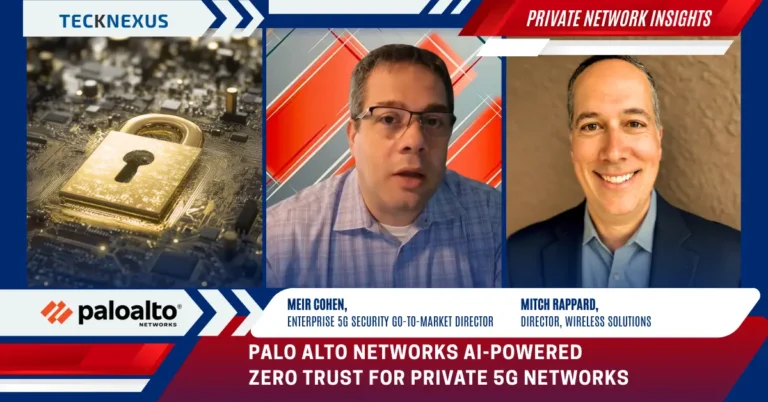
Palo Alto Networks wins “Excellence in Private Network Security” for its AI-powered Zero Trust platform securing private 4G and 5G networks. Built for mission-critical environments, the solution delivers end-to-end protection across core, edge, and cloud—enabling carriers, enterprises, and critical infrastructure operators to deploy private wireless networks securely, at scale, and with confidence.
The FAA has tapped Peraton as prime integrator for a multi‑year modernization of the National Airspace System (NAS), setting in motion a telecom-heavy refresh of networks, radios, and control systems at national scale. The FAA selected Peraton, owned by Veritas Capital, as the single program integrator to manage an initial $12.5 billion upgrade of the aging U.S. air traffic control system. Officials are targeting a three-year execution window to cut outages, improve efficiency, and reinforce safety across the NAS, with additional funding in the $19–20 billion range likely required to fully complete the plan.
Private cellular networks are transforming industrial operations, but securing private 5G, LTE, and CBRS infrastructure requires more than legacy IT/OT tools. This whitepaper by TeckNexus and sponsored by OneLayer outlines a 4-pillar framework to protect critical systems, offering clear guidance for evaluating security vendors, deploying zero trust, and integrating IT, OT, and IoT under a unified, secure-by-design architecture.

Partner Hubs

Download content, access intelligence tools, and hear from executives.

Partner Events

  • FutureNet Asia 2026
  • Network X Vienna 2026
Scroll to Top