


In the second quarter of 2026, telecom operators started reporting AI the way they report their networks: in volumes, response times and revenue. Verizon said it executed more than 70 million network configuration changes autonomously in 2025. Openreach cut missed appointments by a third with AI agents. T-Mobile and Ericsson measured AI-RAN gains on live traffic. And China’s three operators began selling AI by the token, priced like a data plan.
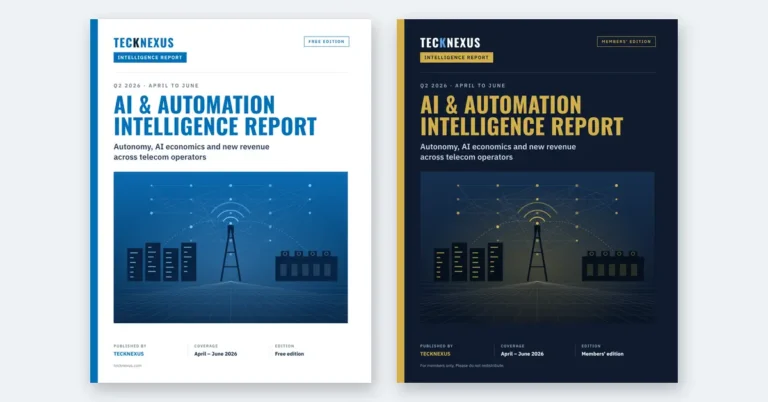
The TeckNexus AI & Automation Intelligence Report, Q2 2026 brings those results together. It covers April, May and June, draws on 253 curated updates from the TeckNexus AI & Automation Monthly Insights archive, and checks every figure against its original source. The free edition is available to download now, and the members’ edition adds four analysis panels and three data annexes.
Why this report tracks value, not volume
Telecom AI news is dominated by announcements: partnerships, platforms, model launches and capacity plans. Counting them shows activity, not results. This report tracks the figures that change a decision for an operator: how much work AI now does in the network, what it costs to run, what it earns, and how far AI-RAN has moved from lab to live traffic.
Every figure is credited by name to the organisation it belongs to, and to whoever published it when that is someone else. Figures that are not measured results are marked as an estimate, target, plan or survey, so a projection is never read as an outcome. Opinion surveys sit in their own clearly marked panel.
Key findings from Q2 2026
- Autonomy is now measured in volume. Verizon executed more than 70 million network configuration changes autonomously in 2025 and is pushing for Level 4 autonomy in critical segments of its core network. It also gave its whole technology workforce, about 33,000 people, access to Claude Code.
- AI agents are moving field and customer KPIs. Openreach cut missed appointments and inbound contacts by a third across 15 million customer journeys, NiCE reports. Circles says its CareX agent resolves 85% of customer queries without people, and Circles.Life Singapore saw a 22% ARPU uplift in the first phase of Xplore IQ.
- AI-RAN reached a commercial trial. T-Mobile and Ericsson report close to 10% better spectral efficiency and up to 15% more downlink throughput from AI-native link adaptation across about 43 sites, running on purpose-built hardware rather than GPUs.
- Sovereign AI became a product operators sell. TELUS grew its AI-enabling capabilities 22% in Q1, sold out its first Sovereign AI Factory within months, and targets about C$2 billion by 2028. BT, Bell, Ooredoo and Tele2 each announced sovereign AI builds with partners.
- Operators started pricing AI in tokens. China’s three operators launched token packages in May. China Telecom’s consumer plans start at 9.9 yuan a month for 10 million tokens, and Shanghai Telecom sells 250,000 credits for one yuan across more than 30 models.
- Rule dates moved. The EU agreed to push high-risk AI obligations to December 2027 for standalone systems and August 2028 for embedded ones, and eight US operators and providers formed C2 ISAC to share threat intelligence in an AI era.
What the numbers mean for operators and suppliers
For operators, the quarter sets a new standard for reporting. The strongest figures were stated in units an operator already manages: changes executed, appointments missed, queries resolved, spectral efficiency and revenue. Those are the measures to ask of any AI programme or vendor, and the report’s six operator moves turn them into practical steps, from reporting autonomy in changes executed to putting AI-RAN into commercial trials with agreed KPIs.
For suppliers, the opportunity is shifting from pilots to measured production and to the commercial plumbing around AI: token metering and billing, sovereign capacity and agent governance. The gaps matter too. Few operators disclosed take-up of their AI plans, AI spend, or what their sovereign capacity earns, and the report flags each of those gaps where it appears.
What’s inside the report
Free edition (7 pages): key findings, measured outcomes, six operator moves and the methodology.
Members’ edition (16 pages): everything in the free edition, plus panels on autonomous operations, AI economics, AI revenue and capacity, and AI-RAN with a standards and rules clock; a research panel on customer and breach data; and three data annexes: a stat ledger with a linked source for every figure, a register of 44 named operator AI activities from the quarter, and a benchmark worksheet.
Who the report is for
Operator leaders in network operations, IT and AI, customer experience, product and strategy use the report to see which AI uses are producing measurable results and to benchmark their own programmes. Network and OSS/BSS vendors, hyperscalers, model providers, chip makers and integrators use it to see which proof points operators recognise and how their own case studies compare. Investors, regulators and standards bodies use it as a sourced quarterly view of how operators are using, building and selling AI.
How the report is built
The report is built from the TeckNexus AI & Automation Monthly Insights archive for April, May and June 2026. Every figure was checked against its original source, with primary sources such as company releases and regulator publications used wherever available. Items first reported before April were excluded. Figures appear as the source states them, including approximations, and currencies are not converted.
Operators and suppliers with measured AI results can feature them in an upcoming edition through the 2027 Telecom AI & Next-Gen Networks program.





