


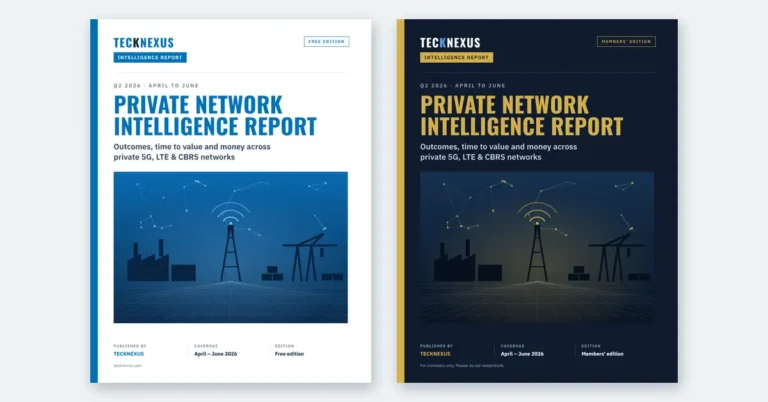
Private networks have moved past the question of whether they work. The questions that now shape budgets and contracts are more practical: what results do deployments deliver, how quickly do they go live, what do they cost, and where are the long poles in the plan? The TeckNexus Private Network Intelligence Report answers those questions every quarter.
The Q2 2026 edition covers April, May and June. It draws on more than 130 curated updates from the TeckNexus Private Network Monthly Insights archive, with every headline figure checked against the original source article. The free edition is available to download now, and a members’ edition adds the full data annexes.
Why this report tracks value, not volume
Counting deployments tells you a market is growing. It does not tell you whether a design will cover your factory with fewer radios, how much installation will cost, or how long spectrum and approvals will take. This report focuses on the figures that change a decision: outcomes measured in operational units, time to value, disclosed spend, the size of real deployments and the policy changes that open or close options.
Every figure carries one of four labels: Enterprise, when the deploying organisation reported it; Vendor, when a solution provider reported it; Public, for government and regulator records; and Research, for independent analysis. That makes it easy to weigh each number before it goes into a business case.
Key findings from Q2 2026
- One 5G access point covers the area of about nine Wi-Fi access points. Cargill reported the 9:1 ratio across its factory deployments and cut cabling and setup costs by 70%, even where 5G equipment cost more than Wi-Fi. Its network guarantees 100 Mbps down and 50 Mbps up per connection.
- AI is unlocking more capacity from existing spectrum. Federated Wireless reported up to 5x network capacity and up to 50% fewer sites for equivalent coverage from AI-driven coordination of shared CBRS spectrum, with up to 40% lower deployment cost.
- Industrial networks are carrying sensor fleets at scale. CIMPOR connected more than 10,000 sensors across three cement plants with Vodafone Portugal and Ericsson, reporting sub-10 ms latency and up to $1M a year in avoided downtime per plant.
- Deployable networks are getting fast. Anduril and Nokia Federal Solutions’ 5G Comms Sentry Tower can be operational in under three hours, and Sumitomo Electric’s edge-AI safety system raised factory warnings in under 150 milliseconds.
- The largest disclosed program was national. Brazil activated the first phase of its US$193M federal private communications network, connecting four security and defence agencies, with completion set for 2027.
- CBRS is the US default, and its administration is changing. About three-quarters of US private 5G networks use CBRS today, with 86% of manufacturing networks projected to by 2032. Google announced it will exit the CBRS Spectrum Access System business within 12 months.
What the numbers mean for buyers and suppliers
Taken together, Q2 shows the economics of private networks being decided as much by design and installation as by equipment price. A design that needs a ninth of the radios, plugs into existing infrastructure and avoids new cabling changes the business case before any outcome is counted. The report’s buyer moves turn that into practical steps: compare designs on access-point count, price the full installation, ask what AI coordination can unlock from spectrum you already hold, and define outcomes in operational units before go-live.
For solution providers, the quarter shows which proof points carry weight. The strongest figures were specific, measured and tied to a named site, such as CIMPOR’s downtime savings or Cargill’s access-point ratio. Those are the numbers buyers are now asking for.
What’s inside the report
Free edition (7 pages): key findings, outcomes, six buyer moves and the methodology.
Members’ edition (16 pages): everything in the free edition, plus time to value, money, scale and the policy clock across nine markets, and three data annexes: a stat ledger with a linked source for every figure, a register of 38 named Q2 deployments and their delivery partners, and a benchmark worksheet for your own business case.
- Download the free edition: [FREE DOWNLOAD URL]
- Get the members’ edition: [MEMBERSHIP SIGN-UP URL]
Who the report is for
Solution providers, integrators and operators use the report to see where the market is producing measurable results, which proof points buyers will recognise, and how their own case studies compare. Enterprise teams planning or expanding a private network use it to set realistic expectations for coverage, cost and timelines, and to prepare sharper questions for partners. Investors and analysts use it as a sourced snapshot of how private networks are being bought and run.
How the report is built
The report is built from the TeckNexus Private Network Monthly Insights archive for April, May and June 2026. Headline figures were checked against the original articles, and every link in the members’ stat ledger was confirmed before publication. Figures appear as reported by the organisations involved, including approximations and maxima. Currencies are not converted.
Have measured results from a deployment? Feature them in an upcoming edition through the 2027 Private Networks & Industrial AI program: https://tecknexus.com/contact-us/
The TeckNexus Intelligence Platform is buyer-neutral and TeckNexus-authored. Vendor co-branded Intelligence Packs are labelled as such and kept separate from the neutral core tools.





