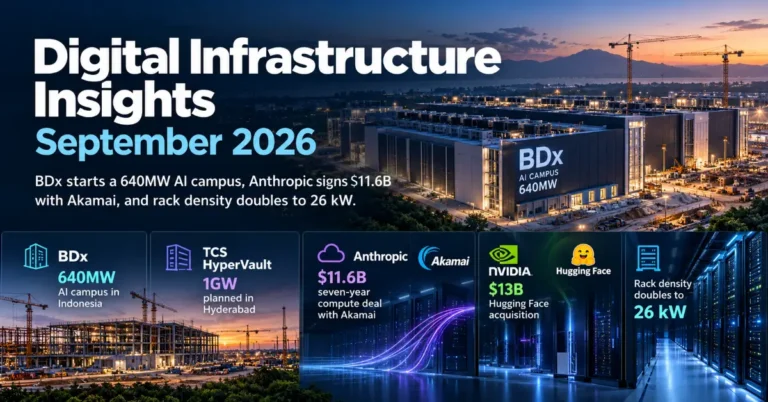
April 2026’s roundup: Samsung‘s Taylor fab comes online with 2nm production for Tesla‘s AI chips, Intel joins Elon Musk’s Terafab project targeting 1 terawatt of annual AI compute, Nokia and NVIDIA position telecom networks as distributed compute platforms, and hyperscalers commit tens of billions more to AI data centers across Asia-Pacific.

At a glance – Digital Infrastructure Insights for April 2026
- Samsung‘s Taylor, Texas fab began 2nm production, anchored by Tesla‘s next-generation self-driving AI chips — TeckNexus’s own headline story this month, following a 2022 groundbreaking backed by an initial $17B investment.
- Intel joined Elon Musk’s “Terafab” AI chip project alongside SpaceX, Tesla, and xAI, aiming to refactor silicon fabrication processes to enable production capacity equivalent to 1 terawatt of AI compute per year for orbital data centres and humanoid robots.
- Nvidia will invest $2B in Marvell, forming a strategic partnership linking Marvell to the Nvidia AI Factory and AI-RAN ecosystem via Nvidia’s NVLink interconnect.
- Microsoft committed $10B to expand AI data center capacity in Japan, and AWS announced a KRW 12.6 trillion investment in South Korea AI and cloud infrastructure through 2031.
- Nokia and NVIDIA are collaborating to position telecom networks as distributed compute platforms for AI workloads, extending accelerated computing to the network edge.
- Equinix launched an AI Discovery Hub in Hong Kong and Fabric Intelligence, an AI-native operational layer for multi-cloud networking, while TIA introduced new AI-focused data center standards.
1. Chip manufacturing capacity scales globally
Chip capacity expanded along two very different paths this month — one proven, one speculative:

- Samsung Electronics: TeckNexus’s own coverage details how Samsung’s Taylor, Texas fab is beginning operations, anchored by 2-nanometer AI chips for Tesla’s next-generation self-driving platforms; after breaking ground in late 2022 with an initial $17 billion investment, the plant is now holding its equipment installation ceremony and transitioning toward production, accelerating Samsung’s US foundry strategy.
- Intel: announced it will collaborate with SpaceX, Tesla, and xAI on Elon Musk’s Terafab AI chip initiative, aiming to refactor silicon fabrication processes to enable production capacity equivalent to 1 terawatt of AI compute per year for orbital data centres and humanoid robots; details were shared via social media posts with limited technical specifications disclosed.
- Intel — foundry talent: separately hired a seasoned Samsung semiconductor manufacturing veteran to bolster its contract foundry operations and process execution, aiming to accelerate its foundry roadmap and improve yield/process maturity against leading foundries.
- DeepX: the Korean AI chip startup is preparing a public share offering (IPO) in South Korea, according to Reuters.
Why it matters for buyers: Samsung’s Taylor fab coming online and Intel’s Terafab collaboration both represent genuine capacity expansion, not just announcements — but they’re pursuing very different paths: Samsung is scaling a proven 2nm foundry process for a named customer (Tesla), while Intel’s Terafab is refactoring fabrication itself toward a speculative 1-terawatt target with minimal technical detail disclosed. Buyers relying on chip supply commitments should weigh disclosed capacity against undisclosed process risk. → Compare chip supply and capacity commitments with TeckNexus Technology Selector.
2. Hyperscaler capital commitments to AI data centers continue at scale
Four separate multi-billion-dollar AI data center commitments landed across Asia-Pacific in a single month:
- Microsoft: plans a $10 billion investment to expand AI-focused data center capacity in Japan, with related efforts to enhance cybersecurity collaboration with Japanese government agencies and to train up to one million engineers in cooperation with domestic telecom/tech stakeholders.
- AWS: announced a KRW 12.6 trillion investment through 2031 to expand AI and cloud infrastructure in South Korea, with emphasis on generative AI services and security capabilities including IAM Access Analyzer and Zero Trust approaches.
- SK Group: SK Innovation and SK Telecom signed an MOU with authorities in Nghe An, Vietnam, to develop an AI-focused data center, marking SK Group’s entry into Vietnam’s AI market.
- Firmus: the Australia- and Singapore-based AI infrastructure provider is raising USD 505 million in strategic equity led by Coatue, with participation from Nvidia (subject to closing), to scale deployment of its AI Factory platform — based on Nvidia’s Vera Rubin DSX reference design — across the Asia-Pacific region.
Why it matters for buyers: four separate multi-billion-dollar (or multi-trillion-won) AI data center commitments landed across Asia-Pacific in a single month — Japan, South Korea (twice, via AWS and Firmus’s APAC-wide platform), and Vietnam. That concentration signals Asia-Pacific specifically, not just the US, is now a primary theater for hyperscaler AI infrastructure competition. → Model data center buildout economics with TeckNexus ROI/TCO tools.

3. CPU-GPU compute diversification accelerates for AI workloads
CPU-based compute is emerging as a genuine second track for AI infrastructure, not just a GPU-supply stopgap:
- Meta: secured access to millions of Amazon-designed CPUs through AWS to run agentic AI workloads, highlighting increased use of CPU-based compute alongside GPUs for AI tasks.
- Google & Intel: broadened their AI chip partnership, with Google committing to use multiple generations of Intel CPUs in its AI data centers; Intel’s latest Xeon 6 processors will support AI training and inference workloads.
- SK Telecom: signed an MOU with Arm and Rebellions to integrate Arm’s newly launched AGI CPU with Rebellions’ RebelCard AI accelerator (planned for Q3 2026) to develop AI inference server solutions, with systems tested and validated in SK Telecom’s AI data centers.
Why it matters for buyers: Meta choosing Amazon-designed CPUs (not Nvidia GPUs) for agentic workloads, and Google’s expanded multi-generation Intel Xeon commitment, both point to CPU-based compute becoming a genuine second track for AI infrastructure rather than a stopgap while GPU supply is constrained — buyers should factor CPU-based inference options into capacity planning, not treat GPU availability as the only constraint. → Compare CPU and GPU compute architecture options with TeckNexus Technology Selector.
4. Networks become AI compute platforms
Both stories this month point the same direction: the telecom network itself is being architected as AI compute infrastructure, not just a transport layer:
- Nokia & NVIDIA: coverage indicates a collaboration positioning telecom networks as distributed compute platforms for AI workloads, suggesting tighter integration between network infrastructure and accelerated computing at the edge.
- Nvidia & Marvell: Nvidia will invest $2B in Marvell and form a strategic partnership connecting Marvell to the Nvidia AI Factory and AI-RAN ecosystem using Nvidia’s NVLink interconnect.
Why it matters for buyers: the telecom network itself is being architected as AI compute infrastructure, not just a transport layer connecting to separate data centers. Nvidia’s direct equity investment in Marvell — rather than just a technology partnership — signals real commercial commitment to embedding NVLink-based interconnect into RAN infrastructure. → Plan network-as-compute-platform architecture with TeckNexus Network Planning tools.
5. Colocation and interconnect providers build AI-native layers
Colocation providers are building AI capability into both the physical facility and the interconnect fabric simultaneously:
- Equinix: announced an AI Discovery Hub in Hong Kong to help enterprises evaluate and deploy AI workloads, featuring enterprise-grade agentic AI capabilities within its colocation environment; separately launched Equinix Fabric Intelligence, an AI-native operational layer for managing network infrastructure and enabling AI-powered, multi-cloud networking on Equinix Fabric.
- Singtel: established a dedicated internal AI center to accelerate development and deployment of AI-driven solutions.
Why it matters for buyers: Equinix’s two announcements this month — a physical AI Discovery Hub and an AI-native software layer (Fabric Intelligence) — show colocation providers building AI capability into both the physical facility and the interconnect fabric simultaneously, rather than treating AI as just another tenant workload. → Evaluate colocation and interconnect AI capabilities with TeckNexus Network Planning tools.
6. Data center standards and autonomous-network infrastructure mature
Formal standards bodies began codifying AI-specific infrastructure requirements this month, alongside deterministic approaches to agentic AI in network operations:
- TIA: announced new AI-focused data center standards work, including an addendum to ANSI/TIA-942 to address AI infrastructure requirements and the DCE 9000 initiative.
- EnterpriseWeb & Snowflake: launched a Snowflake Native App bringing a standards-based Telecom Ontology to Snowflake’s AI Data Cloud, enabling deterministic, policy-governed agentic AI for multi-domain orchestration, assurance, and AIOps — the solution supports causal reasoning, provides context to LLMs via Snowflake Cortex AI, uses MCP for shared memory, and is deployed in Snowpark containers, offering zero-copy/no-code data mapping to typed objects and permissioned access via TM Forum ODA/OpenAPIs, debuted around MWC Barcelona 2026.
Why it matters for buyers: TIA’s ANSI/TIA-942 addendum is the first sign of formal standards bodies codifying AI-specific data center requirements, rather than leaving buyers to interpret vendor-specific claims — and EnterpriseWeb/Snowflake’s deterministic, policy-governed approach to agentic AI is a direct answer to the “how do we trust an AI agent with network changes” question that’s been building across the industry all year. → Score vendor conformance to emerging AI data center standards with the TeckNexus RFP Scorecard Generator.
Every April item, with full source detail, is on the curated Digital Infrastructure Monthly Insights page →
A note on scope: this roundup covers data center infrastructure, power/cooling, chip manufacturing and supply chain, and physical AI infrastructure specifically. AI models, agents, and applications are covered in the companion AI & Automation Insights series; wireless/spectrum/satellite infrastructure is covered in Advanced Connectivity Insights.
What this means if you’re planning digital infrastructure
April’s throughline is that AI infrastructure investment is broadening on every axis simultaneously — geographically (Asia-Pacific hyperscaler commitments), architecturally (CPUs joining GPUs as a real compute track, networks becoming compute platforms), and structurally (formal standards bodies and colocation providers building AI-native layers). Five moves follow directly from the month:
- Weigh disclosed chip capacity against undisclosed process risk — Samsung’s Taylor fab and Intel’s Terafab represent very different levels of technical transparency for similarly large capacity claims.
- If your roadmap depends on APAC data center capacity, track all four major commitments this month (Microsoft/Japan, AWS/Korea, SK Group/Vietnam, Firmus/APAC-wide) — the region is becoming a primary hyperscaler battleground, not a secondary market.
- Factor CPU-based AI inference options into capacity planning — Meta’s and Google’s moves suggest GPU availability is no longer the only constraint shaping compute architecture decisions.
- If you operate telecom network infrastructure, evaluate whether Nokia/Nvidia’s or Marvell/Nvidia’s network-as-compute-platform architecture changes your own edge compute roadmap.
- Reference TIA’s ANSI/TIA-942 addendum when evaluating any AI data center vendor’s infrastructure claims — it’s the first formal standard specifically addressing AI infrastructure requirements.
Catching up? Last month’s inaugural edition is here: NVIDIA’s AI Factory Blueprint Reshapes Data Center Infrastructure: Digital Infrastructure Insights, March 2026 →
→ Start with the TeckNexus Intelligence Platform — independent, buyer-neutral tools for spectrum, TCO, architecture, and RFP decisions.
This analysis is drawn from TeckNexus’s full curated Digital Infrastructure Monthly Insights for April 2026. See every deployment, product, and partnership update.