
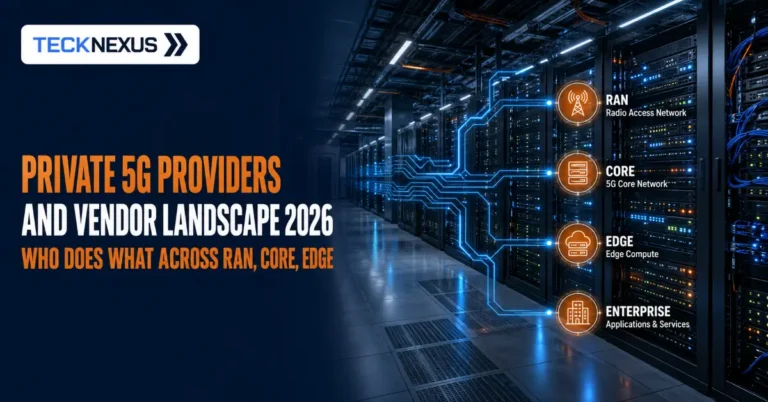
One of the most common early mistakes in private 5G procurement is treating vendor selection as a single decision, picking one company to deliver the whole network. In practice, a private 5G deployment is built from four distinct technology and service layers, each with its own specialist vendor landscape: radio access network equipment, core network software, edge and MEC infrastructure, and systems integration. Understanding what each layer actually covers, and which vendors operate in it, is the foundation for a structured, comparable RFP process rather than an apples-to-oranges comparison of vendors with very different scopes.

|
Layer |
What It Covers |
Primary Selection Criteria |
|---|---|---|
| RAN | Base stations, antennas, radio equipment | Coverage and propagation fit for the specific physical environment |
| Core | Authentication, mobility, policy, slicing | Deployment model fit (owned vs managed); cloud-native vs telecom-grade hardware |
| Edge / MEC | Local compute for latency-sensitive applications | Only needed where use cases genuinely require it; OT integration depth |
| Systems integration | OT/IT connection, physical deployment, ongoing support | Named, distinct specialism — not assumed to be covered by the connectivity vendor |
Radio Access Network Vendors
RAN vendors supply the base stations, antennas, and radio equipment that physically connect devices to the network. This layer includes the major global infrastructure vendors alongside a growing set of specialists focused specifically on private and enterprise deployments, with Open RAN architectures increasingly allowing enterprises to mix radio hardware from one supplier with software and core components from another. RAN selection criteria typically centre on coverage and propagation modelling for the specific physical environment — a warehouse’s dense metal racking, a mine’s underground tunnels, and a port’s open-air container yards all present materially different RF engineering challenges that not every RAN vendor has equally deep experience addressing.

Core Network Vendors
The core is the software layer that manages authentication, mobility, policy, and, critically for Standalone architectures, network slicing and low-latency application support. Core vendors range from the same major infrastructure players active in RAN to cloud-native, software-only core providers built specifically for private and enterprise deployments, often deployable on standard enterprise IT infrastructure rather than requiring dedicated telecom-grade hardware. The core vendor decision is closely tied to the architecture choice covered elsewhere in this series: an enterprise pursuing a fully owned SNPN needs a core it can operate and maintain directly, while a managed service model shifts core operation to the vendor or operator delivering the service.
Edge and MEC Vendors
Multi-access edge compute infrastructure, processing data close to where it’s generated rather than routing everything to a centralised cloud, is increasingly bundled into private 5G deployments to support latency-sensitive applications like real-time video analytics or automated equipment control. Edge vendors span dedicated edge computing platforms, hyperscale cloud providers extending their infrastructure to on-premises edge nodes, and specialist industrial edge providers with deep OT integration experience. Not every private 5G deployment needs a dedicated edge layer, it depends heavily on the specific use cases in scope, but for the latency-critical applications increasingly driving deployment business cases, edge vendor selection deserves the same scrutiny as RAN and core.
Systems Integrators
Integration, connecting the private network to existing OT and IT systems, managing the physical deployment, and handling ongoing support, is consistently the most underestimated layer in vendor evaluation, and frequently the largest share of total project effort. A connectivity vendor is not automatically an OT integration specialist, and the gap between a technically capable network build and a network that’s actually well-integrated with an enterprise’s existing SCADA, MES, or security systems is where many deployments encounter their hardest problems. Recent utility deployments have demonstrated the value of treating integration as a distinct specialism with its own named partner, rather than assuming a connectivity vendor can deliver it as an incidental part of the network build.
Open RAN‘s Growing Role in Vendor Selection
Open RAN architectures, which standardise the interfaces between radio units, distributed units, and centralised units so that components from different suppliers can interoperate, are increasingly relevant to private 5G vendor selection specifically because they widen the practical vendor pool. A traditional, fully integrated RAN stack ties an enterprise to a single vendor’s full radio and baseband product line; an Open RAN approach allows an enterprise, or its integrator, to select best-of-breed radio hardware separately from baseband and core software, which can improve pricing competition and reduce single-vendor dependency. The trade-off is integration complexity — a multi-vendor Open RAN deployment requires more careful interoperability validation and typically leans more heavily on a capable systems integrator than a single-vendor bundled stack, which is worth weighing against the flexibility benefit based on the enterprise’s own integration capability and risk appetite.
How the Layers Combine Into a Deployment Model
The four layers don’t need to come from four separate vendors, some providers offer bundled RAN-plus-core packages, and some system integrators partner closely enough with specific RAN and core vendors that the practical choice narrows quickly. But understanding the layers separately, even when evaluating a bundled offering, makes it possible to ask sharper, more specific questions of any vendor: which layer does this proposal actually cover, and where does responsibility for the other layers sit. That structure is exactly what a rigorous RFP process should be built around, scoring vendors against defined criteria for each layer relevant to a given deployment, rather than comparing dissimilar proposals against each other unstructured.
Evaluating Vendor Claims Within Each Layer
Within any given layer, vendors will differentiate on a consistent set of dimensions worth evaluating systematically rather than accepting at face value:
- Demonstrated deployment experience in a comparable physical environment and industry vertical
- Depth and specificity of reference sites offered for validation
- Maturity and clarity of the vendor’s own technology roadmap
- For RAN and core vendors particularly, interoperability track record with the other layers the enterprise is likely to combine them with
A structured evaluation framework that scores every vendor against the same criteria set, rather than an open-ended qualitative conversation with each vendor separately, produces far more comparable and defensible results, and is the core function a well-built RFP scorecard is designed to deliver.
Why Vendor Financial Stability Belongs in Every Layer’s Evaluation
A criterion that applies equally across all four layers, and is easy to under-weight relative to technical capability, is the vendor’s financial stability and the durability of its market position over the deployment’s realistic lifespan. A private 5G deployment is typically a five-to-ten-year commitment, and a vendor’s technical fit today doesn’t guarantee it remains equally invested in the product line, or continues honouring support commitments, for that full period. This is particularly relevant given how much capital is currently moving through the wider telecom and AI infrastructure supply chain, with different organisations reallocating investment toward different priorities over time. Building financial stability and long-term product commitment questions into vendor evaluation, alongside the technical criteria specific to each layer, is a straightforward way to reduce that risk without needing to become a corporate finance analyst.
TeckNexus’s RFP Scorecard Generator builds a weighted, layer-specific evaluation framework before you issue your tender — https://tecknexus.com/private-network-rfp-scorecard-generator/