In the second quarter of 2026, spectrum came back to the US calendar and operators started putting numbers on standalone 5G. The FCC held its first spectrum auction in four years and approved EchoStar’s spectrum sales with a $2.4 billion escrow. Optus and Ericsson reached 3.4 Gbps on a live 5G standalone network, and Verizon said about 60,000 of its sites now run virtual RAN. In satellite, AT&T, T-Mobile and Verizon agreed in principle to pool their direct-to-device plans, while T-Mobile said its own satellite service sees far less use than it expected.
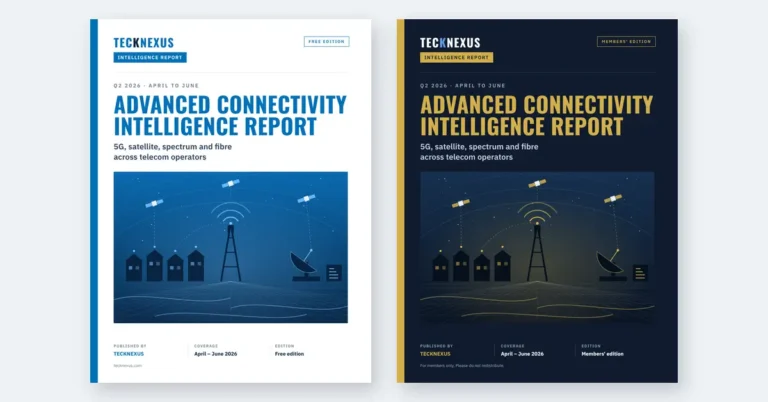
The TeckNexus Advanced Connectivity Intelligence Report, Q2 2026 brings those results together. It covers April, May and June, draws on 409 curated updates from the TeckNexus Advanced Connectivity Monthly Insights archive, and checks every figure against its original source. The free edition is available to download now, and the members’ edition adds four analysis panels, a research panel and three data annexes.
Why this report tracks value, not volume
Connectivity news is full of announcements: launches, trials, partnerships and filings. Counting them shows activity, not progress. This report tracks the figures that change a decision for an operator: what networks actually delivered, what is live against what is still a plan, what spectrum and fibre cost, and the dates that set when new capacity can reach customers.
Every figure is credited by name to the organisation it belongs to, and to whoever published it when that is someone else. Figures that are not measured results are marked as an estimate, target, plan or survey, so a projection is never read as an outcome. Third-party measurement and surveys sit in their own clearly marked research panel.
Key findings from Q2 2026
- US spectrum auctions are back. The FCC’s AWS-3 re-auction, its first auction in four years, drew $3.57 billion in gross bids for 200 licences. Verizon won 82 licences for $3.2 billion and T-Mobile 102 for $277.8 million, and the FCC set a July vote on 160 MHz of upper C-band.
- EchoStar’s sales cleared, with conditions. The FCC approved EchoStar’s spectrum sales to SpaceX and AT&T, worth over $42 billion combined, on condition of a $2.4 billion escrow. EchoStar’s Q1 filing carried a going-concern warning until the deals close.
- Standalone 5G showed its speed. Optus and Ericsson aggregated 180 MHz across 2.3 and 3.5 GHz on commercial phones, reaching 3.4 Gbps down and 200 Mbps up. VodafoneThree says up to 50 million people can now reach its fastest 5G after core and RAN sharing.
- Open RAN reached scale, with evidence. Verizon runs roughly 60,000 virtual RAN sites, all from Samsung. Ookla found that download task failures on AT&T sites moved off Nokia fell from 12% to 5% during 2025.
- Satellite won approvals, but usage trails sign-ups. AT&T, T-Mobile and Verizon agreed in principle to a joint direct-to-device venture, and O2 extended satellite messaging to iPhone. T-Mobile’s CEO said its service sees “a lot less usage” than expected, and Rocket Lab agreed to buy Iridium at about $8 billion enterprise value.
- Broadband got cheaper while fixed consolidation moved. USTelecom puts real prices for popular US plans down 43.6% since 2014, with speeds up 145%. Bouygues Telecom, Free–iliad and Orange entered exclusive talks for SFR at €20.35 billion.
What the numbers mean for operators and suppliers
For operators, the quarter puts dates back into network planning. AWS-3 closed in June and upper C-band rules were set for a July vote, so capex and spectrum strategy now have a calendar to follow. Standalone 5G produced the first priced slicing plans, such as Airtel’s Priority Postpaid, and multi-gigabit aggregation on commercial phones. The report’s six operator moves turn those figures into practical steps, from planning around auction calendars to asking what an open RAN change delivered.
For suppliers, demand is forming around measurable network change: RAN swaps backed by before-and-after data, event capacity, slicing that comes with a service level, and fibre supply that hyperscalers now compete for. The gaps matter too. Airtel and Vodafone gave no take-up for slicing or 5G home broadband, and T-Mobile gave no satellite usage figures. The report flags each of those gaps where it appears.
What’s inside the report
Free edition (7 pages): key findings, measured network outcomes, six operator moves and the methodology.
Members’ edition (16 pages): everything in the free edition, plus panels on 5G SA and network performance, satellite and direct-to-device, spectrum, fibre and money, and a spectrum and policy clock; a clearly marked research panel with USTelecom, Ookla and New Street Research data; and three data annexes: a stat ledger with a linked source for every figure, a register of 45 named operator network activities from the quarter, and a benchmark worksheet.
Who the report is for
Operator leaders in network strategy, spectrum, wholesale, enterprise and product use the report to see which 5G, satellite and fibre moves are producing measurable results, and to plan around spectrum and policy dates. Network vendors, satellite operators, fibre suppliers, tower and infrastructure companies and integrators use it to see which proof points operators recognise and where demand is forming. Enterprise buyers of connectivity, investors and regulators use it as a sourced quarterly view of what operators are building, selling and spending.
How the report is built
The report is built from the TeckNexus Advanced Connectivity Monthly Insights archive for April, May and June 2026. Every figure was checked against its original source, with primary sources such as company releases, regulator notices and filings used wherever available. Items first reported before April were excluded. Figures appear as the source states them, including approximations, and currencies are not converted.
Operators and suppliers with measured network results can feature them in an upcoming edition through the 2027 Telecom AI & Next-Gen Networks program.