
Why AT&T’s $250B Connectivity Investment Matters
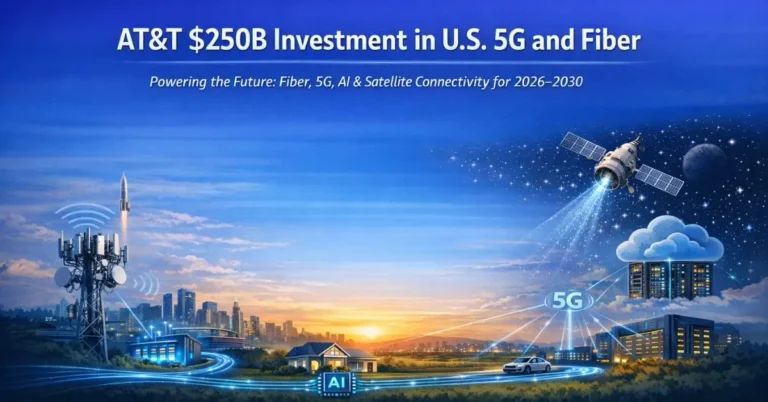
AT&T’s five-year, $250 billion U.S. network commitment sets the tone for the next phase of fiber, 5G, and satellite convergence as traffic, AI workloads, and resilience requirements climb sharply.

Scale, Timing, and Demand Drivers (2026–2030)
The 2026–2030 window aligns with the industry’s transition into 5G-Advanced (3GPP Release 18/19), the scaling of edge AI, and increased cloud traffic between homes, enterprises, and hyperscalers. Data growth is no longer linear, and the cost of downtime is rising. Large, front-loaded builds in fiber and 5G Radio Access Network (RAN), paired with new satellite overlays, are how national carriers will chase coverage, performance, and reliability targets simultaneously. AT&T’s move signals intent to lead on capacity and resilience, not just footprint.
Competitive Landscape and Ecosystem Context
Verizon and T-Mobile have pushed hard on mid-band 5G and fixed wireless access; cable operators are defending with DOCSIS 4.0 and targeted fiber; and new direct-to-device satellite models are taking shape across the industry. AT&T’s collaboration with AST SpaceMobile targets coverage in remote areas without specialized handsets, a counter to rival sat-to-cell partnerships such as T-Mobile with SpaceX. In public safety, FirstNet (built with AT&T) remains a national differentiator. This investment cycle is therefore as much about platform positioning—across ground and space—as it is about raw capex.
What AT&T Plans to Build (2026–2030)
The roadmap centers on always-on connectivity, workforce scale, and integrated security to meet enterprise and public sector requirements as well as consumer demand.
Fiber, 5G, and Satellite Expansion
AT&T plans to accelerate fiber builds and 5G home internet while extending coverage in underserved areas via satellite with AST SpaceMobile. Expect more dense urban 5G sites, deeper suburban fiber, and rural footprints stitched together with hybrid access (fiber, wireless, satellite) to stabilize performance and reach. For enterprises, this can expand last-mile choice, increase diversity options for critical sites, and improve direct cloud on-ramps.
Resilience, Public Safety, and Built-in Security
The company highlights modernization of critical infrastructure and strengthening of FirstNet for first responders. Network-integrated security, threat intelligence, and automated defenses are becoming table stakes as ransomware, DDoS, and supply chain risks grow. AT&T’s approach emphasizes controls at the network layer, where telemetry and policy can be enforced without adding latency at the endpoint—important for zero trust strategies and regulated industries.
People and Operational Capacity
Large-scale builds hinge on skilled labor. AT&T is signaling thousands of technician hires, extensive training, and upskilling, including AI fluency, to support deployment pace and lifecycle operations. A strong unionized workforce and local training pipelines should help sustain quality, safety, and time-to-repair, which factor directly into service-level outcomes.
Strategic Implications for Carriers, OEMs, and Ecosystem
This capex wave will shape vendor rosters, standards adoption, and how APIs expose network capabilities to developers and enterprises.
Network Strategy and Architecture
Expect heavier emphasis on RAN densification, fiber backhaul, and power efficiency, with cloud-native cores, observability, and automation guiding operations. The 5G-Advanced feature set—positioning, RedCap evolution, sidelink, and enhanced uplink—will matter for industrial IoT and video-heavy use cases. Edge siting near metro data centers will tighten round-trip latency for AI inference at the edge.
Vendor Dynamics and Network Openness
AT&T’s language on “opening up” the network suggests more weight behind open interfaces, software-defined components, and a broader supplier base. Watch how the company balances performance, energy, and TCO as it scales disaggregated solutions. API exposure via industry efforts like GSMA’s CAMARA and network function APIs (NEF) could let developers request quality, security, or location features programmatically, creating new monetization paths if SLAs are credible.
Actions for Enterprises and Public Sector Buyers
Procurement and architecture teams should align connectivity strategy to a world of multiple access paths, integrated security, and programmable QoS.
Design for Multi-Path Resilience
Combine fiber with 5G fixed wireless or satellite as tertiary backup for high-availability sites. Evaluate direct-to-cell satellite for remote IoT, field service, and emergency continuity where terrestrial coverage is thin. Pressure-test failover times, DNS behavior, and SD-WAN/SASE interoperability across access types.
Leverage Network-Integrated Security
Shift inspection and policy closer to the carrier edge to reduce latency and blind spots. Map carrier-native controls to zero trust requirements, and integrate telemetry into your SIEM/SOAR. For regulated workloads, validate encryption, segmentation, and lawful intercept posture across fiber, 5G, and satellite paths.
Plan for 5G-Advanced and Edge
Identify use cases that benefit from lower latency and better uplink (computer vision, robotics, live production). Pilot APIs for prioritized traffic and location assurance once commercially available. In parallel, review private 5G options for plants and campuses and how they federate with macro networks for roaming and policy consistency.
Public Safety and Critical Infrastructure
Agencies should revisit FirstNet roadmaps for mission-critical push-to-talk, video, and situational awareness features aligned with 3GPP MCX. Validate hardening, coverage, and deployables for extreme weather and wildfire seasons, and ensure cross-agency interoperability during multi-jurisdiction events.
Key Questions to Watch (Execution and ROI)
The outcome of this investment cycle will depend on execution, policy stability, and measurable performance gains.
Capital Profile and Funding Mix
How quickly does spending ramp, and what is the balance between fiber, RAN, core, and satellite integration? Monitor free cash flow, debt trajectory, and the role of public-private programs and tax policy in sustaining pace through 2030.
Build Prioritization and Economics
Where does AT&T expand first—dense fiber overbuilds with strong take-rate potential, or rural footprints with subsidy support? Track passings, penetration, and wholesale strategies that could improve asset utilization and returns.
Performance Outcomes and Programmability
Do customers see measurable improvements in latency, jitter, and availability, not just headline speeds? Watch for credible SLAs, network slicing readiness, and API productization that turns the network into a platform, not just a pipe.
Bottom Line
AT&T’s $250 billion plan is a bid to lead the next decade of U.S. connectivity across fiber, 5G, and satellite with resilience and security baked in.
What to Do Next
Enterprises should revisit access diversity designs, align SASE and zero trust to carrier-integrated controls, and earmark pilots for 5G-Advanced features and network APIs. Public safety and critical infrastructure buyers should pressure-test coverage, hardening, and interop. For the ecosystem, this is a call to compete on openness, efficiency, and measurable outcomes—not marketing claims.