

What is T-Mobile’s 600MHz spectrum deal with Bluewater Wireless?
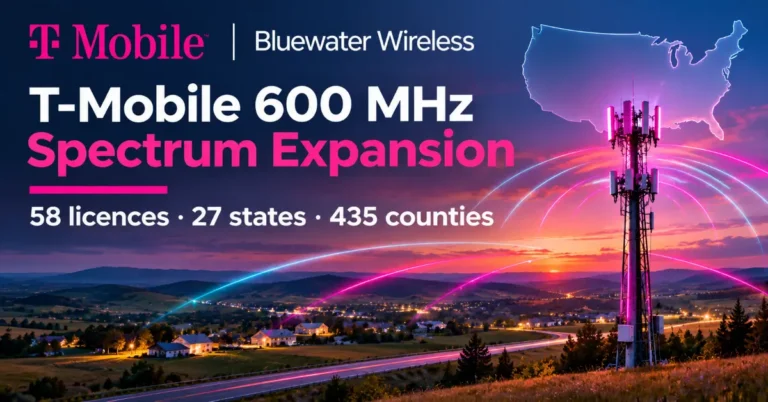
T-Mobile has filed with the Federal Communications Commission (FCC) to buy 58 licences in the 600MHz band from Bluewater Wireless. The licences cover 435 counties in 27 US states and would add 10MHz of low-band spectrum in most of those counties, and 20MHz in a small number of counties in Colorado and South Carolina. A short-term lease lets T-Mobile start using the spectrum within ten days of filing.

The filing came to light on 17 November 2026. The purchase price has not been disclosed, and the transaction still needs FCC approval. The lease arrangement means customers in the affected areas could see the benefit long before the sale itself closes.
Why T-Mobile’s 600MHz expansion matters
Low-band spectrum is the coverage layer of a mobile network. Signals at 600MHz travel much further than mid-band frequencies and penetrate buildings far better, which makes the band especially valuable in rural areas, along highways and indoors. It is the foundation that lets an operator promise wide-area 5G coverage, with mid-band spectrum such as 2.5GHz adding capacity where demand is highest.
The Bluewater deal matters for three reasons:
- Wider channels in the coverage layer. An extra 10MHz, or 20MHz in some counties, increases the capacity of T-Mobile’s low-band layer, which usually translates into better speeds and more consistent performance at the edge of coverage.
- Speed to deployment. Because T-Mobile has the radios and device support for 600MHz in place, the short-term lease allows the new spectrum to be switched on quickly rather than waiting for a new network build.
- Consolidation continues. The deal is the latest in a long series of 600MHz purchases that has made T-Mobile the dominant holder of the band in the US.
How the Bluewater deal fits T-Mobile’s 600MHz strategy
T-Mobile has built its low-band position step by step since the FCC’s incentive auction. It has repeatedly leased spectrum from other 600MHz licence holders, then converted those leases into ownership. The timeline below shows the main steps:
| Date | Transaction | Key details |
| 2017 | FCC 600MHz incentive auction | T-Mobile won 1,525 licences for about $8 billion, the largest share of the band |
| March 2020 | Temporary use of third-party 600MHz | T-Mobile sought special temporary authority from the FCC to use 600MHz licences held by others, including Bluewater Wireless |
| 2022 to 2023 | Columbia Capital (Channel 51 and LB License) | Purchase of previously leased 600MHz licences for $3.5 billion, approved by the FCC in December 2023 |
| 2023 | Comcast | Agreement to lease and later buy Comcast’s 600MHz licences for $1.2 billion to $3.3 billion depending on markets included |
| July to August 2026 | Grain Management swap | FCC approved and the parties closed a deal in which T-Mobile sold its 800MHz licences to Grain for $2.9 billion in cash plus 10MHz of 600MHz in 212 counties |
| November 2026 | Bluewater Wireless | Filing to buy 58 licences covering 435 counties in 27 states, with a short-term lease for immediate use |
The pattern is consistent: identify 600MHz spectrum held by investors or smaller licensees, lease it to put it into service quickly, then buy it outright. Because T-Mobile’s network and its customers’ devices already support the band, each new block adds value almost immediately. That is a very different proposition from buying spectrum that needs new radios and new handsets before it carries traffic.
What the FCC’s recent 600MHz decision signals for the Bluewater deal
The FCC’s July 2026 order approving the Grain transaction offers useful context for how regulators view T-Mobile’s 600MHz purchases. In that order, the Wireless Telecommunications Bureau found that T-Mobile’s total and below-1GHz attributable spectrum would actually decrease, because the company was giving up 800MHz at the same time as gaining 600MHz. It also found that the 600MHz assignment would bring customers greater capacity, speed and reliability, including better rural reach and in-building coverage.
The Bureau rejected arguments from the Rural Wireless Association that T-Mobile’s acquisition of rural 600MHz licences would harm smaller carriers, and declined to require T-Mobile to partition those licences for rural operators. The Bluewater deal is a straight acquisition rather than a swap, so spectrum aggregation will again be part of the review, but the Grain decision shows the FCC’s recent reasoning on 600MHz in rural markets.
What T-Mobile’s 600MHz spectrum means for coverage and enterprise connectivity
For consumers, the most visible effect of more low-band spectrum is better performance in places where mid-band signals do not reach well: inside buildings, in rural communities and on the outskirts of towns. Wider 600MHz channels let more users share the coverage layer without the slowdowns that can occur when a single narrow channel is congested.
For enterprises and public sector users, low-band capacity matters for different reasons:
- Wide-area IoT. Asset trackers, utility sensors and agricultural devices often sit in fringe coverage or indoors, where 600MHz performs best.
- Fleet and field operations. Vehicles and mobile workers crossing rural areas depend on the low-band layer for continuous connectivity.
- Public safety and priority services. Services that rely on network slicing or priority access benefit when the underlying coverage layer has more headroom.
- Network resilience. Extra low-band capacity gives operators more room to keep coverage stable when other layers are degraded or congested.
The deal also highlights the value of the 600MHz secondary market. Investors and smaller licensees that acquired spectrum in or after the 2017 auction have found a reliable buyer in T-Mobile, which can put the band to work faster than almost anyone else.
What comes next for T-Mobile’s 600MHz holdings
Several developments will show how the Bluewater transaction plays out:
- FCC review of the assignment applications, including any petitions from rural carriers or other parties.
- How quickly T-Mobile activates the leased spectrum across the 435 counties, and whether performance gains show up in independent network testing.
- Disclosure of the deal value in T-Mobile’s regulatory or financial filings.
- Whether further 600MHz licences remain available to T-Mobile, as the pool of unconsolidated holdings shrinks.
Low-band spectrum rarely makes headlines in the way that new mid-band auctions do. But for T-Mobile, the 600MHz band has been the base of its 5G coverage strategy since 2017, and the Bluewater deal shows it is still adding to that base wherever it can. With the lease allowing near-immediate use, the practical impact for customers in 27 states should arrive well before the paperwork is complete.
For more analysis like this, subscribe to the TeckNexus Newsletter, explore our 2027 programs, or partner with us to share your perspective and generate leads.