DAS

With GSA counting 2,003 private mobile network references, June 2026's story shifted from whether private cellular works to what it returns. This roundup covers TeckNexus's vertical ROI tools, 3GPP's confirmed 6G timeline, AI moving into the RF layer, CBRS SAS consolidation, and a widening set of verticals from mining to healthcare.
Enterprises need indoor mobile coverage that works like the macro, integrates with private wireless, and sets a path to 5G and AI without ripping-and-replacing infrastructure. InfiniG’s Neutral Host as a Service turns a CBRS shared-spectrum deployment into an extension of public mobile networks using a 3GPP MOCN architecture. Employees, contractors, and visitors get native service from AT&T, T-Mobile, and Verizon on their existing SIMs—no apps, no plan changes. The Nokia RAN is 5G-ready out of the box, protecting investments as operators certify 5G Standalone and VoNR on neutral host. Radios and gateways are software-upgradable, so enterprises can deploy today for LTE and move to 5G without swapping hardware.
Boldyn Networks is rolling out a neutral host 5G upgrade at Silverstone that shifts the circuit from seasonal stopgaps to a year-round, high-capacity mobile platform for fans, teams, and broadcasters. The architecture spans 25 locations, with 57 sectors engineered across 87 DAS zones to handle concentrated traffic and maintain performance under crowd pressure. The design anticipates surges in uplink and signaling, supports concurrent sessions at scale, and smooths throughput across hotspots. A permanent, multi-operator 5G foundation unlocks new revenue, better service metrics, and more efficient event delivery. When connectivity works, dwell time, spend, and satisfaction rise.

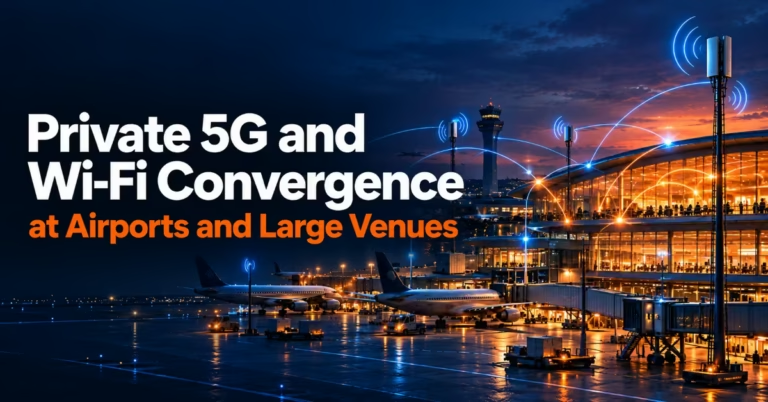
Boingo Wireless is integrating Globalstar’s XCOM RAN to accelerate private 5G across airports, stadiums, hospitals, convention centers, transit hubs, and military bases. Globalstar said Boingo will add XCOM RAN, a software-defined private 5G platform built around the Supercell architecture, to its private network portfolio. A highlighted approach is overlaying XCOM RAN on existing distributed antenna system (DAS) infrastructure to preserve DAS coverage advantages while boosting capacity and performance. Enterprises are moving beyond pilot projects to operational private 5G in high-traffic, RF-challenged environments. This aligns with rising demand for low-latency, secure connectivity for IoT, video, automation, and mission-critical operations.
Boingo Wireless marks 25 years of innovation in neutral host wireless networks, winning global recognition for private 5G, DAS, and Wi-Fi 6/6E/7 deployments across airports, military bases, healthcare facilities, and venues. Boingo’s converged architecture combines secure, high-performance wireless infrastructure with AI, zero-trust security, and green initiatives for future-ready connectivity.
Boingo deployed a private CBRS network at the Rhode Island Convention Center and Amica Mutual Pavilion to modernize venue connectivity for large-scale events. Integrating Wi-Fi 6 and CBRS, the system supports high-density operations like ticketing, POS, streaming, and IoT. The converged network enhances staff performance and fan experience while giving operators full control over wireless infrastructure. This project showcases how private networks can meet modern connectivity demands in sports and event venues.
CAF’s signalling division and Cellnex demonstrated that OPTIO, a modular and multi-bearer CBTC platform, operates reliably on a private 5G network in both lab and field conditions, including challenging scenarios such as tunnels. The system already supports Wi‑Fi and LTE; adding 5G confirms a multi-access design that lets operators choose the right bearer per line, phase, or location. Private 5G brings ultra-low latency, higher capacity, stronger QoS control, and end-to-end security under the operator’s domain. The project received European co-financing via the Recovery and Resilience Facility under Spain’s UNICO Sectorial 2023 program, underscoring public support for digital rail modernization.
A new neutral host 5G deployment at 10 World Trade in Boston’s Seaport sets a practical blueprint for scalable, multi-operator indoor connectivity in Class A commercial real estate. Most mobile traffic is generated indoors, yet macro networks struggle to penetrate dense, energy-efficient buildings. The 10 World Trade deployment—delivered by Boston Global Investors (BGI) with Aspen Venue Partners and Ericsson - addresses all three pressures with a small-cell-based, neutral host design that multiple operators can share while also supporting private 5G and future network slicing. The model aligns with broader industry trends: 3GPP-based indoor systems, shared infrastructure economics, and spectrum agility that includes CBRS in the U.S.
Hospitals are turning to a dual-network model that pairs neutral host coverage with private 5G to handle surging data, device density, and distinct user groups across large clinical campuses. Healthcare networks are stressed by electronic health records, telehealth, connected medical equipment, and higher patient expectations for always-on mobile service. A combined neutral host and private 5G architecture lets IT leaders segment traffic and policy by role and use case, align with data sovereignty requirements, and scale capacity as device fleets and AI-driven workflows grow. The model separates public cellular access for general users from dedicated private 5G for clinical and operational workloads.
AT&T has gone live on Boldyn Networks’ neutral-host infrastructure in New York’s Joralemon Street tunnel, with G line tunnel segments next in the rollout. AT&T customers can now access 5G mobile service through the 1.1-mile (1.8 km) Joralemon Street tunnel, the oldest underwater subway tunnel in New York City, which links the 4/5 lines between Borough Hall in Brooklyn and Bowling Green in Manhattan. Subway connectivity has shifted from convenience to critical infrastructure for safety, accessibility, and productivity. AT&T’s first-mover status sets a competitive benchmark; other national carriers (Verizon and T‑Mobile) are expected to follow as on-boarding progresses across the system.
Large arenas now live or die on mobile performance: digital ticketing, cashless concessions, in-seat ordering, real-time replays, and social sharing all hinge on dense, resilient RF. With nearly 20,000 seats and a heavy calendar of sports and concerts, the Moda Center joins a cohort of tier-one venues investing in 5G as core infrastructure rather than a nice-to-have. American Tower’s role as a neutral host is noteworthy; it positions the venue to support multiple operators on a shared platform, spreading cost, accelerating carrier onboarding, and improving consistency across the “Rose Quarter,” including the adjacent Veterans’ Memorial Coliseum.
India's telecom usage is now predominantly indoors, and TRAI's new property rating framework puts digital connectivity on par with core utilities. TRAI's chairperson flagged a decisive shift: most mobile data is consumed inside homes, offices, malls, hospitals, and transit hubs. Connectivity inside buildings is moving from convenience to necessity. TRAI's 2024 Regulations introduce a voluntary, performance-based star rating that assesses how ready a property is to deliver high-quality broadband and mobile connectivity. The framework encourages developers to embed Digital Connectivity Infrastructure (DCI) at design stage, aligns with Digital India and Smart Cities Mission, and invites ministries and agencies to incorporate DCI into guidelines, tenders, and training.
Sponsored by Palo Alto Networks
⚡ Utilities ⏱ 8 min ✓ Free
This tool is built and hosted by TeckNexus.
Launch Tool →
Whitepaper
Airports are deploying AI surveillance, biometrics, and autonomous vehicles faster than most networks can secure them. See what 100 real-world airport deployments reveal about the airside/landside security gap — and the 4-layer framework built to close it....
Scroll to Top