April 2026 Private Networks at Glance
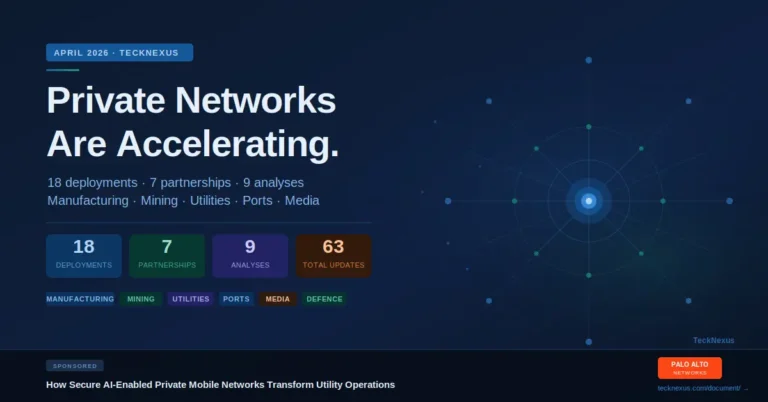
| Category | Count |
|---|---|
| Deployment Updates | 18 |
| Partnerships | 7 |
| Industry Analyses | 9 |
| Feature Updates | 14 |
| Spectrum & Policy | 4 |
| Thought Leadership | 4 |
| Award Updates | 3 |
| Deal Wins | 1 |
| Total Updates | 63 |
Sponsored Resource
Sponsored by Palo Alto Networks How Secure AI-Enabled Private Mobile Networks Transform Utility Operations Utilities are deploying private 4G/5G to connect substations, smart meters, field teams, and edge AI systems at scale. But expanded connectivity also expands the attack surface. Advanced campaigns like Volt Typhoon and Salt Typhoon have demonstrated that critical infrastructure is a primary target — and more than 70% of OT breaches originate in the IT environment. This whitepaper outlines a secure-by-design framework built on three pillars:
- Visibility — asset-level insight across every device, session, and application on the private network
- Zero Trust — unified IT/OT policy enforcement from the grid core to the mobile edge
- Resilience — AI-powered threat prevention, DNS security, and inline deep learning to block attacks before they reach critical systems
Deployment Updates
Eighteen deployment updates this month — the largest count in recent memory — spanning manufacturing, mining, ports, media & entertainment, utilities, maritime, and defence. The throughline: private 5G is moving from pilot infrastructure to operational backbone.

Industrial & Manufacturing
Siemens made the biggest geographic move of the month, expanding its private 5G infrastructure to the United States, Canada, Belgium, Finland, France, Norway, Poland, and the United Kingdom — bringing its total footprint to 15 countries. US deployments will use a dedicated CBRS-band on-premises radio unit, and the full stack — core, CU/DU, and RU — runs on Siemens industrial computers. Read the official Siemens press release →
Strategic signal: Siemens is positioning private 5G as standard industrial infrastructure — not a speciality offering. The North American expansion makes on-premises 5G a real option for manufacturers who previously had limited vendor choice.
Mercedes-Benz expanded its use of dedicated mobile private networks across manufacturing operations, explicitly choosing private over public 5G to eliminate latency variability and support high-precision, time-critical automation. When the world’s most precision-focused automaker rejects public 5G in favour of on-premises private networks, it validates the industrial private 5G case more powerfully than any vendor white paper.
Cargill deployed private 5G on factory floors to support AI-enabled and automated workflows, reporting a striking infrastructure efficiency finding: a single 5G access point covers the footprint of approximately nine Wi-Fi access points. That 9:1 ratio changes the economics of large-footprint factory wireless deployments.
Strategic signal: The 9:1 coverage ratio is an infrastructure planning data point — not a marketing figure — that changes the economics of factory-floor wireless for enterprise buyers.
Catalyx partnered with Canoga Perkins to integrate deterministic private 5G with Time Sensitive Networking (TSN) into its OpenLine platform, targeting reduced changeover costs and downtime in pharmaceutical production lines.
LG Electronics entered the private 5G market in South Korea after years of 6G R&D investment, positioning AI-native private 5G as a commercial adjacency to its next-generation wireless research.
XCOM RAN operated a private 5G network in a manufacturing context to support factory AI and automation workloads, signalling that manufacturers are fundamentally rethinking the network behind the factory floor.
Mining
Mariana Minerals deployed a Celona private 5G LAN across its Copper One mine and refinery in Utah, replacing legacy Wi-Fi entirely. The network serves as the communications backbone for MarianaOS, supporting:
- Continuous data ingestion and real-time monitoring
- Digital twin updates and optimized drill patterns
- Orchestration of autonomous drills and haul trucks
- AI/ML-driven automation at scale
This is one of the most comprehensive autonomy-first private 5G deployments in the mining sector to date — a reference architecture the industry will watch closely.
“The network serves as the communications backbone for MarianaOS — supporting autonomous drills, haul trucks, digital twin updates, and AI/ML-driven automation at Copper One.”
Ports & Logistics
CentrePort completed its first operational deployment on its private 5G network, installing 5G-enabled Peplink modems to support port operations — marking the critical transition from network build-out to active operational use.
Ericsson delivered a private 5G network covering Lyttelton Port Company‘s operations on New Zealand’s South Island, extending its Asia-Pacific ports footprint.
Inwi and China Mobile unveiled a private 5G network dedicated to industrial use at GITEX, serving a factory in Morocco — one of two separate private 5G industrial announcements from Morocco this month.
Media, Events & Sports
Orange deployed private 5G across Stade de France, Bercy (Accor) Arena, and La Défense Arena in Paris to support high-capacity connectivity and in-venue venue-casting services for live sports and events.
Verizon had three significant private 5G deployments this month:
- FIFA World Cup 2026 host stadiums — private 5G to support Lenovo Referee View body cameras and ultra-low-latency applications
- Fox show ‘Extracted’ — portable private 5G covering approximately four square miles for remote reality TV filming in the Canadian wilderness
- NHL Innovation Lab at Prudential Center — private 5G and Secure Cloud Interconnect to test venue operations tools, coach-to-player video, near real-time stats, and 4K/8K media workflows
Strategic signal: Remote, portable private 5G for media production is an emerging use case entirely outside traditional enterprise verticals — and Verizon is building reference wins across all of them simultaneously.
Vislink showcased integrated RF and private 5G modular workflows at NAB Show 2026, including a private 5G camera workflow demo with Grass Valley and the new DragonFly dual-modem 5G transmitter.
Maritime & Defence
Wilson Connectivity deployed a Zinwave wideband DAS on the Africa Mercy II, simultaneously supporting cellular, private mobile radio (PMR), and Private 5G over a single RF infrastructure — a multi-technology approach with significant implications for maritime deployments.
Future Technologies outlined an integrated PNI-NPN, MOCN, and MEC architecture for adaptive, edge-driven connectivity in contested logistics environments — maintaining operational continuity for forward units in denied or degraded conditions.
Utilities
Anterix had a landmark month on the deployment front:
- Signed a USD 3.2M 900 MHz spectrum license deal with Texas-New Mexico Power — serving more than 280,000 customers in Texas
- Partnered with Benton PUD to deploy the first utility-owned 900 MHz private wireless network in the Pacific Northwest
TeckNexus Analysis — Beyond the Hype: April surfaced a useful tension in the industrial 5G narrative. Mercedes-Benz chose private 5G because public 5G couldn’t guarantee the deterministic latency needed for precision manufacturing — a powerful real-world validation. Yet industry analysis this month also warned that cost, complexity, and deployment constraints still temper expectations for industrial IoT broadly. The companies winning with private 5G are treating it as infrastructure — not a pilot. Cargill’s 9:1 access point coverage ratio isn’t a headline; it’s an operational decision that compounds across a multi-site estate over time.
Partnerships
Seven significant partnerships in April, spanning Open RAN-as-a-service, Zero Trust security, indoor CBRS, and enterprise co-development — signals of a maturing ecosystem where vendors are building integrated stacks rather than point solutions.
Rakuten Symphony + Celona — Combining Rakuten Symphony’s cloud-native Open RAN platform with Celona’s enterprise LAN/private 5G stack to deliver an as-a-service private 5G solution. Designed to lower deployment complexity and open private networks to businesses of varying sizes.
Celona + OneLayer — Pairing Celona’s private LTE/5G platform with OneLayer’s asset management, operational intelligence, and Zero Trust security. OneLayer also launched its Sentry Partner Program to extend Zero Trust across multi-carrier private APN environments at scale.
InfiniG + Nokia — Nokia supplying indoor CBRS infrastructure for carrier-grade private cellular and AI-ready RAN for US enterprise deployments — addressing the indoor coverage density gap that standard CBRS solutions have not fully solved.
Orange Maroc + Ericsson — Co-developing and promoting private 5G for Moroccan enterprises, with a full radio and 5G core platform deployed in Orange Maroc’s 5G Lab. Announced at Gitex Africa 2026.
Catalyx + Canoga Perkins — Embedding deterministic private 5G TSN into Catalyx’s line clearance solution for utility field operations.
Anterix + Benton PUD — Deploying the first utility-owned 900 MHz private wireless network in the Pacific Northwest.
Ericsson + Orange Maroc — Full private 5G co-development for the North Africa enterprise market.
Feature & Product Updates
Belden BRS-5G — World’s First 5G Industrial Switch
Belden introduced the BRS-5G at Hannover Messe — an industrial Ethernet switch that embeds Qualcomm’s Snapdragon X72 5G Modem-RF System to carry OT traffic over private 5G with low latency and high reliability. A live demo showed real-time data exchange for a conveyor system. Drives & Controls coverage → | Native Layer 2 detail →
Why it matters: Native Layer 2 Ethernet over wireless 5G closes the final architectural gap between OT networking practice and private 5G. Industrial engineers can now treat 5G as a drop-in Ethernet replacement — not a parallel network requiring protocol translation.
XCOM RAN — End-to-End Private 5G for Physical AI
XCOM RAN announced an end-to-end private 5G offering aimed at physical AI workloads, with plans to broaden supported spectrum options and partner relationships for global availability. GSMA Intelligence assessed Globalstar’s XCOM RAN strategy for industrial deployments across Europe and Asia.
Clear-Com FreeSpeak Cell — LTE/5G Intercom for Wide-Area Production
Clear-Com launched FreeSpeak Cell, a full-duplex wireless intercom operating over LTE/5G including CBRS Band 48. It supports 100+ beltpacks, dual SIM (physical/eSIM), and integrates with Eclipse HX — compelling for campus-scale and multi-zone production environments. Scheduled to ship in the US in spring 2026.
Singapore NUHS — Private 5G Smart Health System
Singapore’s National University Health System integrated a private 5G network with digital twin models, XR applications, IoT devices, and ambient AI to support a smart regional health system — one of the most comprehensive healthcare private 5G use case integrations reported to date.
Spectrum & Policy
CBRS: Growing Role, Growing Risk
Two opposing signals emerged on CBRS in April. An NCTA study confirmed CBRS is powering US manufacturing modernization and reshoring initiatives. At the same time, a separate research study warned that allowing high-power CBRS devices in the 3.5 GHz band could raise interference, disrupt PAL/GAA coexistence, and weaken the economics of private LTE/5G deployments across US industry sectors. Spectrum policy is increasingly a competitive battleground.
Anterix: Two Utility Spectrum Wins
- USD 3.2M 900 MHz spectrum license with Texas-New Mexico Power — serving 280,000+ customers in Texas
- 10 MHz 900 MHz license sold to Benton PUD — enabling the first private wireless deployment by a publicly owned utility in the Pacific Northwest
Europe: Slovenia Opens, Poland Pushes Back
Slovenia’s regulator AKOS issued the final call for 3.8–4.2 GHz private network spectrum allocations, with portal-based licensing expected by end of June 2026. In contrast, Polish ICT industry group Cyfrowa Polska pushed back against UKE’s draft allocation rules in the same band, warning the restrictions could hinder private 5G development.
Industry Analysis
The AI-RAN Convergence
Private 5G is quietly becoming the connectivity layer for a new class of AI — not cloud LLMs, but on-device inference running on low-cost edge hardware. NTT DATA outlined this month that Raspberry Pi-class devices on a private 5G network can run real-time physical AI workloads without any cloud dependency. Meanwhile, AT&T is integrating private 5G with an AI compute grid to enable AI-RAN-style optimization. The next battleground in private networks isn’t coverage, it’s intelligence at the edge.
India’s Shift from Connectivity to Capability
ET Telecom highlighted India’s move beyond basic connectivity, with manufacturers deploying Captive Non-Public Networks (CNPNs) with slicing and API-driven capability exposure. Private 5G in India is becoming a capability platform, not just a connectivity replacement.
Morocco: Two Announcements in a Single Month
Inwi/China Mobile’s factory deployment and Ericsson/Orange Maroc’s co-development program in the same month signals that North Africa is emerging as a genuinely active private 5G market — not just a proof-of-concept region.
The Ceragon Opportunity
Roth Capital maintained a Buy rating and USD 3.75 target on Ceragon Networks, citing USD ~10M in recent private network orders and market share opportunity from Nokia’s reduced focus on wireless transmission. Ceragon also highlighted USD 10M in private network contracts signed in the month, reinforcing momentum in mission-critical connectivity.
Private 5G for Oil & Gas: The TCO Case
Ericsson made the TCO case for private 5G in oil and gas, framing total cost of ownership around reduced downtime, enhanced safety, and workforce efficiency — elevating private 5G from discretionary spend to business-critical infrastructure.
Brazil Power Grids: Private LTE/5G as Critical Infrastructure
Huawei and the 450 MHz Alliance released a white paper at UTCAL 2026 in Rio de Janeiro advocating private LTE/5G for Brazil’s power distribution networks, covering teleprotection, smart metering, field control, and predictive monitoring.
Award Updates
NTT DATA had a landmark recognition month — named a Leader in the Gartner Magic Quadrant for 4G and 5G Private Mobile Networks based on Completeness of Vision and Ability to Execute, and simultaneously won The Fast Mode Award for Private 5G recognizing network throughput, reliability, and adaptability.
Invences Inc. CTO Bhaskara Raju Rallabandi was recognized by Marquis Who’s Who for contributions to AI-native 5G, open/virtualized RAN, and private network deployments including US projects in smart agriculture and cloud-native autonomous network observability.
Educational Resource
Software Radio Systems published a tutorial on setting up a private 4G/5G network using the open-source srsRAN stack and software-defined radio — covering installation, configuration, and basic testing. Useful for engineers evaluating or prototyping private cellular networks.
Sponsored Resource
Sponsored by Palo Alto Networks How Secure AI-Enabled Private Mobile Networks Transform Utility Operations Utilities are deploying private 4G/5G to connect substations, smart meters, field teams, and edge AI systems across vast service territories. But expanded connectivity also expands the attack surface. Advanced campaigns like Volt Typhoon and Salt Typhoon have demonstrated that critical infrastructure is a primary target — and more than 70% of OT breaches originate in the IT environment, according to Palo Alto Networks’ State of OT Security Report. This whitepaper outlines a secure-by-design framework built on three pillars:
- Visibility — asset-level insight across every device, session, and application on the private network, closing the implicit trust gap that Zero Trust is designed to prevent
- Zero Trust — unified IT/OT policy enforcement from the grid core to the mobile edge, covering substations, smart meters, and field devices simultaneously
- Resilience — AI-powered threat prevention, inline deep learning, DNS security, and ML-powered URL filtering to block malware, exploits, and malicious domains before they reach critical systems
Explore More on TeckNexus
This post covers the highlights. The full Private Network Monthly Updates page includes every story tagged by category and vertical — Deployment Updates, Deal Wins, Feature Updates, Industry Analysis, Partnerships, Spectrum & Policy, Thought Leadership, Regulation & Policy, Educational, and Award Updates.
Explore our Intelligence Decision Platforms:
- Private Network Decision Platform
- Manufacturing Intelligence Platform
- Mining Intelligence Platform
- Ports Intelligence Platform
- Airports Intelligence Platform
- Private Network Hub
TeckNexus is a telecom and private networks B2B media and intelligence platform. Subscribe to the TeckNexus newsletter for monthly updates, analysis, and intelligence delivered to your inbox.