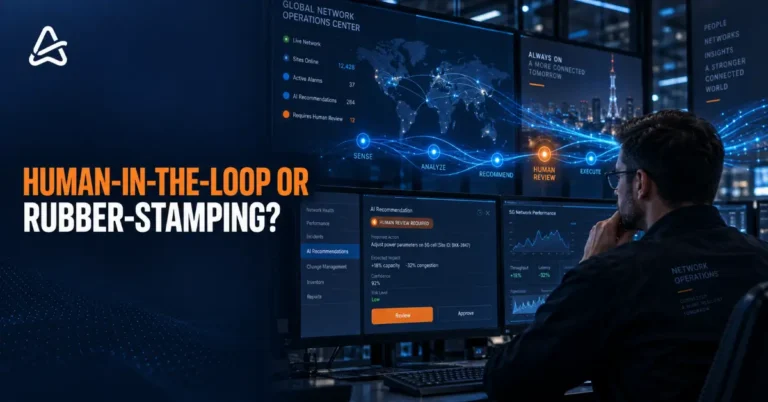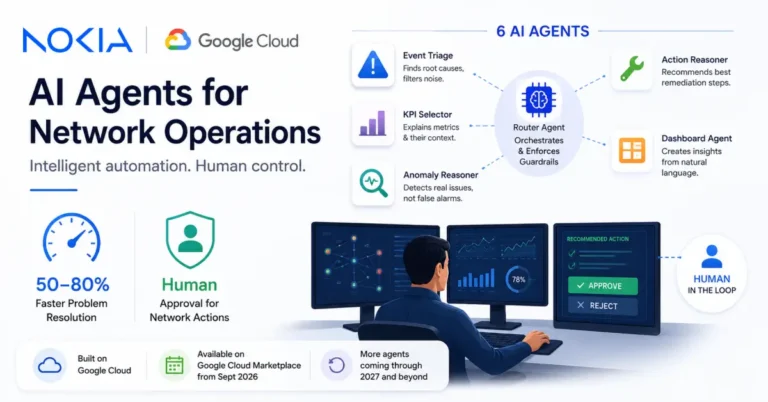
Nokia and Google Cloud’s announcement on 22 June 2026 is notable not primarily because it introduces AI into network operations — that conversation is well underway — but because of the specific design choice embedded in the architecture. The six Gemini-powered AI agents being integrated into Nokia‘s Assurance Center are built around what Nokia describes as ‘glass box autonomy’: AI handles the analysis, pattern recognition and recommendation work; human engineers retain approval authority over any action that touches the network. The autonomy is real, but it stops before the control plane.
What the six agents actually do
The agent architecture is structured as a multi-layer system rather than a single model trying to handle everything. A router agent sits at the centre, interpreting incoming requests and orchestrating communication between the other agents while enforcing operational guardrails. Below it, the remaining five agents handle discrete tasks in the fault-isolation and remediation workflow:
- An event triage agent that analyses live alarms against historical patterns to identify root causes and distinguish genuine faults from noise.
- A KPI selector agent that provides domain-expert interpretation of network performance metrics, definitions and measurement units — essentially acting as institutional memory about what each metric actually means in context.
- An anomaly reasoner agent that evaluates whether an unusual pattern represents a real problem or a false positive.
- An action reasoner agent that matches confirmed events against existing automation catalogues and recommends specific remediation steps, with confidence scores attached.
- A dashboard agent that generates analytics views and performance reports from natural language prompts, removing the requirement for specialised data skills to get operational visibility.
The router and event triage agents are already operational. The full platform will be available on Google Cloud Marketplace as a SaaS offering from September 2026, with the four remaining agents following through rolling software updates extending into 2027. Nokia has indicated that further agents are in development beyond the initial six — including a topology expert, services design agent and security-focused agents — structured as individual software products with their own development lifecycle.
The glass box distinction matters more than the speed claims
Nokia and Google Cloud cite 50% to 80% reductions in network problem-solving time as a headline outcome. That is a significant claim, though it sits alongside similar claims from earlier generations of network analytics tooling that also promised to transform operations and delivered uneven results. The more interesting claim, analytically, is the rationale Nokia gives for why agentic AI will succeed where earlier automation stalled.
Renata Silva, Nokia’s head of Autonomous Networks Business, draws a direct line between explainability and adoption. Traditional machine learning tooling — strong at pattern recognition across large datasets, reliable for deterministic tasks — has historically been opaque about the reasoning behind its outputs. That opacity, she argues, is a large part of why telco network automation has moved more slowly than the underlying technology would permit: operations teams are asked to trust recommendations they cannot interrogate, for actions with potentially service-affecting consequences, in environments where accountability sits firmly with human engineers rather than the software.
The agentic approach changes that contract. Because each agent can explain the reasoning behind its conclusions — not just output a recommendation but show the data and logic path that produced it — the human approval step becomes meaningful rather than ceremonial. Engineers can evaluate the analysis, challenge it if the reasoning doesn’t fit the operational context, and make an informed decision before authorising action. For policy-approved, low-risk scenarios with high model confidence, the same architecture supports fully closed-loop remediation without human intervention. The design scales between those two modes based on the specific scenario rather than committing to a single automation posture across the whole network.
Six to seven months from concept to operational agents
The partnership grew out of Google Cloud’s Autonomous Network Operations Framework, launched at DTW the previous year. From that starting point, Nokia and Google Cloud spent roughly six to seven months developing and validating the initial agent set, with meaningful momentum building from February 2026. The development process drew on Nokia’s existing network operations data and direct input from operator deployments, though Nokia’s Vivek Jaiswal acknowledges that operator environments vary significantly enough that some fine-tuning will be required for individual deployments — a realistic qualification that is absent from most vendor announcements.
The infrastructure choice is also worth noting. The entire multi-agent framework runs on standard Google Cloud compute and storage via Kubernetes and Google Cloud Storage, rather than requiring bespoke managed services infrastructure. Nokia frames this as cost-optimisation and flexibility, and it is both — it also means enterprises evaluating the platform are not locked into a proprietary stack that can’t coexist with other cloud tenants or tooling.
Why enterprise private network operators should follow this
This announcement describes a public telco application — Nokia’s network management software, deployed by mobile and fixed operators to manage large-scale infrastructure. But the operational problem it addresses maps almost precisely onto the environment many industrial private network operators find themselves in as their deployments mature past initial commissioning.
Private 5G networks in manufacturing, mining, ports, airports and utilities generate continuous streams of performance metrics, alarms and anomaly alerts — and the teams responsible for managing them are typically OT engineers or IT generalists, not specialist radio network operations centres. Alert fatigue, slow fault isolation and the difficulty of translating raw KPI data into actionable operational insight are common friction points that appear well before a network scales to the size where a dedicated NOC becomes justifiable. The agent architecture Nokia and Google Cloud have described — particularly the combination of anomaly reasoning, automated triage and explainable recommendations reviewed by a human before action — is structurally suited to exactly that environment.
The commercial availability question is more complex. Nokia’s initial deployment is through Nokia Assurance Center targeting public telco operators, and the September 2026 marketplace launch is oriented toward that customer base. Whether and how similar agentic capabilities migrate into industrial private network management tooling — either through Nokia’s own private network portfolio or through third-party integration — is not defined in this announcement. That migration path is worth tracking for any organisation currently building out a private 5G estate and thinking ahead to its operational management requirements.
The cost question also deserves attention. AI inference is not free, and the per-token cost of running multi-agent reasoning continuously across a live network is a real variable in any total-cost-of-ownership calculation. Nokia acknowledges that opex will not reach zero — some manual cost will be replaced by AI infrastructure cost — with the net expectation being a reduction rather than elimination. Organisations evaluating agentic AI for network operations should model that trade-off explicitly against their current baseline rather than assuming the headline resolution-time improvement translates directly into cost savings.
| Related Tool
What SLA commitments does your private network’s management capability actually support? If agentic AI in network operations promises 50–80% reductions in fault-resolution time, the follow-on question for enterprise buyers is what that implies for service level agreements with the business units depending on the network. The TeckNexus SLA Mapper helps you define, structure and stress-test SLA commitments for private network deployments — mapping uptime, latency and resolution-time requirements to the operational architecture and management model that underpins them, so SLAs are grounded in what the network and its management layer can actually deliver. Run the Use Case-to-SLA Mapper → |