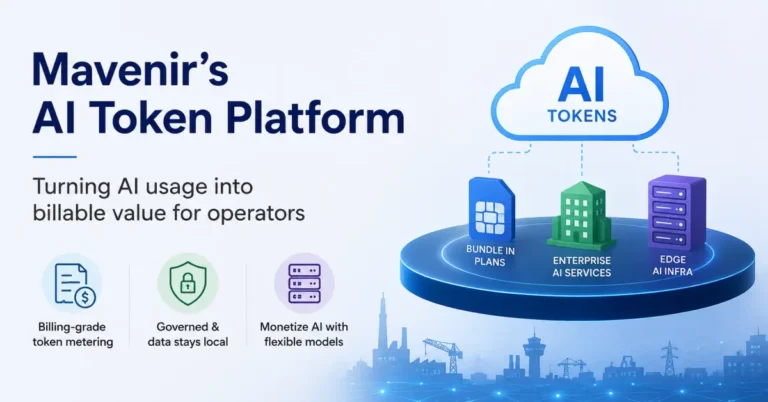
The idea is easy to state and considerably harder to build. Operators have spent two decades perfecting the systems that meter a gigabyte with forensic precision and turn it into a line item on a bill. Tokens — the unit in which every large language model interaction is actually priced — have no equivalent home inside that stack. An operator marketing an “AI assistant” plan today is, in effect, reselling a cloud vendor’s invoice and hoping the margin survives contact with usage.
The billing gap nobody built for
When inference runs on a third-party cloud server, the only party counting tokens is the cloud vendor. The operator has no independent meter, no mechanism to enforce a plan limit, and no early warning before a customer’s usage — and the operator’s own cost exposure — runs past whatever was budgeted. It is the rough equivalent of selling a mobile data plan with no way to see how many bytes a subscriber has actually used until the wholesale invoice arrives. Mavenir‘s pitch is that this single gap, more than any lack of ambition, is what has kept operators on the sidelines of AI monetisation.
Mavenir‘s Digital Enablement platform, already used for charging and mediation on existing network services, has been extended to count input and output tokens at what the company describes as billing-grade accuracy — the same precision standard applied to regulated data usage. Quota enforcement, overage handling and itemised records run through the same charging path operators already use for data plans: network event, mediation, rating, invoice. No parallel billing system is required.
Three routes to revenue, not one
Rather than a single product, the platform is built around three distinct commercial shapes that operators can run independently or in combination. The first is the most familiar: token allowances bundled into subscriber plans and billed directly on the existing connectivity invoice, structured in tiers — entry-level, standard, business-unlimited — much like data add-ons are sold today.
The second targets enterprise customers directly, offering metered, governed access to AI models and compute as an extension of an existing connectivity contract, with subscriber data remaining on the operator’s own infrastructure rather than departing to a third-party cloud account.
The third treats the operator’s physical footprint — central offices, edge sites, distributed compute capacity — as inference infrastructure that third-party applications can rent, monetising real estate that has historically just sat there providing connectivity.
Each model carries different economics and a different buyer, but all three are metered, billed and governed through the same underlying layer, which is the structural bet Mavenir is making: that unifying the charging mechanism matters more to operators than which of the three models they end up emphasising commercially.
Hybrid by design, not by compromise
The architecture underneath all three models is deliberately hybrid. Routine workloads — the bulk of any deployment’s traffic — run on operator-owned, on-premises small language models with no per-token cloud licence attached. A model router sits in front of every request, checks which subscriber tier and policy applies, and only forwards genuinely demanding reasoning tasks to external frontier models through a governed, metered connection. Every external call still passes through the same token-counting layer, so the operator retains billing visibility and cost control regardless of where a given request is ultimately processed.
That structure converts AI’s cost base from something unpredictable — a per-token cloud bill that scales with demand in ways an operator can’t fully control — into something closer to a fixed infrastructure cost it can plan against. “Operators are watching AI revenues flow to hyperscalers and third-party platforms” while providing the connectivity underneath them, said Bejoy Pankajakshan, Mavenir’s Chief Technology and Strategy Officer, in announcing the platform — a framing that puts the commercial logic, rather than the technical architecture, at the centre of the pitch.
Why this matters beyond telecom
For TeckNexus’s audience — manufacturing, mining, ports, airports and utilities operators already evaluating or running private 5G networks — this development is worth tracking even though it originates one layer up the stack. It points to a third procurement path for enterprise AI capacity that didn’t exist in a structured form before: alongside building AI infrastructure in-house or contracting directly with a hyperscaler, enterprises may increasingly be able to consume governed, metered AI capacity bundled into the same commercial relationship they already hold with their connectivity provider.
That option will appeal most where data sovereignty already matters for other reasons — environments operating under frameworks such as NERC CIP, ISPS Code or ATEX classification, where keeping operational data and model weights on tightly controlled infrastructure is already a procurement requirement rather than a preference. It may also appeal where latency-sensitive edge applications make proximity to the point of use a genuine constraint, and where consolidating AI spend into an existing vendor relationship simplifies governance rather than adding a fourth or fifth contract to manage.
None of that makes operator-sold AI capacity an automatic default. The commercial case Mavenir points to — token plans already running as utility-style add-ons in some markets — is still early and geographically uneven, and any enterprise evaluating the option should weigh it on the same total-cost-of-ownership basis as building or buying compute directly, not assume it wins by default because it arrives on a familiar invoice.
The plumbing-first signal
Operators have talked about becoming AI service providers for several years without much to show beyond positioning slides. What distinguishes this announcement is the level of operational detail attached to it: billing-grade token metering tied to existing mediation systems, policy-governed routing mapped to subscriber tiers, and a stated reference deployment rather than a roadmap. Whether that translates into operators actually capturing a meaningful share of enterprise AI spend will depend less on the platform itself than on whether operators price it competitively against the hyperscaler infrastructure it is built to compete with — a test that plumbing alone cannot pass.
| Related Tool
Weighing operator-sold AI capacity against building your own? If a managed AI consumption model from your network provider becomes part of the procurement conversation, it needs to be compared on the same basis as any other infrastructure decision — direct costs, integration costs, and total cost of ownership over the contract term. The TeckNexus TCO Comparator models build-vs-buy-vs-managed scenarios across hardware, connectivity, licensing and operational overhead, so you can stress-test a token-based AI plan against the alternative of building or buying compute outright before it’s written into a multi-year contract. Run the TCO Comparator → |