SaaS

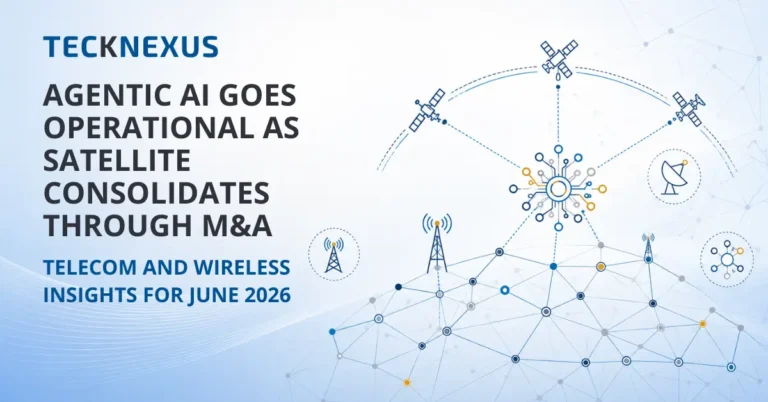
June 2026's roundup: agentic AI moves from pilot to operational core across telecom networks, satellite consolidates through Rocket Lab's $8B Iridium acquisition and SpaceX's $75B IPO, AI-RAN's GPU divide matures into shipping products, US spectrum auctions return after a four-year hiatus, and telecom M&A accelerates globally.
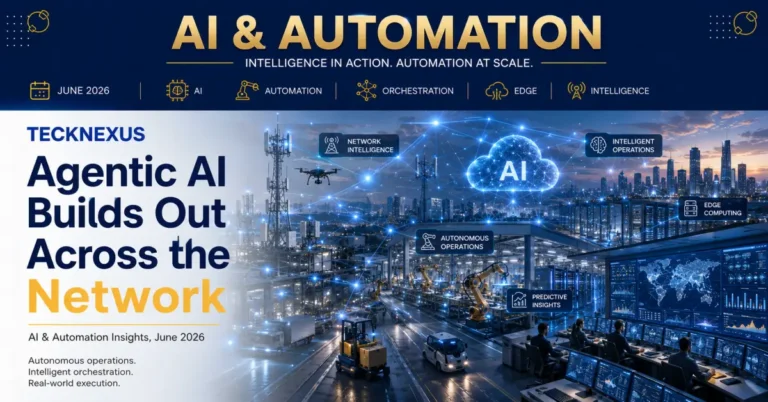
June 2026 showed agentic AI scaling from pilot to platform: industry-wide standards momentum, AI-RAN field trials from Nokia, Amdocs and KDDI, and fresh capital across data centers on three continents. This full roundup covers every deployment, partnership, funding round and governance move from the month, with tools to prioritise AI use cases and plan the network around them.
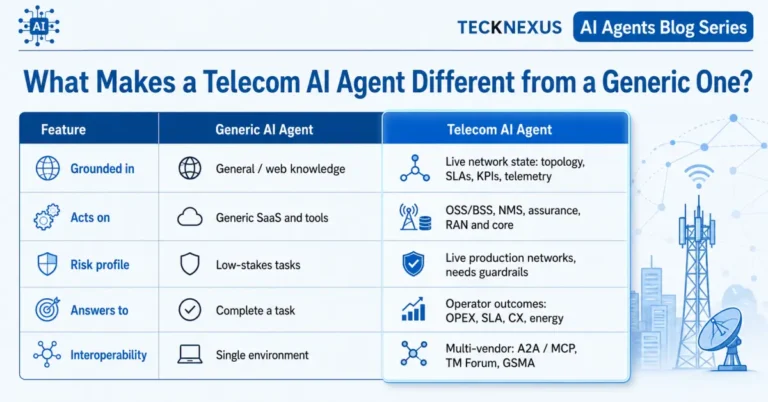
Telecom AI agents share the same anatomy as any AI agent - but grounding, systems, stakes, goals, and multi-vendor interoperability set them apart. Here are the five differences that matter, plus how to evaluate an agent before you trust it on a live network.
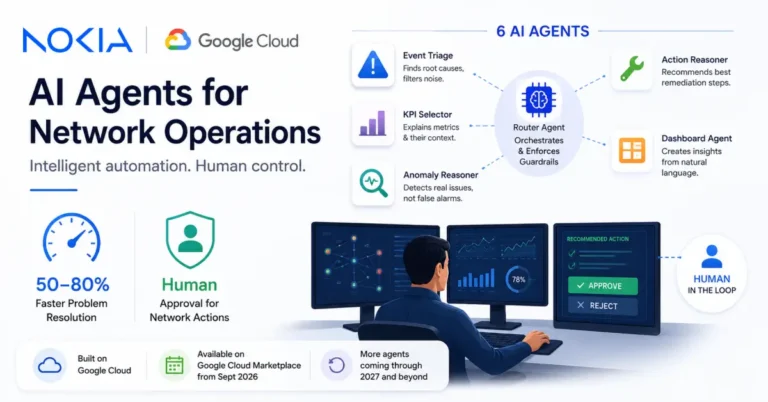
Nokia and Google Cloud have embedded six Gemini-powered AI agents into Nokia's Assurance Center, promising to cut network fault-resolution times by 50–80%. The 'glass box' design keeps human engineers in the approval loop - a deliberate choice Nokia argues is why this generation of automation will stick where earlier approaches stalled.
Circles and OpenAI have reached a major milestone in building the world's first AI-native telco stack, moving beyond legacy BSS/OSS bolt-on approaches. Flagship products CareX and Xplore IQ deliver measurable outcomes — including 85% autonomous query resolution and a 22% ARPU uplift in Singapore deployments. Built on a multi-agent architecture and OpenAI's API platform, the stack enables telecom operators across 14 countries to automate customer operations and drive proactive revenue monetization without rebuilding infrastructure from scratch.
The rebranding of O2 Daisy to O2 Business marks a strategic shift in UK enterprise technology. Following the August 2025 merger of Virgin Media O2's B2B division with Daisy Group, the combined entity now offers integrated connectivity, managed IT, and unified communications under a single brand. With 66 per cent of UK business leaders citing growing technology complexity and 30 per cent reporting rising costs as a result, O2 Business is positioning itself as a consolidated alternative to fragmented multi-supplier models — targeting mid-market and enterprise segments across commercial and public sector verticals.
European regulators have cleared the path for Telecom Italia (TIM) to offload its global wholesale arm, Sparkle, advancing a restructuring with implications for sovereignty, subsea capacity, and wholesale competition. The European Commission has approved the acquisition of Sparkle by Italy’s Ministry of Economy and Finance (MEF) and infrastructure provider Retelit, valuing the asset at €700 million and granting joint control to the two buyers. TIM had initially targeted closing in late 2025, but now guides to completion in the first half of 2026. Brussels found the deal would not materially distort competition in the relevant wholesale markets.
A new cross-industry consortium is forming to codify how trusted technology should be built, operated, and governed across borders. On February 13, 2026, fifteen companies spanning cloud, networks, semiconductors, software, and AI launched the Trusted Tech Alliance during the Munich Security Conference. The goal: define verifiable, provider-agnostic practices for a trustworthy technology stack—from connectivity and cloud infrastructure to chips, software, and AI—so customers and governments can rely on secure, resilient services regardless of where solutions are developed or deployed. Trust, sovereignty, and resilience are now gating factors for growth as AI scales and geopolitical risk reshapes supply chains.
OpenAI introduced Frontier as an enterprise platform to build, govern, and monitor AI agents—positioning agent management as core infrastructure rather than a feature. Frontier is an end-to-end platform for creating and managing AI agents that can connect to external data and applications, execute tasks, and operate under enterprise controls. OpenAI is emphasizing an open architecture: organizations can manage agents built on Frontier and agents constructed with third-party frameworks.
Orange Money Group and Visa are expanding a strategic partnership that brings a virtual Visa card into the Orange “Max it” app, letting users fund purchases directly from their mobile money balance for local and international e-commerce. The service is live in Botswana, Madagascar, Jordan, and now Côte d’Ivoire, with rollouts planned for Guinea, Burkina Faso, and the Democratic Republic of Congo. For Orange Middle East and Africa, which serves over 170 million customers in 17 countries and counts tens of millions of active mobile money wallets, this extends acceptance to the global Visa network while preserving the simplicity of a wallet-led user experience.
Google has introduced a sharply priced AI Plus subscription in India to push generative AI into the mass market and counter OpenAI’s ChatGPT Go. The AI Plus plan launches at ₹199 per month for new users for six months, then moves to ₹399 per month. The bundle raises usage limits for Gemini 3 Pro, unlocks video generation within Google’s apps, expands NotebookLM’s “deep research” capabilities, and adds 200GB of storage across Google Photos, Drive, and Gmail. Family sharing is included, signaling a household-centric growth strategy.
Versant’s lineup spans USA Network, CNBC, MS NOW (formerly MSNBC), Oxygen, E!, SYFY and Golf Channel, plus Fandango, Rotten Tomatoes, GolfNow, GolfPass and SportsEngine. Management argues the reach of up to ~65 million households and a 62% live programming mix gives it durable leverage in news and sports while it builds digital and direct-to-consumer (DTC) revenue. For MVPDs, vMVPDs and broadband providers, this is a new negotiating counterparty with incentives to protect affiliate value while expanding FAST, OTA and DTC channels that can bypass bundles. Versant stock will trade on Nasdaq as VSNT starting January 5, 2026.

Partner Hubs

Download content, access intelligence tools, and hear from executives.

Partner Events

  • M360 ASEAN
  • FutureNet Asia 2026
  • Network X Vienna 2026
Scroll to Top