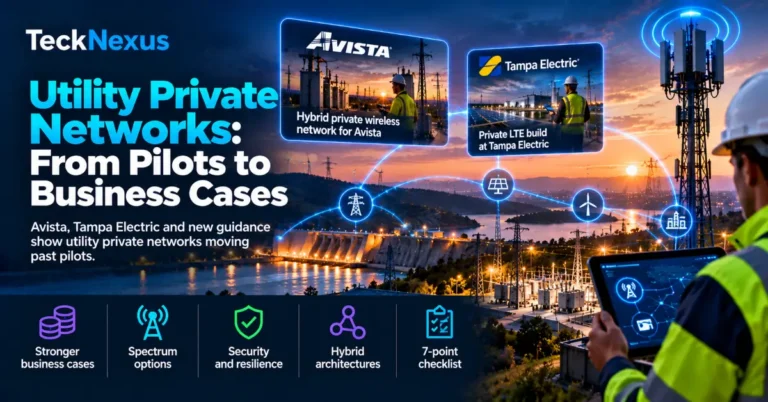
Utilities were among the earliest enterprise adopters of private wireless, and for years many of their projects remained pilots: a substation here, a test of smart meters there. That is changing. In October 2026, Heddian was selected by Avista to implement a hybrid private wireless network combining Giesecke+Devrient SGP.32 eSIM technology, a utility-grade core from Druid Software and network security from OneLayer, with round-the-clock monitoring and support. Nokia and Burns & McDonnell set out how private LTE and 5G with edge AI underpin smart grid modernisation, and West Monroe published guidance on balancing cost, control and reliability in private LTE investments.

These follow August’s announcement that Ericsson, OneLayer and Burns & McDonnell will deliver a private LTE network for Tampa Electric, covered in our August Private Network Insights. Taken together, they mark a shift in the conversation. Utility private networks are now judged on business cases that weigh total cost of ownership, spectrum, security and hybrid connectivity, not on whether the technology works.
Why Utility Private Networks Are Moving to Business Cases
Several pressures are pushing utilities from experimentation to commitment:
- Grid complexity: Nokia and Burns & McDonnell note that solar, wind and battery storage are expected to make up 93% of new US generating capacity in 2026, creating many more distributed assets to monitor and control.
- Rising demand: electrification and new AI data centres are adding load, increasing the value of real-time visibility across the grid.
- Resilience expectations: regulators and customers expect faster fault detection and restoration, and communications that keep working when public networks are congested or down.
- Legacy networks: ageing narrowband radio systems and leased circuits are expensive to maintain and limited in what they can carry.
- Security obligations: operational technology is now a priority target, and utilities need clear control over who and what connects to their networks.
The result is that private networks are being evaluated as long-term operational infrastructure, comparable to substations or control systems, rather than as innovation projects.
The Building Blocks of a Utility Private Network Business Case
A defensible business case looks beyond the cost of radios and core software. It captures avoided costs, operational gains and risk reduction over the life of the network.
| Business case element | What to include | Why it matters |
| Capital costs | RAN, core, devices, backhaul, integration and site work | Usually the largest upfront item and the focus of approval |
| Spectrum | Licence, lease or shared access costs and terms | Determines control, coverage and long-term certainty |
| Operating costs | Managed services, monitoring, support and lifecycle upgrades | Shapes total cost of ownership over 15+ years |
| Avoided costs | Carrier fees, leased circuits, legacy radio upkeep, truck rolls | Often offsets a large share of the investment |
| Resilience value | Faster fault detection and restoration, fewer outage minutes | Links the network to regulatory and customer outcomes |
| Security and compliance | Device identity, access control, monitoring, audit | Protects operational technology and meets obligations |
| Future applications | Distribution automation, DER control, drones, edge AI | Captures option value beyond the first use case |
Many utilities underestimate the value side of this ledger, particularly resilience and the option value of future applications. Our analysis of the missing line in private network ROI explores how these harder-to-quantify benefits can be made visible to finance teams.
Hybrid Architectures Reshape Utility Private Network Economics
The Avista deployment illustrates an important change in design philosophy. Rather than building a private network to cover every asset, utilities are combining private and public connectivity and managing them as one system. SGP.32 eSIM technology allows devices to be provisioned and switched between connectivity profiles remotely, so a meter, sensor or vehicle can use the private network where it exists and a public network elsewhere, without a site visit to change SIM cards.
West Monroe’s guidance makes the same point from the economics side. Public carrier and satellite services offer flexible alternatives, while private LTE provides dedicated infrastructure and greater control over performance and security. A balanced strategy lets utilities concentrate private investment where control matters most, such as substations, distribution automation and critical operations, and rely on public or satellite links for lower-priority or remote assets. Hybrid designs reduce upfront capital, shorten the path to value and make the business case easier to approve in phases.
Spectrum Choices for Utility Private Networks
Spectrum shapes both cost and control. In the United States, utilities can use dedicated 900 MHz broadband spectrum from Anterix, shared CBRS spectrum or leased operator spectrum, each with different coverage, capacity and certainty. Device support is improving, with new iPhone models reported to work on private LTE networks using 900 MHz, as noted in our September Private Network Insights. Our comparison of CBRS, licensed, shared and leased spectrum models sets out the trade-offs in more detail. For a business case, the key questions are licence certainty over the life of the network, coverage per site for wide service territories, and the availability of utility-grade devices in the chosen band.
Security as a Line Item in Utility Private Networks
Security is increasingly a named component of utility private network projects rather than an assumption. Both the Avista and Tampa Electric projects include OneLayer for network security and device management alongside the connectivity and integration partners. As our analysis of why utility private networks are growing faster than their security models argued, each new connected device adds an entry point to operational technology, and the consequences of a breach can reach physical infrastructure.
Integration with existing enterprise security is another priority. In October, NTT DATA integrated Cisco Identity Services Engine with the City of Brownsville‘s private 5G network, extending the city’s identity and access policies to cameras, sensors and tablets on the 5G network. The same approach applies to utilities: device identity, centrally enforced access policy and audit logging should be part of the business case from the start, with clear ownership between IT, OT and network teams.
Utility Private Networks Beyond the Grid
The same business case logic is extending into renewables and wider critical infrastructure. In Malaysia, U Mobile and renewable energy developer HLGY Energy signed a memorandum of understanding to explore private 5G-powered smart solar farms, combining AI analytics, autonomous drone inspections, smart CCTV and integration with battery energy storage. In Taiwan, Jieyuan Energy is piloting private 5G-connected AI at a geothermal power plant with Taiwan Mobile. Vodafone Oman has proposed pilot-led private 5G deployments for oil and gas, ports and public safety, with return on investment measured through productivity, safety and operating cost outcomes.
Government networks are following similar principles. Brazil’s EAF demonstrated a secure national private mobile network for the Brazilian Navy, with a one-year pilot using a main data centre in Brasília, a redundant hub in Rio de Janeiro, and terrestrial and low Earth orbit satellite connectivity with priority and pre-emption. Redundancy and hybrid backhaul are becoming standard features of critical infrastructure designs.
A Business Case Checklist for Utility Private Networks
Utilities that win approval for private networks tend to present them as long-term operational infrastructure with clear outcomes, costs and risks, not as technology projects. These seven steps help build a utility private network business case that will stand up with finance teams, regulators and boards:
- Start from operational outcomes: fault detection, restoration time, DER visibility and field workforce safety, not network specifications.
- Define the hybrid split: decide which assets need private connectivity and which can use public or satellite links.
- Secure spectrum with long-term certainty: match licence terms to a network life of 15 years or more.
- Count avoided costs: carrier fees, leased circuits, legacy radio maintenance and truck rolls.
- Budget security explicitly: device identity, access control, monitoring and integration with existing security tools.
- Plan operations: decide early between in-house operation and a managed service with 24/7 monitoring.
- Phase the rollout: begin with high-value sites and expand as benefits are proven.
What to Watch in Utility Private Networks
Over the coming months, the signals to watch include further utility selections that pair connectivity, security and integration partners; the use of eSIM-based hybrid connectivity at scale; growth in utility-grade devices for 900 MHz and other private bands; and the extension of private networks to solar, wind, storage and geothermal sites. Utilities that build their cases around outcomes, hybrid design and security from day one will move fastest from pilot to production.
Utilities assessing their readiness can use the Private Network Security for Utilities assessment, and for more private network analysis, tools and assessments, explore TeckNexus Intelligence.