Few questions in telecom carry more money than this one: will artificial intelligence change how much traffic flows up the network, and if so, who pays to carry it? For decades networks have been built for downloads. Video streaming is overwhelmingly downstream, and mobile operators allocate most of their capacity accordingly. AI, with its photo queries, live video to inference engines, smart glasses and machine vision, promises to reverse part of that pattern.

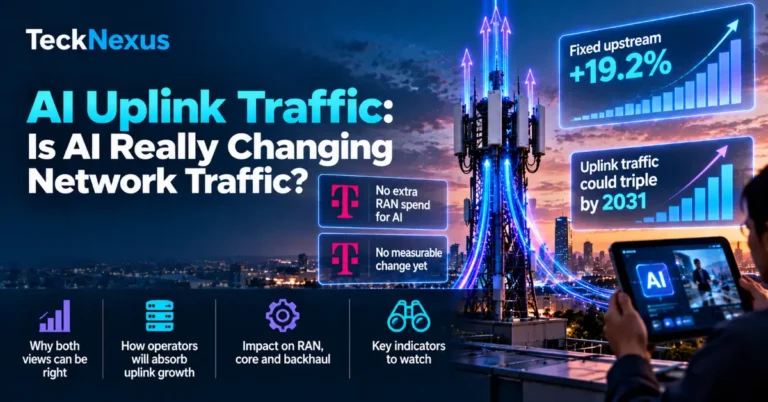
October 2026 produced evidence for both sides of the argument. Deutsche Telekom told investors that AI-driven uplink traffic will not require extra radio spending in the medium term. Data from fixed broadband showed upstream usage growing at its fastest rate in three years. And the industry’s own forecasts continue to project a sharp rise in uplink demand later this decade. Reconciling these signals is the key to understanding where AI uplink investment will actually go.

The Case That AI Uplink Traffic Is Not Here Yet
On mobile networks, the measurable impact so far is small. At its first AI Investor Day, Deutsche Telekom said it does not expect AI-driven uplink traffic to raise its capital intensity after 2027, and that no internal request for additional uplink investment had emerged beyond existing RAN modernisation plans. In September, T-Mobile US said AI had not yet produced a measurable change in mobile usage patterns on its network, with most of the effect felt so far in transport networks and around large data centres, as covered in our September AI & Automation Insights.
Testing supports that view for today’s devices. Signals Research Group found only a very modest impact on uplink capacity when running AI and augmented reality applications on smart glasses and smartphones over T-Mobile‘s network. For now, the typical AI interaction, a short text prompt or a single photo, is small compared with the video that dominates downstream traffic.
The Case That AI Uplink Demand Is Building
Fixed networks tell a different story. OpenVault’s Q2 2026 broadband data shows upstream usage up 19.2% year on year, the third consecutive acceleration after rises of 15.9% in 2024 and 17.9% in 2025. The download-to-upload ratio has narrowed from 16.6:1 in 2019 to 11.2:1. Fibre customers, with symmetric speeds, now upload an average of 94.1 GB a month against 58.2 GB for cable customers. Gaming and video calls remain major drivers, but AI-generated content and cloud synchronisation are rising contributors, with cloud sync alone accounting for an estimated 15% to 16% of upload volume.
Industry forecasts point the same way for mobile. Ericsson data puts uplink at around 8% of mobile traffic today, but projects uplink volumes reaching three times their 2025 level by 2031, while total mobile traffic grows about 2.2 times. Cloud-based AI on smart glasses could need between 1 and 10 Mbps of sustained uplink per user, and some applications could invert the usual traffic balance entirely. AT&T has cited the need to build a better upstream as part of its reasoning for acquiring 600 MHz spectrum, selecting radios with eight receive paths to strengthen the uplink.
| Signal | Evidence | What it suggests |
| Mobile capex outlook | Deutsche Telekom expects no rise in capital intensity from AI uplink after 2027 | Growth absorbed within existing RAN plans |
| Mobile usage today | T-Mobile reports no measurable change yet; tests show very modest uplink impact | Current AI apps are light on uplink |
| Fixed upstream | Upstream up 19.2% year on year; ratio narrowed to 11.2:1 | Shift is visible first on fixed networks |
| Mobile forecasts | Uplink traffic three times 2025 levels by 2031 vs 2.2 times total growth | Uplink share set to rise later this decade |
| Spectrum and radios | AT&T 600 MHz radios with eight receive paths | Operators preparing uplink capacity selectively |
Why Both Sides of the AI Uplink Debate Can Be Right
The contradiction is smaller than it looks. Three distinctions explain most of it.
First, timing. Today’s AI usage on phones is light, and the heavy uplink applications such as always-on video from wearables or fleets of cameras feeding inference engines are still early. Forecasts are about the end of the decade, while capital plans are about the next two to three years.
Second, network type. Fixed broadband carries the bulk of large uploads, from cloud backups to AI-generated files, so it is no surprise that the upstream shift is visible there first. Mobile networks will see it later, as devices and applications mature.
Third, concentration. AI uplink demand is unlikely to rise evenly. It will cluster in specific places: stadiums and venues, factories running machine vision, logistics hubs, and dense urban areas where wearables catch on. Network-wide averages can stay flat while individual cells and sites come under real pressure.
How Operators Can Absorb AI Uplink Growth Within Existing Budgets
Deutsche Telekom’s position does not mean operators will ignore uplink. It means they expect to handle growth with tools already in their roadmaps rather than new capital programmes:
- Reconfiguring TDD frames: US carriers allocate about 20% of mid-band TDD resources to uplink, and shifting that balance where demand appears is largely a software decision.
- 5G-Advanced uplink features: uplink carrier aggregation, uplink MIMO and transmit switching, which T-Mobile says position it for AI demand.
- Better receivers: radios with more receive paths, such as AT&T’s eight-receiver 600 MHz units, improve uplink reach and capacity.
- AI in the RAN: AI-driven scheduling and link adaptation, now reporting spectral efficiency gains of around 20% in live trials, raise capacity in both directions.
- New spectrum: additional mid-band supply over the next few years gives operators more room to dedicate capacity to uplink.
This mirrors a point TeckNexus made earlier this year in examining why AI drives the need for a stronger 5G uplink in the US: the uplink share of capacity has stayed flat or fallen in many markets even as upload speeds improved, leaving headroom that can be reclaimed as demand rises.
AI Uplink Traffic and Enterprise Networks
Enterprises are likely to feel the shift sooner than consumers. Industrial AI is inherently uplink-heavy: cameras, sensors and robots generate data on site and send it to inference engines, while instructions flowing back are small. Research for Nokia has identified the uplink as a key bottleneck for AI networking across factories, drones and clinical imaging. Private 5G networks can be configured with uplink-heavy frame structures from the outset, one reason industrial networks already suit physical AI, as explored in our analysis of T-Mobile’s kinetic token framework.
AI Uplink Indicators to Watch
Below indicators to watch for AI Uplink:
- Uplink share of mobile traffic in operator disclosures and the next Ericsson traffic updates, compared with today’s level of around 8%.
- Fixed upstream growth in future quarterly broadband data, and whether it keeps accelerating beyond 19.2%.
- Adoption of camera-equipped AI glasses and other wearables that stream video continuously.
- Changes in TDD frame configurations or uplink-focused spectrum strategies by major operators.
- Operator capital guidance after 2027, the point at which Deutsche Telekom says AI will not raise its capital intensity.
The likely outcome is not a sudden uplink crisis but a gradual rebalancing, handled first through software, scheduling and existing spectrum, and showing up earliest in fixed networks, enterprise sites and dense venues. Operators that track demand at the cell level, rather than in national averages, will see the shift coming first.
For more insights on advanced connectivity, explore the TeckNexus Monthly Insights, and to share your perspective with our audience and generate qualified leads, partner with TeckNexus through an Intelligence Program.