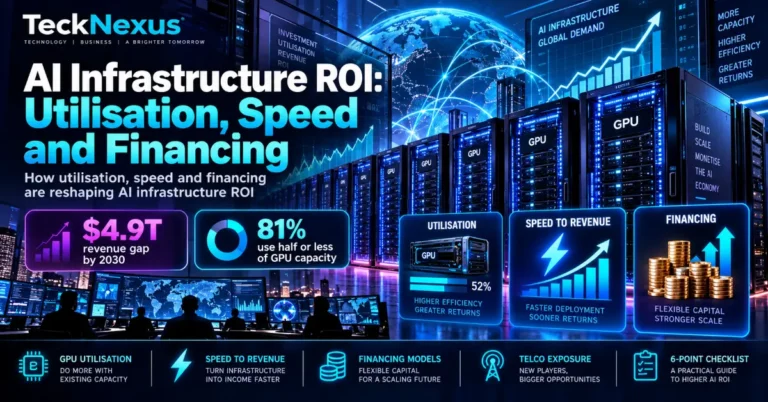
Two numbers published in the same week of October 2026 capture the central tension in AI infrastructure. Gartner estimated that data centre owners would need around $8.5 trillion in cumulative revenue by 2030 to cover their AI capital spending and earn a 12% return on invested capital, yet only about $3.6 trillion of AI revenue is likely to be attributable to those assets, leaving a gap of roughly $4.9 trillion. The same week, a VB Pulse survey reported by VentureBeat found that 81% of companies running AI in production use half or less of their GPU capacity, while 71% still plan to invest in more infrastructure.

Alongside them, NVIDIA‘s Jensen Huang argued that a three-month delay in bringing an AI data centre online can forgo around $10 billion in revenue. Read together, these signals do not describe a market about to stop building. They describe one that is shifting its attention from how much capacity to build to how quickly, how fully and how efficiently that capacity earns a return. AI infrastructure ROI has become the defining question for the next phase of the buildout.

The AI Infrastructure ROI Gap in Numbers
Gartner’s analysis puts the scale of the challenge in context. It forecasts AI capital spending of about $7.5 trillion between 2025 and 2030, close to $1 trillion in 2026 alone and approaching $2 trillion a year by the end of the decade. Because no more than about 30% of AI revenue is expected to be booked against the underlying infrastructure, it does not expect owners to reach their hurdle rates before 2032, and estimates that up to $3.5 trillion of assets could face impairment by 2030 if the gap persists.
| Signal | Figure | What it tells us |
| Revenue needed to hit a 12% return (Gartner) | About $8.5 trillion cumulative by 2030 | The scale of returns AI capex must generate |
| AI revenue attributable to infrastructure (Gartner) | About $3.6 trillion, a gap of roughly $4.9 trillion | Monetisation lags investment |
| AI capex 2025 to 2030 (Gartner) | About $7.5 trillion | Spending keeps growing towards $2 trillion a year |
| GPU utilisation (VB Pulse) | 81% use half or less of GPU capacity | Large gains available from better utilisation |
| Cost of delay (NVIDIA) | About $10 billion per three-month delay | Speed to deployment drives returns |
| US business fixed investment, Q1 2026 | Up 11% annualised, led by AI | Demand and construction remain strong |
None of this means demand is weak. Business fixed investment in the United States rose at an 11% annualised rate in the first quarter of 2026, largely because of AI spending, and data centre construction continues to accelerate. The issue is the distance between investment and monetisation, and the levers that can shorten it.
Why Utilisation Is the First AI Infrastructure ROI Lever
An idle GPU earns nothing, and the VB Pulse findings suggest idle capacity is common. Underutilisation has several causes: clusters sized for peak training runs that sit partly empty afterwards, fragmented scheduling across teams, data pipelines that cannot feed accelerators fast enough, and inference workloads that arrive in bursts rather than steadily.

The industry’s response is to measure AI data centres the way manufacturers measure factories. NVIDIA’s new Minerva AIOps platform pulls telemetry from GPUs, networking, storage, schedulers and workloads into a single model of the facility, with the stated aim of improving yield metrics such as GPU uptime, goodput, cluster uptime and token production. Early users and planned adopters include IBM, Jio, Lambda and Tesla. Power efficiency is being treated the same way: NVIDIA’s DSX MaxLPS software, adopted by European partners including CoreWeave, Nebius and Google Cloud, aims to deliver up to 30% lower power for the same token output.
The metric that matters is shifting from installed megawatts or GPU counts to useful output per unit of capital and energy. Operators that can show high, steady utilisation will earn better returns from the same hardware, and will find it easier to raise capital for the next phase.
Speed to Revenue as an AI Infrastructure ROI Lever
If utilisation determines how much revenue a facility earns, time to deployment determines when that revenue starts. Large campuses can take years to complete. Digital Realty’s proposed 1 GW campus in Kokomo, Indiana, for example, is planned to reach full capacity by 2033, and Chief Telecom‘s new AI data centre in Taiwan is scheduled to open in the second half of 2028.
Modular, factory-built designs aim to compress that timeline. NVIDIA’s DSX POD reference design for Vera Rubin systems pre-integrates compute, networking, cabling, rack power and liquid cooling in the factory, so units arrive ready to connect to site utilities. NVIDIA says this can cut deployment from around six months to as little as 14 days, with partners delivering from early 2027. Every month saved brings revenue forward and reduces the period in which capital sits idle, which is why time to first token is becoming as important to investors as total capacity.
How Financing Is Adapting to AI Infrastructure ROI Pressure
The way AI data centres are funded is changing as investors weigh returns more carefully. Our September Digital Infrastructure Insights tracked how compute was moving into long-term contracts and new financing structures, such as Anthropic‘s $11.6 billion, seven-year compute agreement with Akamai. October extended that trend in several directions:
- Asset-backed and equipment financing: Crusoe secured a $700 million facility from Neuberger Specialty Finance, secured by recently ordered power generation equipment for its AI factories.
- Flexible bridge facilities: Nebius closed a $3.5 billion, 364-day senior secured facility led by Citi, keeping room for longer-term and asset-backed financing later.
- Offtake agreements: HUMAIN paired an 84 MW NVIDIA-based deployment in Saudi Arabia with a 50 MW offtake agreement with Nebius, securing demand alongside capacity.
- Structured debt and sale-leasebacks: India‘s data centre market is turning to structured debt, sale-leaseback transactions and direct hyperscaler capital to fund AI-driven growth.
- Recalibrated public listings: DayOne Data Centers signalled its Nasdaq listing may be postponed or downsized, Firmus withdrew a planned IPO, and PLDT moved its Vitro data centre REIT listing to 2027.
The common thread is that capital is increasingly tied to specific assets, contracts and milestones rather than to broad growth stories. That is a healthy sign of a maturing market. Lenders and investors are pricing risk more precisely, and builders with contracted customers and proven delivery are best placed to secure funding on good terms.
Telcos Take a Measured Approach to AI Infrastructure ROI
Telecom operators are participating in the buildout in ways that limit their exposure to the ROI gap. Many are focusing on connectivity to AI data centres, where revenue comes from contracted capacity rather than GPU utilisation. Elisa secured around €100 million in cumulative data centre connectivity orders in the first nine months of 2026, supported by an expanded partnership with Google covering facilities across Finland. Zayo is planning more than 8,000 miles of new fibre for AI data centres, backed by a partnership with NVIDIA and a long-term supply agreement with Corning.
Where operators do build compute, they are often anchored by sovereign demand or government support. Bell Canada is accelerating an AI data centre near Regina with backing from the Saskatchewan government, Globe Telecom plans to invest at least $1 billion in data centre capacity to attract AI workloads to the Philippines, and TIM is building a sovereign AI platform across its cloud and edge network in Italy. This combination of connectivity revenue and anchor tenants gives telcos a lower-risk route into AI infrastructure. It also lets them build compute capacity in step with demand that is already committed, rather than ahead of it.
An AI Infrastructure ROI Checklist
For investors, operators and enterprises planning AI capacity, six questions now matter as much as the size of the build:
- How much of the capacity is contracted? Offtake agreements and long-term customer commitments reduce demand risk.
- What utilisation will it sustain? Model realistic GPU utilisation, not peak, and plan for scheduling and orchestration that keeps it high.
- How fast can it earn revenue? Compare modular and prefabricated options against conventional builds on time to first token.
- What does each token cost to produce? Track power, cooling and operating costs per unit of output, not just per megawatt.
- How flexible is the hardware? Facilities able to host successive accelerator generations and mixed workloads protect against obsolescence.
- Is the financing matched to the asset? Align debt terms with contract length and expected hardware life to avoid refinancing pressure.
What the AI Infrastructure ROI Reckoning Means for the Market
The AI infrastructure ROI debate is a sign of a market growing up, not of one losing momentum. Demand for compute continues to rise, and capital is still flowing into chips, power, cooling and connectivity. What is changing is the discipline applied to it. Builders that measure output like factories, deploy capacity in weeks rather than months, and match financing to contracted demand will close the gap between investment and revenue fastest. For everyone else, utilisation and speed are now as important as scale.
For more insights on advanced connectivity, explore the TeckNexus Monthly Insights, and to share your perspective with our audience and generate qualified leads, partner with TeckNexus through an Intelligence Program.