Spectrum Invincible WiFi: Carrier‑grade home internet reliability with Wi‑Fi 7 and 5G backup
Charter Communications is bundling Wi‑Fi 7, battery backup and 5G failover under its Spectrum brand to keep home networks online through power blips and access outages.

What Spectrum Invincible WiFi includes
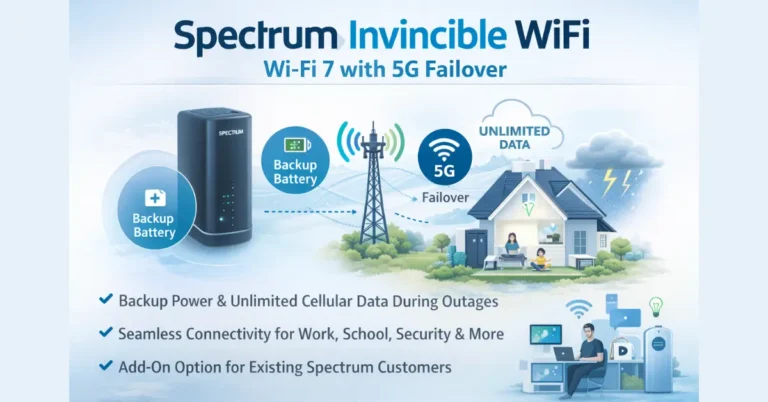
Charter introduced Spectrum Invincible WiFi, a package built around its Advanced Wi‑Fi 7 router paired with an integrated backup battery and an embedded 5G cellular pathway. The system automatically rides through local power interruptions for up to eight hours and, if the wired broadband link drops, switches to cellular with unlimited data until the primary connection returns. The offer targets households running multigig internet and dozens of smart devices, and is positioned as a simple add-on for existing Spectrum customers.
Why resilient home internet matters now
Home connectivity has become mission‑critical for work, school, security and telehealth while weather-related disruptions and grid instability are rising. Most residential setups still hinge on a single point of failure: a powered gateway tied to a single access path. By converging wireline and 5G access with local power resiliency in the CPE, Charter is pushing a pragmatic form of high availability to the mass market—without asking users to manage generators or separate hotspots.
How Spectrum’s Wi‑Fi 7 + 5G failover works
The design blends power resiliency and access redundancy and then automates failover/failback so users don’t have to touch their network when something goes wrong.
Battery backup and 5G failover for always‑on access
The battery module keeps the Wi‑Fi 7 router functioning for up to eight hours during local outages. If the wired connection over Spectrum’s “fiber‑powered” HFC network (or fiber where available) is interrupted—due to upstream power loss, a line cut or maintenance—the router shifts traffic to an integrated 5G cellular link. That cellular link is provisioned for unlimited data, enabling continuity for streaming, conferencing and smart home functions while the primary path is restored.
Automatic failover to 5G and seamless return to broadband
Monitoring is built into the router, which triggers battery power the moment mains power drops and activates the 5G backup only when the wireline path is unavailable. When grid power or primary broadband comes back, the system reverts automatically, minimizing session disruption. Real‑world performance will still depend on local cellular coverage and spectrum conditions during an outage, but the default experience is designed to be fully hands‑off.
Inside the Wi‑Fi 7 router: speed, latency and device density
Invincible WiFi is anchored by a next‑gen Wi‑Fi platform to support higher throughput, lower latency and dense device environments.
Key Wi‑Fi 7 features (320 MHz, MLO, tri‑band)
The Advanced Wi‑Fi 7 router supports IEEE 802.11be capabilities such as wider 320 MHz channels, higher‑order modulation and tri‑band operation across 2.4, 5 and 6 GHz. On capable clients, Wi‑Fi 7 features like Multi‑Link Operation can improve reliability by using multiple bands concurrently. Charter positions the system for multigig service tiers, whole‑home coverage around 2,000 square feet and more than 200 connected devices—aligning with the realities of modern homes loaded with cameras, sensors, TVs and laptops.
Optimized for multigig internet and high‑density homes
As Charter expands multigig offers, a Wi‑Fi 7 gateway helps translate access speed into usable in‑home performance. For customers on 1 Gbps and 2 Gbps tiers, the combination of wider channels and better scheduling reduces contention and jitter, which is noticeable in 4K streaming, cloud gaming and high‑density IoT scenarios.
Pricing, plans and how it compares
Invincible WiFi is framed as a simple, affordable step up in reliability with clear bundling logic as operators converge mobile and broadband.
Pricing and plan details
Charter prices Invincible WiFi as a $10‑per‑month upgrade for Spectrum Gig customers with Advanced WiFi, and includes it at no additional cost with its 2 Gig plan. The value proposition is straightforward: a single device and subscription that adds power continuity plus a cellular safety net with unlimited data.
Competitors and alternatives
Comcast markets a similar concept with its storm‑ready gateway that pairs LTE backup and a battery. Mesh vendors have introduced software‑based backup that can tether to phones or alternative ISPs. What differentiates Charter’s approach is the tight integration of 5G failover, Wi‑Fi 7 and battery in a carrier‑managed CPE with automatic policy and monitoring—lowering friction for mainstream households and offering a clearer reliability story than ad‑hoc hotspot workarounds.
Strategy for ISPs: converged access and retention
This is converged access by design. It defends ARPU and reduces churn by packaging resilience as a feature instead of an expensive upsell, and it deepens mobile cross‑sell given Charter’s MVNO footprint. For the network team, CPE‑based failover can offload outage traffic to cellular while plant issues are resolved. For product teams, Wi‑Fi 7 gateways become a platform for add‑on services (security, parental controls, device analytics) that ride on top of a stickier connection.
Buyer checklist and what to watch
Resilient home networking is maturing fast; diligence on implementation details will determine the real‑world experience.
Questions to ask before buying
Confirm what the battery actually powers in your setup. If your service uses a separate modem or ONT, ensure the backup supports the components needed to keep the wired link alive—or plan for an external UPS. Validate 5G coverage at your address and ask how traffic is prioritized during regional outages. Clarify any fair‑use policies behind “unlimited” backup data. If you rely on home voice or security systems, verify how those services behave on battery and cellular. Finally, check client device support for Wi‑Fi 7 features to realize the full in‑home performance gains.
Implications for vendors and the ecosystem
There’s an opening to standardize consumer‑grade failover behavior (policy, health checks, telemetry) and to improve power efficiency in CPE so backup windows extend beyond eight hours. Expect growing demand for Wi‑Fi Certified 7, TR‑369/USP‑based management, and tighter SD‑WAN‑like policies in the home that steer sessions across wireline and cellular. Partnerships that blend HFC/fiber access with 5G and intelligent CPE will set the bar for “always‑on” consumer broadband in 2025.
Bottom line: a pragmatic path to always‑on home internet
Charter’s Invincible WiFi packages the right pieces—Wi‑Fi 7, battery backup and 5G failover—into a managed offer that directly addresses home connectivity’s weakest link. For households and home offices that can’t afford to drop offline, it’s a pragmatic step toward carrier‑grade resilience without enterprise‑grade complexity.