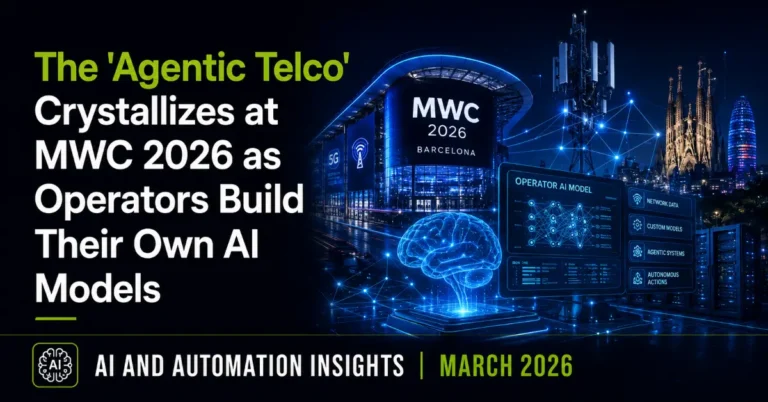
March 2026’s roundup: GSMA, Google Cloud, Huawei, and AWS all converge on an “agentic telco” framing at MWC Barcelona, SoftBank and SK Telecom build proprietary telecom-specific AI models and infrastructure, and physical AI reaches airports, drones, and network edge sites — with AI-RAN and connectivity infrastructure covered separately in our companion Advanced Connectivity Insights, March 2026.

At a glance – AI & Automation Insights for March 2026
- GSMA, Google Cloud, Huawei, and AWS all converged on an “agentic telco” framing at MWC 2026, with Google Cloud reporting concrete results: a 25% drop in complaints at Bell Canada and a 95% reduction in network management event times with Deutsche Telekom‘s RAN Guardian.
- SoftBank Corp. built a coordinated multi-agent platform within its Large Telecom Model (LTM) and began verification for autonomous base station integration, using NVIDIA NeMo Safe Synthesizer to train the model on synthetic network data.
- SK Telecom is piloting “Small AI” to manage factory rail systems within SK Group and outlined a “Full Stack AI Provider” vision spanning AI data centers, sovereign models, and 5G enterprise expansion — with plans to export its sovereign AI playbook internationally.
- Superloop deployed agentic customer-facing assistants “Teddy” and “Mo” for billing and self-service diagnostics, while Sinch introduced Voice Relay to connect AI agents to live phone calls.
- AGIBOT deployed service robots at Singapore’s Changi Airport Terminal 5 via its first overseas telecom partnership with Singtel, and Orange Business launched Drone Guardian, a nationwide counter-UAS sensing service built on telco infrastructure.
- Telia and Brookfield partnered on Sweden’s largest sovereign AI initiative, Singtel launched a $250M AI-focused venture fund, and TRAI signaled a new regulatory framework for AI in India‘s telecom networks.
1. The “agentic telco” movement crystallizes at MWC 2026
Four separate major players converged on the same framing independently this month:
- GSMA: MWC 2026 discourse emphasized agentic AI progressing toward autonomous networks, marking a shift from MWC 2025’s focus on outcome-based automation.
- Google Cloud: outlined its 2026 “agentic telco” roadmap, integrating Gemini-driven autonomous agents across network operations to detect anomalies, trigger workflows, and remediate faults with minimal human intervention; reported a 25% drop in complaints at Bell Canada and a 95% reduction in network management event times with Deutsche Telekom‘s RAN Guardian, is expanding its autonomous network framework with Vodafone, and launched a GraphML-based AIOps pilot with MasOrange and NetAI using digital twins and graph neural networks.
- Huawei: outlined a shift from API-based control to service-based intent interaction, positioning agent-driven AI to translate service needs into automated network behavior, and separately asserted that supporting 100 billion AI agents will require new networks and new KPIs.
- AWS: an AWS technologist outlined a 6G vision where agentic AI and non-terrestrial network (NTN) integration drive telco value creation, with AWS’s Telco AI Platform including jointly building a core large language model to develop AI agents for telco domains.
- Amdocs: outlined telecom’s shift from AI hype to practical deployments, framing a vision for “agentic reality” in operator environments.
- NASSCOM: published guidance debunking seven common myths around agentic AI, framing practical capabilities, adoption constraints, and alignment with enterprise digital transformation and GenAI programs.
Why it matters for buyers: four separate major players — GSMA, Google Cloud, Huawei, and AWS — all converged on the same “agentic telco” framing in the same month, and Google Cloud backed it with concrete, named operator results (Bell Canada’s complaint drop, Deutsche Telekom’s event-time reduction). That’s a genuine industry-wide framing shift, not one vendor’s marketing narrative — buyers should expect “agentic telco” language to become the default way vendors pitch network AI going forward. → Prioritise agentic AI initiatives against these emerging frameworks with the TeckNexus AI Use Case Prioritiser.
2. Operators build their own AI foundation models and infrastructure
SoftBank and SK Telecom are both moving from using third-party AI models to building and training their own telecom-specific foundation models:
- SoftBank Corp.: integrated a coordinated multi-agent system into its Large Telecom Model (LTM) and started verification in base station integration to automate analysis, decision-making, and execution in network operations; separately introduced a synthetic data generation pipeline using NVIDIA NeMo Safe Synthesizer with Differential Privacy to protect confidential network operations data while training the LTM.
- SK Telecom — Small AI: is piloting an agentic AI system built on its small language model to manage factory rail systems within SK Group, targeting elimination of equipment downtime and advancing toward autonomous manufacturing.
- SK Telecom — memory partnership: plans to work with sister company SK Hynix to mitigate AI memory bottlenecks using SK Hynix’s Gaia generative AI platform, with deployment targeted for 2026.
- SK Telecom — Full Stack AI Provider vision: its CEO outlined plans to evolve into an AI-powered mobile network operator and “Full Stack AI Provider” spanning AI data center solutions and AI models, alongside intent to export its sovereign AI approach to external markets; separately, the operator is investing in AI data centers and launching sovereign AI models for Korean enterprises while scaling 5G and private networks, aiming to lift ARPU and expand B2B revenues.
Why it matters for buyers: SoftBank and SK Telecom are both moving from using third-party AI models to building and training their own telecom-specific foundation models on proprietary network data — a meaningfully different, higher-commitment strategy than licensing generic LLMs. Buyers evaluating operator AI capabilities should distinguish between operators building genuine model infrastructure versus those primarily integrating vendor AI products. → Compare build-vs-buy AI infrastructure strategies with the TeckNexus AI Use Case Prioritiser.
3. AI moves into telecom CX and operations at scale
AI adoption spread across essentially every customer-facing and operational function simultaneously this month:
- Superloop: is advancing an AI-driven billing system initiative while operating two customer-facing agentic AI assistants (Teddy and Mo) and integrating automated self-service diagnostic tools.
- Sinch: introduced Voice Relay (early access) within its Enterprise Voice platform to bridge text-based AI agents with live calls, handling ASR, TTS, interruption management, and low-latency media, alongside branded calling protection and expanded global network capabilities.
- Microsoft & Vodafone: Microsoft highlighted the use of cloud-based agentic AI to compress Vodafone’s B2B sales cycle, indicating deployment of AI agents on Azure to streamline enterprise sales and service processes, with references to AT&T, T-Mobile, and Telefónica suggesting broader operator interest.
- TPG Telecom: is upgrading its Service Operations Centre with AIOps capabilities by integrating Splunk IT Service Intelligence and Cisco AIOps tooling to improve observability, event correlation, and incident response across network and IT services in Australia.
- Orange: is integrating AI as a core pillar of its corporate strategy and extending an AI-enabled product within its “Max it” app to a broader market.
- ServiceNow: is extending its AI-driven capabilities to target government and telecom sectors specifically.
- NETSCOUT: is aligning its telecom portfolio to deliver AI-ready network data and observability pipelines for service providers, enabling analytics, automation, and ML-driven operations.
Why it matters for buyers: the range here — from consumer-facing billing assistants (Superloop) to voice-call AI agent bridging (Sinch) to enterprise sales cycle compression (Microsoft/Vodafone) — shows AI adoption spreading across essentially every customer-facing and operational function simultaneously, not concentrating in one department. → Rank which of these functions to prioritise first with the TeckNexus AI Use Case Prioritiser.
4. Physical and industrial AI reach telecom-adjacent applications
Physical AI is reaching telecom-adjacent applications faster than pure network AI in some respects — service robots, counter-drone sensing, and edge inference are deployed use cases this month, not roadmap items:
- AGIBOT: secured its first overseas telecom partnership with Singtel and deployed service robots at Singapore’s Changi Airport Terminal 5.
- T-Mobile & Nvidia: at Nvidia GTC, outlined plans to deliver “physical AI” workloads at telco edge locations (radio towers, central offices), leveraging T-Mobile’s network footprint to host low-latency AI inference close to users and data sources.
- Orange Business — Drone Guardian: launched a counter-UAS service that turns telco infrastructure into a nationwide sensing fabric, leveraging secure nationwide connectivity, cloud qualified to ANSSI’s SecNumCloud 3.2 standard, and a domestic security operations capability.
- Orange Business — trusted AI voice: is putting authenticated, AI-augmented voice back into the critical path of CX and employee workflows, addressing fraud, impersonation scams, and eroded trust in the phone channel.
- Huawei: asserted that supporting 100 billion AI agents will require telecom networks to evolve with new AI-era service assurance metrics and architectures.
Why it matters for buyers: physical AI is reaching telecom-adjacent applications faster than pure network AI in some respects — service robots in live airport operations, counter-drone sensing built on existing telco infrastructure, and edge inference at radio towers are all deployed or piloted use cases, not roadmap items. → Evaluate physical AI and edge inference opportunities with the TeckNexus AI Use Case Prioritiser.
5. Sovereign and cross-operator AI partnerships expand globally
Sovereign AI this month spans a genuine spectrum, from national infrastructure initiatives to specific point solutions:
- Singtel & Cohesity: partnered to introduce a sovereign data service aimed at fault-tolerant, highly secure AI adoption for enterprises and government agencies, anchored in-country for data residency and compliance.
- Grameenphone & ZTE: partnered to develop autonomous network operations using large language models and agentic AI, employing an A2A-T protocol to enable closed-loop automation and multi-agent coordination.
- Indosat Ooredoo Hutchison & Safaricom: formed a partnership to apply AI across telco operations and digital financial services, including predictive care for network issues, AI-driven customer engagement, AI-based fraud/risk management, payment reliability improvements, and AI-informed Smart CAPEX planning, importing proven M-PESA operating models alongside joint leadership and AI skills development.
- Telia & Brookfield: entered a long-term strategic partnership to build Sweden’s largest sovereign AI initiative, aimed at strengthening Sweden’s and Europe‘s digital capabilities.
- Singtel: its venture arm launched a $250 million growth fund targeting AI solutions for network operations, cybersecurity, IT automation, and enterprise AI platforms.
- C-DOT: its indigenous AI-driven fraud detection platform “FraudPro” was named a top finalist in a national competition, supporting India‘s secure digital infrastructure and trusted connectivity initiatives.
- TRAI: signaled intent to establish a regulatory framework for AI use across Indian telecom networks, particularly in core functions such as network management and traffic control, emphasizing governance, security, and accountability.
Why it matters for buyers: sovereign AI and cross-operator AI partnerships this month span from national-scale infrastructure (Telia/Brookfield’s Swedish initiative) to specific fraud-detection tools (C-DOT‘s FraudPro) to regulatory groundwork (TRAI) — suggesting sovereign AI is becoming a genuine spectrum of commitments, not a single category of offering. → Compare sovereign AI models and partnership structures with TeckNexus Vertical Intelligence.
6. Industry standards and alliances organize around telecom AI
A useful reality check emerged alongside this month’s heavy “agentic telco” framing:
- Selectstar: joined the GSMA Telecom AI Alliance under the Open Telco AI initiative, becoming the only Korean startup participant, aligning with operators and vendors collaborating on telecom-focused AI development and adoption, with an emphasis on safety and accuracy.
- Advanced Micro Devices: confirmed participation in GSMA’s Open Telco AI initiative at MWC 2026, supporting an open portal (open-telco.ai) with shared datasets, tools, and benchmarks; will supply Instinct GPUs with the ROCm software platform for AI training and inference, introduced EPYC 8005 CPUs optimized for distributed edge and vRAN workloads, and expanded its Ryzen AI portfolio for OEM AI PCs.
- VoIP Review: reported on an “Open Telco AI” collaboration theme, noting that only 16% of telecom GenAI implementations currently touch network operations and calling for cross-industry coordination to operationalize GenAI beyond customer-facing use cases.
- IDC: at MWC 2026, stated that Chinese vendors are extending AI from software into hardware (e.g., AI-enabled “robot phones”), with generative AI and context-aware automation entering smartphones and smart devices, and AI moving into communications infrastructure and enterprise workflows, underpinned by China’s supply chain depth and talent base.
- AI News: analyzed the cost dynamics of multi-agent AI for enterprise automation, highlighting the “thinking tax” and the expense of relying on massive models for each subtask, with implications for model orchestration and hardware selection.
Why it matters for buyers: VoIP Review’s finding that only 16% of telecom GenAI implementations currently touch network operations is a useful reality check against this month’s heavy “agentic telco” framing — most GenAI deployment today is still customer-facing, not network-operational. Buyers should calibrate vendor claims about agentic network AI against this actual adoption baseline. → Benchmark your own AI adoption against industry standards with the TeckNexus AI Use Case Prioritiser.
Every March item, with full source detail, is on the curated AI & Automation Monthly Insights page →
A note on scope: this roundup focuses on AI models, agents, applications, and AI-specific governance. AI-RAN, 6G, and other connectivity infrastructure stories from this same month — including AT&T’s $250B network investment, Ericsson and Nokia‘s diverging AI-RAN strategies, and several MWC 2026 AI-RAN demonstrations — are covered in the companion Advanced Connectivity Insights, March 2026.
What this means if you’re evaluating AI and automation investments
March’s throughline is that “agentic telco” became the industry’s shared vocabulary this month — GSMA, Google Cloud, Huawei, and AWS all converged on it independently — but VoIP Review’s finding that only 16% of GenAI implementations actually touch network operations is a reminder that the framing is running ahead of deployment. Six moves follow directly from the month:
- Calibrate vendor “agentic telco” claims against actual named results — Google Cloud’s Bell Canada and Deutsche Telekom figures are a useful bar to compare other vendors’ claims against.
- Distinguish operators building genuine proprietary AI model infrastructure (SoftBank’s LTM, SK Telecom’s Small AI) from those primarily integrating third-party AI products — the commitment level and defensibility differ substantially.
- Prioritise AI adoption across customer-facing and operational functions in parallel, not sequentially — this month’s deployments span billing, voice, sales, and service operations simultaneously.
- Treat physical AI (service robots, counter-drone sensing, edge inference) as a live deployment category, not an experimental one, when scoping telecom-adjacent AI investment.
- Recognize sovereign AI now spans a genuine spectrum from national infrastructure initiatives to specific point solutions — match your evaluation approach to which type you’re actually assessing.
- Benchmark your own network-operations AI adoption against VoIP Review’s 16% baseline — if you’re already past that threshold, you may be ahead of most of the industry.
This is the earliest edition currently published in the AI & Automation Insights series — continue the story with our April 2026 roundup: India Becomes an AI Infrastructure Super-Node as Sovereign AI Consolidates: AI & Automation Insights, April 2026 →
→ Start with the TeckNexus Intelligence Platform — independent, buyer-neutral tools for AI, ROI, network planning, and RFP decisions, useful to enterprises, vendors, and the broader ecosystem alike.
This analysis is drawn from TeckNexus’s full curated AI & Automation Monthly Insights for March 2026. See every deployment, product, and partnership update.